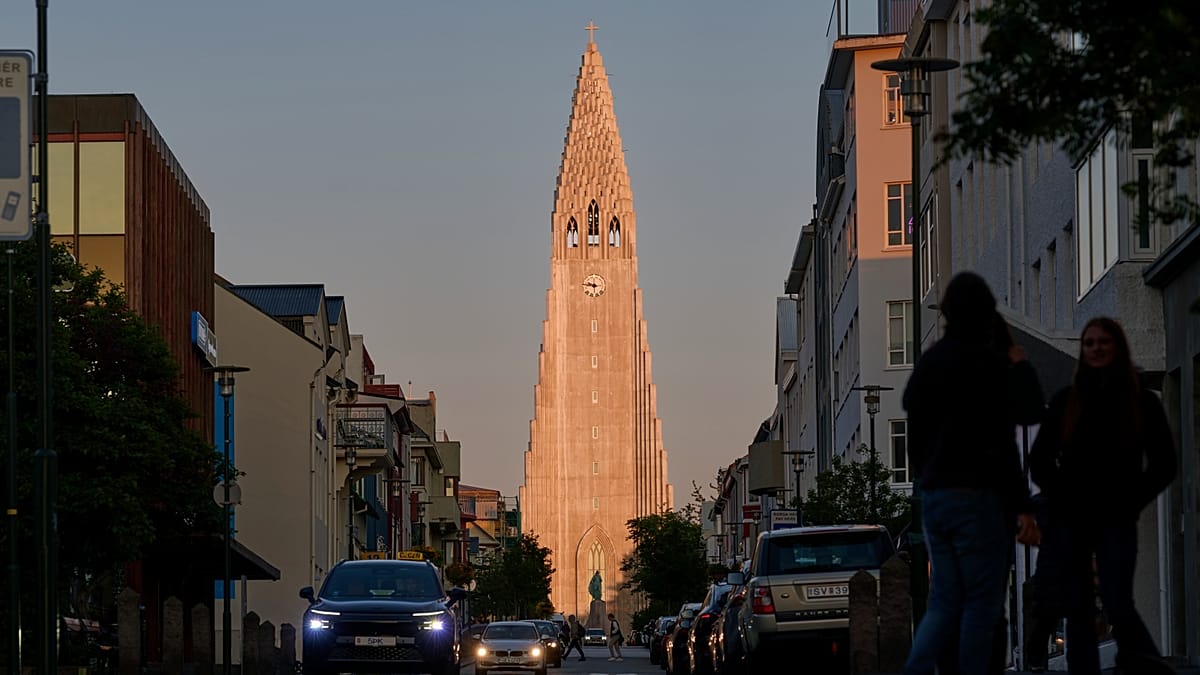
In a referendum that kept the country on edge until the final count, Iceland has decisively said "Nei" to reopening EU accession talks. With 52.8% voting against and 47.2% in favour, the door to membership remains firmly shut for now.
The result, announced after a high-turnout vote (82.5%), ends any immediate prospect of Reykjavík re-entering the negotiation process it abandoned in 2015. Back then, Iceland had already closed 11 of the 35 negotiating chapters and was widely seen as a potential frontrunner. Instead, voters chose to preserve the country's current arrangement: a close partnership with the EU that stops short of full membership.
Fish trumps geopolitics
For outside observers, the referendum invited geopolitical interpretations—Russia's war in Ukraine, China's trade practices, and Donald Trump's tariff threats and designs on Greenland. But the decisive issue was far more local: fish.
Iceland's fishing industry is not just an economic sector; it is a cornerstone of national identity. It accounts for roughly 8% of GDP and nearly 40% of exports, and it employs thousands in coastal communities. The country has a long history of defending its fishing rights, most famously during the "Cod Wars" with the United Kingdom from 1958 to 1976, which ended in Reykjavík's favour.
EU membership would have placed Iceland under the Common Fisheries Policy (CFP), which sets quotas and rules on who can fish, where, and when. A Gallup poll before the vote showed that 90% of fishing-related companies opposed joining the bloc. The government tried to assuage fears by saying it would seek "full authority" over its fishing waters, and the European Commission signalled willingness to explore "creative" solutions. But these assurances did not convince enough voters.
An urban-rural divide
The referendum exposed a clear urban-rural split. Only two of Iceland's six constituencies voted "yes"—both in the capital, Reykjavík. In Reykjavík South, 54.5% backed resuming talks; in Reykjavík North, 57.5% did. This mirrors patterns across Europe, where cities tend to be more pro-integration.
In contrast, the Northwest, Northeast, and Southern constituencies all returned "no" votes with margins above 60%. These regions rely more heavily on fishing and related industries. The Southwest constituency, which surrounds Reykjavík, voted 53% against, with 47% in favour.
Turnout was higher than in the last parliamentary election (82.5% vs. 80.18%), reflecting the significance of the issue. In total, 225,031 votes were cast, with 118,040 against and 105,399 in favour; 1,652 ballots were blank or invalid.
The status quo holds strong
By rejecting accession talks, Icelanders have reaffirmed their commitment to the existing framework. Through the European Economic Area (EEA) agreement, Iceland enjoys broad access to the EU's single market—alongside Norway and Liechtenstein—though fisheries and agriculture are excluded. It is also part of the Schengen Area, the Emissions Trading System, and programmes like Erasmus and Horizon.
This arrangement has required Iceland to adopt nearly 9,000 pieces of EU legislation without having a vote in Brussels. Yet voters seem content with that trade-off. Prime Minister Kristrún Frostadóttir noted during the campaign that "people are very satisfied with the EEA agreement and with the arrangements we currently have with the European Union." She added, "This may show that we need to do an even better job of defending that agreement, and I hope the entire parliament will rally behind that."
Iceland also remains closely aligned with EU foreign policy and is a member of NATO, the Council of Europe, and the "Coalition of the Willing" for Ukraine. The referendum result suggests that, for many Icelanders, the current level of integration is sufficient.
No accession for the wealthy
Had Iceland voted "yes," it would have become an immediate frontrunner in the EU's enlargement race. With a GDP per capita of around €84,000, a highly developed economy, and nearly 100% renewable electricity, it would have leapfrogged other candidates. Brussels officials privately acknowledged this, but also worried about the optics of Iceland overtaking Western Balkan countries that have waited over a decade. One idea floated was coupling Iceland with Montenegro to avoid regional backlash.
That scenario is now moot. The accession queue remains unchanged, but the question lingers: can the EU attract wealthy countries? Iceland's answer suggests that, for now, the status quo is more appealing than the uncertainties of membership. The result also has implications for Norway's European ties, as Oslo watches closely. For those following the broader debate, the implications for Reykjavík and Brussels are significant, even if the immediate path is clear.