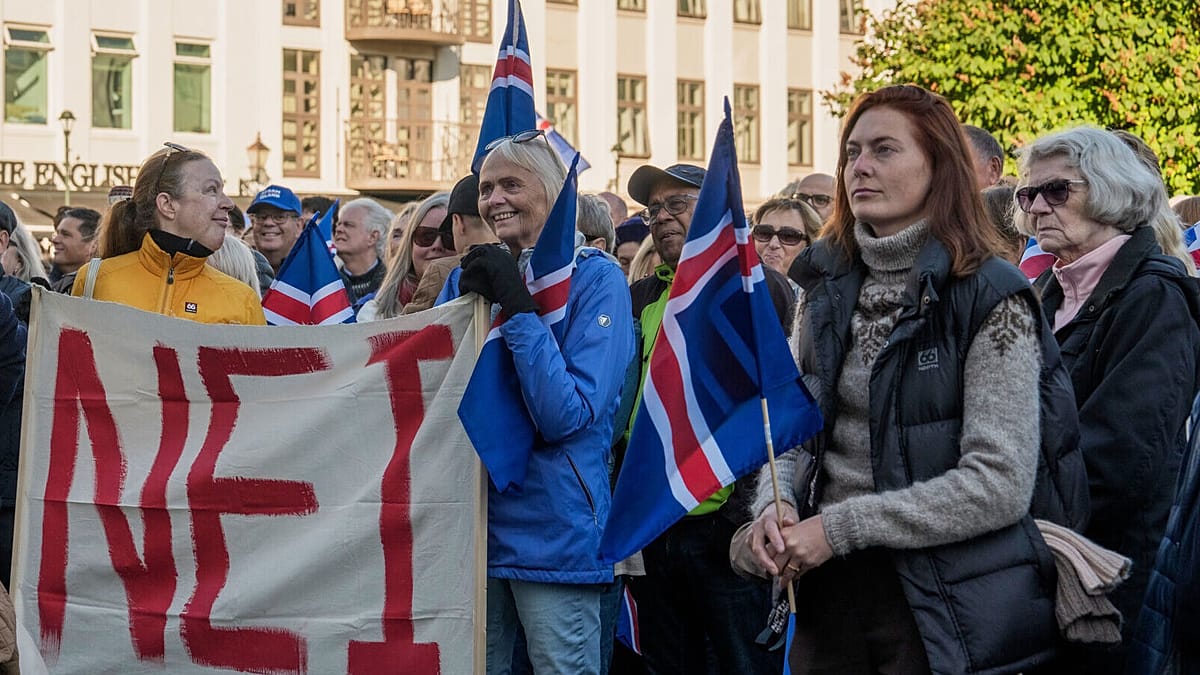
Brussels returned from its summer break to a bracing Nordic rebuff on Monday, as Icelanders voted by 52.8% to 47.2% against restarting European Union membership talks. The referendum result freezes Reykjavik's EU ambitions for the foreseeable future and delivers a significant setback to the bloc's enlargement agenda.
The outcome is a particular blow to EU officials who had hoped to reinvigorate the accession process, especially after years of stagnation. Iceland, a founding member of NATO and a member of the European Economic Area, is far wealthier than any current candidate country, making its rejection a pointed signal about the EU's attractiveness to advanced, northern economies.
Muted response from EU institutions
The EU's reaction was notably restrained. A European Commission spokesperson issued a brief statement "taking note" of the result, while European Council President António Costa exchanged messages with Icelandic Prime Minister Kristrún Frostadóttir on Sunday. Costa said the EU "fully respects the democratic choice of the Icelandic population" and pledged to continue strengthening bilateral ties.
Hard-right leaders across Europe, including Marine Le Pen in France, seized on the vote as a victory for national sovereignty. But framing the result purely as a geopolitical rebuke would miss the more prosaic concerns that ultimately swayed voters.
The fish factor
Fisheries proved decisive. Fish accounts for roughly 40% of Iceland's export value, and Icelandic vessels land more fish annually than any other EU nation. The prospect of joining the EU's Common Fisheries Policy (CFP) — which sets quotas and management rules for the bloc's fleet — alarmed an industry that prizes control over Iceland's 760,000 square kilometre exclusive economic zone (EEZ).
Brussels had signalled openness to "creative solutions" in negotiations, but the fear of losing autonomy over fishing rights echoed the dynamics of the 2016 Brexit referendum, where fish became a potent symbol of sovereignty.
Margrét Ágústa Sigurðardóttir, secretary general of the Icelandic Farmers Association, told Europe Today that avoiding the EU's Common Agricultural Policy (CAP) was also crucial. "Icelanders voted to keep decisions about Iceland in Iceland," she said, stressing that the island had not "rejected Europe" but rather "full EU membership."
Pro-EU voices disappointed
Supporters of EU membership were left deflated by the narrow defeat. Dagur B. Eggertsson, former mayor of Reykjavik, told Europe Today he was "disappointed" after what he described as a "very harsh campaign" that had "echoes of Brexit and the Brexit playbook."
The result has broader implications for the EU's enlargement strategy, which is already struggling with stalled talks in the Western Balkans and Ukraine. The momentum behind EU enlargement now faces fresh questions about whether the bloc can attract prosperous northern members.
For now, Iceland's EU bid is frozen, but the narrow margin suggests the debate is far from settled. As one analyst noted, the vote may be a pause rather than a full stop.