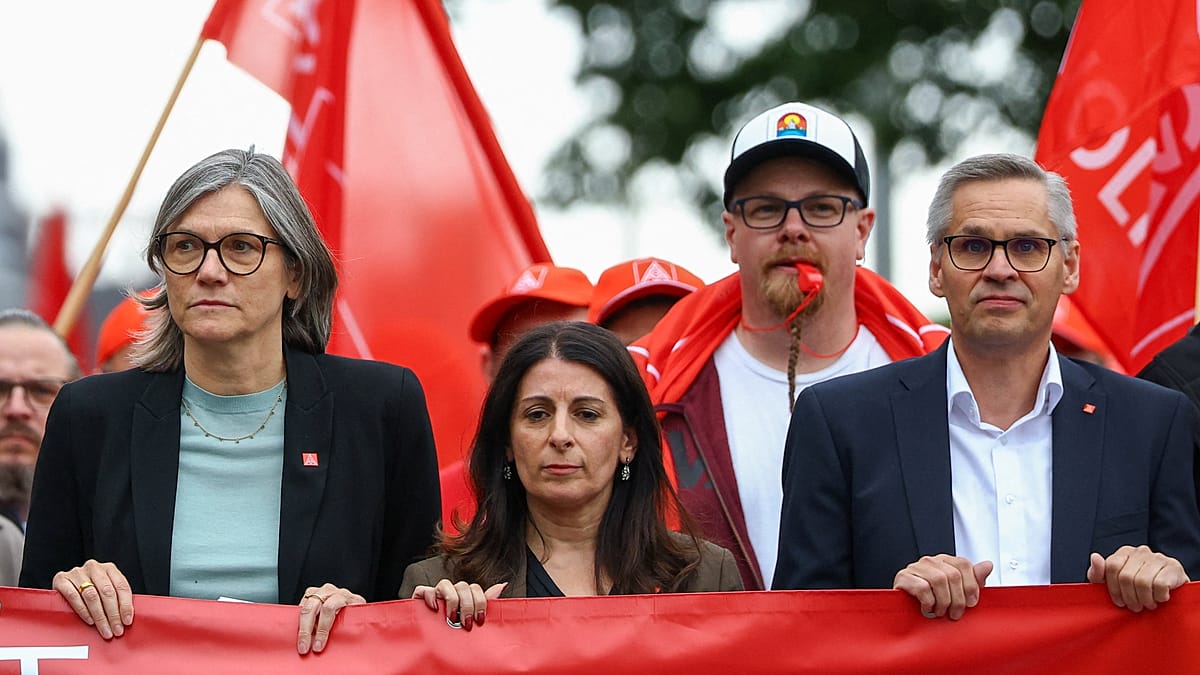
After 26 hours of intense negotiations, Germany's largest trade union, IG Metall, and employers in the metal and electrical industries have reached a collective bargaining agreement that could set the tone for the country's industrial future. The deal, initially covering two German regions, has the potential to extend to 3.7 million workers across sectors such as carmaking, electrical equipment, electronics, aerospace, defence, and mechanical engineering.
The agreement, announced on Thursday, provides for a 2% wage increase from 1 May 2027, followed by a further 2.3% rise from 1 April 2028. In addition, employees will receive a one-off payment in March 2027, ranging from €150 to €450 depending on their employer's net return on sales, according to IG Metall.
The deal runs for 25 months, until 30 November 2028, as confirmed by Gesamtmetall, the umbrella organisation for the sector's employers' associations. Both sides have also agreed on a mechanism that allows companies facing economic difficulties to seek labour cost reductions, provided they make binding commitments to invest and maintain employment in Germany.
A balancing act between wages and competitiveness
The agreement comes at a critical time for German industry, which is grappling with weak growth and intense competition from Chinese manufacturers, particularly in the automotive sector. Germany's economy expanded by just 0.1% in the third quarter, a slowdown from the previous quarter's 0.3% and below initial estimates.
IG Metall had initially demanded a 5% pay rise over one year. Its president, Christiane Benner, described the outcome as "a solid agreement in turbulent times." Gesamtmetall's president, Udo Dinglreiter, called it a "painful compromise on pay," adding that the deal "pushes the limits of what is possible and, for some of our companies, perhaps even goes beyond them."
The agreement follows two waves of warning strikes that involved more than 956,000 workers, according to IG Metall. Walkouts earlier this week disrupted production at plants operated by Mercedes-Benz and BMW, underscoring the urgency of reaching a settlement.
The new flexibility mechanism is a key feature of the deal. It allows companies to negotiate cost-saving measures in exchange for guarantees on investment, product development, or technology that promise long-term job security. This is intended to help manufacturers navigate the current downturn while preserving employment in Germany.
Dinglreiter emphasised that the agreement looks ahead and will "help to secure jobs and sites." The deal is seen as a pragmatic response to the challenges facing the sector, which has been hit by a combination of weak demand, high energy costs, and shifting global trade dynamics.
The agreement is likely to have ripple effects across Europe, as other countries watch how Germany balances wage demands with industrial competitiveness. The outcome may also influence discussions in Brussels about the future of European manufacturing, especially in light of recent reports highlighting the risk of job losses in the sector.
For now, the focus shifts to whether the deal will be adopted nationwide and how it will be implemented in practice. Both IG Metall and Gesamtmetall have expressed cautious optimism, but the real test will come as companies begin to apply the new rules in a challenging economic environment.