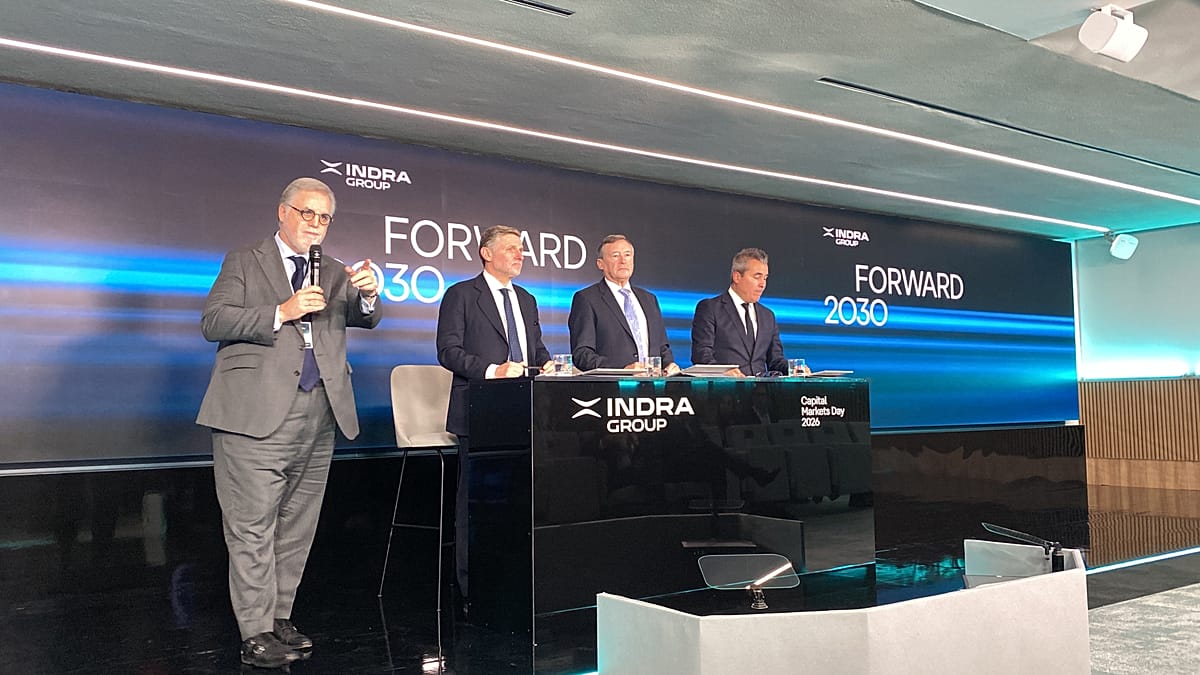
Indra, the Spanish defence and technology group, has laid out an ambitious roadmap to more than double its business within five years. At its Investor Day on Wednesday, the company presented Forward2030, a strategic plan that targets revenue exceeding €12 billion by 2030, up from €5.457 billion in 2025, and an EBIT of more than €1.5 billion. The market responded favourably, with shares climbing as much as 7% in early trading.
The plan replaces the previous Leading the Future strategy, unveiled in 2024, which had set a more modest goal of €10 billion in revenue and a 12% EBIT margin by 2030. Now, Indra is looking further ahead to 2035, when it expects to generate €20 billion in revenue, with half coming from outside Spain.
Security and the blurring civil-military divide
Chairman Ángel Simón devoted much of his address to the broader geopolitical and technological context. He noted that there are currently 60 medium- and high-intensity armed conflicts worldwide, and that in Spain a cyber incident is handled every four minutes. He pointed to recent security alerts that disrupted commercial flights across Europe and cyberattacks that hit supermarkets and schools. “Our everyday life depends on secure and reliable systems,” he said.
Simón argued that defence “is a public good that benefits all citizens” and called for the Armed Forces and state security forces to have the best technological capabilities. He also warned that the boundary between civil and military technology is disappearing, and that artificial intelligence has opened the market to companies that are born with it already embedded.
According to the chairman, Forward2030 should help Indra stop being “a mere aggregator of businesses” and become “an integrated, synergistic company”. He wants the firm to pull along the rest of Spain's defence industry, from SMEs to start-ups and universities, and to spread its production centres across different parts of the country. Europe, he added, has to overcome the fragmentation of its defence markets, and Indra aspires to be Spain's main representative there.
The three Es: execute, evolve, expand
Chief executive Josep Maria Recasens explained why a new strategic plan was needed. He gave two reasons: the boundaries between the civil and military sectors are blurring, and tech giants and newcomers that compete in different ways have entered the playing field. “It is a totally different sport, in which the recipe of the past no longer works,” he summed up.
The company has structured the plan around what it calls the three Es: execute, evolve and expand. Recasens stressed that they do not follow one after the other, because a company like the one he wants to build has to manage “two clocks” at the same time, delivering today while preparing for the future.
The most immediate lever is the order book, worth more than €22 billion, of which around 70% should turn into revenue before 2030. Some €12 billion relates to physical deliveries, mainly from Defence Special Modernisation Programmes (PEM), air-traffic control radars for the United States, equipment for London and the European IRIS² satellite programme.
To achieve this, execution will depend on a single team under a new chief operating officer, while the business units retain the client relationship and their profit and loss accounts. Indra will keep control of system architecture, integration and delivery, and will rely on partners and around 2,500 suppliers for the rest.
It will go from six plants in 2025 to 14 in 2027, will add 2,000 engineers to the industrial side and will quadruple its manufacturing footprint, with an investment of €400 million. The factories will be grouped into three corridors in Spain. The northern corridor will focus on land vehicles, the central one on drones, electronic warfare and simulators, and the southern one on radars and anti-drone systems.
The model Recasens wants to replicate is Córdoba, where the company has multiplied its radar production capacity by seven in less than six months and cut costs by 30%. This year Indra will deliver 70 air-traffic control radars, the highest number in its history.
IndraMind: the AI core
The second E, evolve, translates into money for products. Indra will invest €1 billion of its own resources between 2026 and 2030, four times more than in the last five years, to launch more than 200 products. Seventy percent will have dual use, civil and military, and 90% will have artificial intelligence built in. Recasens pledged to cut to a third the time it takes its products to reach the market.
At the centre is IndraMind, the artificial intelligence unit the company launched in October 2025. It has an order book of €400 million, 15 solutions developed, contracts signed for eight of them and more than 3,000 experts. Recasens described it as an open operating system, “more Android than iOS”, to which solutions from the group and from third parties can connect.
He gave an example. Today, coordinating the response to a threat across several systems in different domains takes about 45 minutes. With IndraMind, according to the chief executive, 23 seconds are enough.
In Defence, Indra wants to consolidate its position as one of Europe's main prime contractors, with an order book of around €11.4 billion. One of its bets is Land Next Gen, a modular, hybrid and electric land platform, crewed or uncrewed, in which it will invest nearly €20 million. It wants to have it ready in 2028 or 2029 for under €1 million per unit and to cut to three years a development cycle that in the sector usually runs to around ten.
The space business has changed scale after the purchase of Hispasat and Hisdesat. With IRIS² and other programmes, Indra is positioning itself as a key player in European space infrastructure. The company is also part of an alliance to safeguard Europe's undersea cables, a critical vulnerability highlighted by recent incidents in the Baltic Sea.
Indra's push comes as Europe grapples with rising defence spending and technological sovereignty. The company's ability to execute on its ambitious targets will be closely watched, not least because it is seen as a bellwether for Spain's broader industrial strategy.