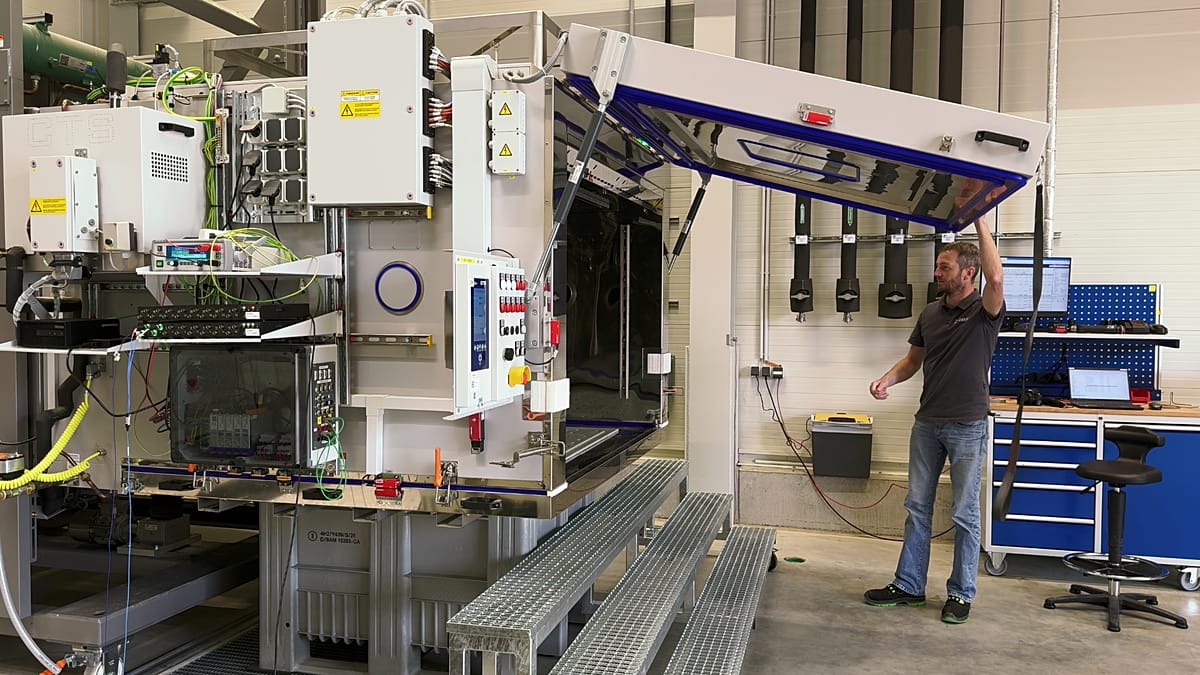
In the quiet countryside of Lusatia, eastern Germany, lies a facility that looks more like a high-security research bunker than a testing ground. Here, in the town of Klettwitz, engineers at DEKRA operate Europe's largest battery testing centre, a place where the components powering the continent's green transition are pushed to their absolute limits.
Thomas Hucke, head of the facility, leads visitors through a labyrinth of garage-sized chambers, each designed to simulate a specific form of abuse. Thermometers and warning lights line the corridors, hinting at the extreme conditions inside. 'We're testing how battery prototypes behave at very low temperatures, or at very high temperatures. From Siberia to the Sahara,' Hucke explains, gesturing to a control panel. He turns a dial to minus 40 degrees Celsius, the kind of cold that would cripple most electronics.
The facility's 'torture chambers' replicate the harshest environments a battery might encounter over its lifetime. A dedicated dust chamber can whip up a full-blown sandstorm, essential for certifying batteries destined for desert solar farms. In another hall, vibration tests mimic the jolts of a car hitting a curb or the mechanical shocks of a collision. Every test is documented and reported to manufacturers, who only receive certification once their batteries survive the ordeal.
Consumer safety is the driving force behind this rigorous regime. The European Union's Battery Regulation sets out the exact tests required, covering sustainability, the value chain, and, above all, safety. 'The energy transition isn't just about electric mobility,' Hucke notes. 'We're increasingly testing energy storage solutions for stationary applications – intermediate storage for solar and wind. That is the future.'
Fire, crush, and the limits of safety
The most dramatic tests take place in the 'fire hall,' where engineers recently attempted to set an entire battery container alight. This is not a theoretical exercise. As climate change fuels more intense wildfires across Europe, the risk of a fire reaching a solar or wind farm's buffer storage becomes real. 'Up to certain temperature levels, a large-scale battery storage facility must be able to withstand this,' Hucke says.
Beyond fire, there is the 'crush bed' – a bunker hall with massive metal blocks bolted to the floor. An oversized vice squeezes batteries with immense force. 'The battery is squeezed – and the regulations stipulate that absolutely nothing must happen,' Hucke explains. The goal is to ensure that even in a severe accident, a battery will not explode or catch fire.
These tests are not just about meeting legal requirements; they are about building public trust in technologies that are central to Europe's decarbonisation. As the continent accelerates its shift to electric vehicles and renewable energy, the safety of batteries becomes a matter of everyday concern. The work at Klettwitz helps ensure that a malfunction in a garage or a storage facility remains a rare and contained event.
The facility's importance extends beyond Germany. With the EU's Battery Regulation setting a global benchmark, the tests conducted here influence standards worldwide. For instance, the underground storage of renewable energy is another frontier where safety and reliability are paramount. Similarly, innovations like the Dutch solar ambulance rely on batteries that must perform in demanding conditions.
As Europe pushes forward with its Green Deal, the role of testing centres like DEKRA's becomes ever more critical. They are the silent guardians of the energy transition, ensuring that the technologies of tomorrow are not only efficient but also safe. And while the work is often hidden from public view, its impact is felt every time a driver plugs in an electric car or a solar farm feeds power into the grid.