The war in the Middle East, centered on Iran, has achieved what no trade dispute or tariff threat could: it has pushed the eurozone into a contraction. According to flash Purchasing Managers' Index (PMI) data released by S&P Global on Thursday, business activity across the euro area fell sharply in April, with the services sector—the engine of the bloc's 2025 recovery—posting its weakest reading since the pandemic lockdowns of early 2021.
The flash Eurozone Composite PMI dropped to 48.6 from 50.7 in March, well below the 50 threshold that separates growth from contraction. This marks the weakest level in around a year and a half. The services PMI fell to 47.4 from 50.2, while input costs surged to a more than three-year high. Business confidence hit its lowest since late 2022.
Manufacturing's Misleading Uptick
Paradoxically, the manufacturing PMI rose to 52.2 from 51.6, a nearly four-year high, and the output index climbed to an eight-month high. But this gain is deceptive. Companies across the bloc are ordering inputs ahead of expected shortages and further price increases, reflecting defensive stockpiling rather than recovering demand. Suppliers' delivery times in the eurozone manufacturing sector lengthened to the greatest extent since July 2022, a direct consequence of supply-chain disruption tied to the Middle East war.
"April's flash PMI has moved into contraction territory for the first time since late 2024, signalling a 0.1% quarterly rate of GDP decline after a 0.2% gain had been signalled for the first quarter," said Chris Williamson, chief business economist at S&P Global Market Intelligence.
Stagflation Signals Intensify
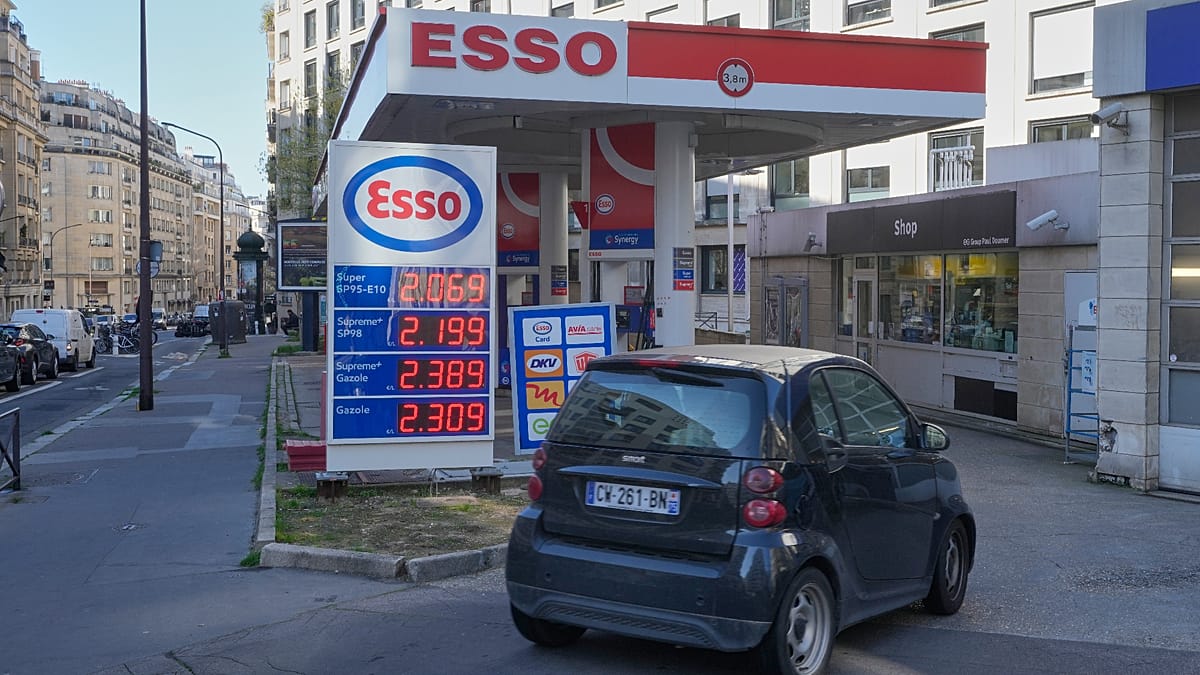
The cost side of the survey underscores the stagflation dilemma. Input costs rose at their fastest pace since late 2022, while output prices hit a peak not seen in just over three years. Every major eurozone economy recorded a downside surprise at the composite level. Germany saw its first contraction in activity in almost a year, while France's slowdown deepened to its weakest level in over a year.
"The recovery in the German economy has been stopped in its tracks by the war in the Middle East," said Phil Smith, economics associate director at S&P Global Market Intelligence. In German manufacturing, input price inflation hit a 3.5-year high; in France, it touched a three-year high. "The [French] service economy has deteriorated due to a diminishing willingness to spend—a typical consequence of uncertainty—pulling overall business activity levels lower," added Joe Hayes, principal economist at S&P Global Market Intelligence.
IMF Slashes European Forecasts
The International Monetary Fund's April 2026 World Economic Outlook delivered the largest growth downgrade for the euro area among major advanced economies. IMF staff now expect euro area growth to decline from 1.4% in 2025 to 1.1% in 2026 and 1.2% in 2027. Both 2026 and 2027 forecasts were revised down by 0.2 percentage points versus the January 2026 Update. Germany absorbed the largest hit, with its 2026 and 2027 growth forecasts both cut by 0.3 percentage points. Italy remained stuck at 0.5% annual growth across both years, the weakest baseline in the eurozone. Spain decelerated from 2.8% in 2025 to 1.8% in 2027, while France held flat at 0.9% on the annual measure but lost 0.3 points on the Q4-over-Q4 profile. The IMF attributed the revision to the negative impact of the Middle East conflict, adding to lingering effects from the persistent rise in energy prices since Russia's invasion of Ukraine, and the real appreciation of the euro.
ECB's Stagflation Dilemma Returns
The April data places the European Central Bank in an uncomfortable position. "The ECB once again has the unenviable task of deciding whether to raise interest rates in the face of the worrying inflation picture, or whether this price spike will prove temporary and its focus should instead be on the need to prevent the economy sliding into a deeper downturn," Williamson said. Prediction markets currently price the probability of an ECB rate hike in 2026 at around 72%, up sharply from low double digits before the Strait of Hormuz closure.
Goldman Sachs economist Niklas Garnadt argued this week that the current Hormuz shock differs from the 2022/23 European energy crisis. First, the price move is smaller and less persistent: Goldman sees Brent averaging $83 per barrel in 2026 versus $64 before the conflict, and European TTF gas at €44 per megawatt hour against €34—a 20% to 30% annual increase. By contrast, Brent averaged $99 in 2022 (up 40%), and TTF hit €133 (up 180%). Second, this crisis is oil-driven, not gas-driven, making damage less concentrated in energy-intensive industries but more diffused across export-oriented sectors like autos and machinery. Third, Asia is not insulated this time: Chinese petrochemical prices have risen alongside European ones, unlike in 2022 when European energy prices roughly doubled while Chinese prices barely moved.
The broader implications for Europe are stark. The conflict is already reshaping consumer behavior, with EU electric vehicle sales surging nearly 50% in March as fuel prices rise. Meanwhile, the Katowice Economic Congress recently opened with a call for European self-sufficiency, a theme that gains urgency as supply chains fray. The eurozone's recession may already be unfolding, and the policy response remains uncertain.