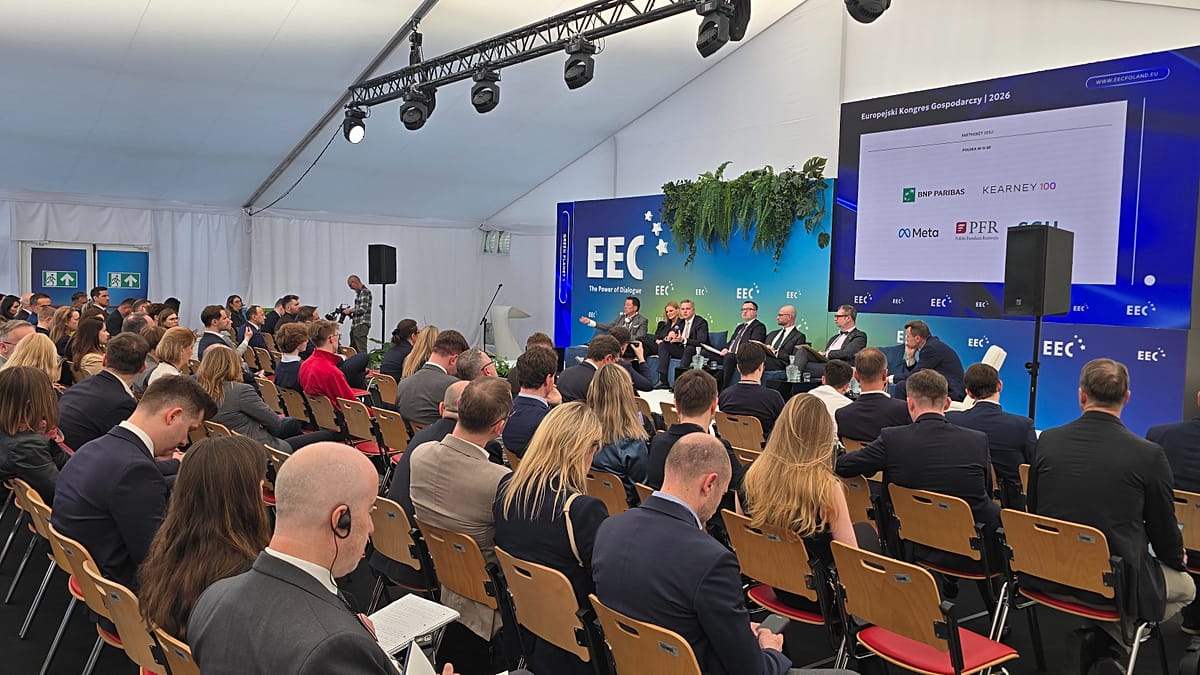
The 18th European Economic Congress in Katowice has placed Poland's evolving role in global economic governance at the centre of its agenda. The three-day gathering, which draws politicians, business leaders and academics from across the continent, is this year paying particular attention to Warsaw's debut in the G20's finance track.
Finance and Economy Minister Andrzej Domański and National Bank of Poland Governor Adam Glapiński attended the G20 finance ministers and central bank governors meeting in Washington on 16 April — the first time Poland has taken part in that format. Speaking during a panel titled "Poland in the G20" in Katowice, Domański framed the milestone as the culmination of decades of structural reform.
"Poland is no longer merely an observer of global processes — today we are helping to shape their direction," Domański said. He added that Warsaw brings both the perspective of Central and Eastern Europe and the experience of what he called "the most successful economic transformation of the past 40 years."
The minister noted that discussions in Washington were dominated by tensions in the Middle East and rising energy and fuel costs — issues that directly affect European competitiveness. Despite the uncertain global backdrop, Domański pointed to International Monetary Fund forecasts predicting Poland will be the fastest-growing large economy in the European Union, with GDP growth exceeding 3% this year.
"We return from the G20 with the conviction that Poland's voice is being heard very carefully," he said.
Beyond the Invitation
Kasia Kieli, managing director of TVN Warner Bros. Discovery, offered a more cautious assessment. "Just being invited to the table doesn't mean we have a place there — we earn that place by contributing," she said. Kieli argued that G20 participation offers an opportunity to build a coherent narrative about Poland that extends beyond economics to include culture, sport and new technologies.
Professor Piotr Wachowiak, rector of the Warsaw School of Economics, described Poland's G20 presence as "both a great achievement and a great responsibility." He warned against complacency and stressed the need to further strengthen the country's economy and institutions. Wachowiak also suggested Poland could act as a bridge between different regions of the world, leveraging its geographic and historical position.
The congress also devoted significant attention to energy transition. Domański said energy prices will be crucial for European competitiveness in the coming years and highlighted nuclear power as a stable component of the energy mix, while insisting that investments must be assessed primarily in terms of cost.
The broader context of Poland's growing international role was reflected in other discussions at the congress. The Katowice Economic Congress opened with a call for European self-sufficiency, a theme that resonates strongly with Poland's push for greater strategic autonomy within the EU. Meanwhile, the continent's security landscape continues to shift: Thales defence orders surged 75% amid global tensions and European demand, underscoring the defence-industrial dimension of the region's evolving priorities.
Poland's G20 debut comes at a time when the country is also playing a leading role in hosting Ukrainian refugees. Germany, Poland and Czechia lead the EU in hosting Ukrainian refugees after four years of war, a humanitarian effort that has further raised Warsaw's profile in European and transatlantic forums.
Whether Poland can translate its G20 seat into lasting influence will depend on its ability to articulate a clear vision and deliver on its commitments. As the Katowice congress makes clear, the country is determined to be more than a passive participant in the global economic debate.