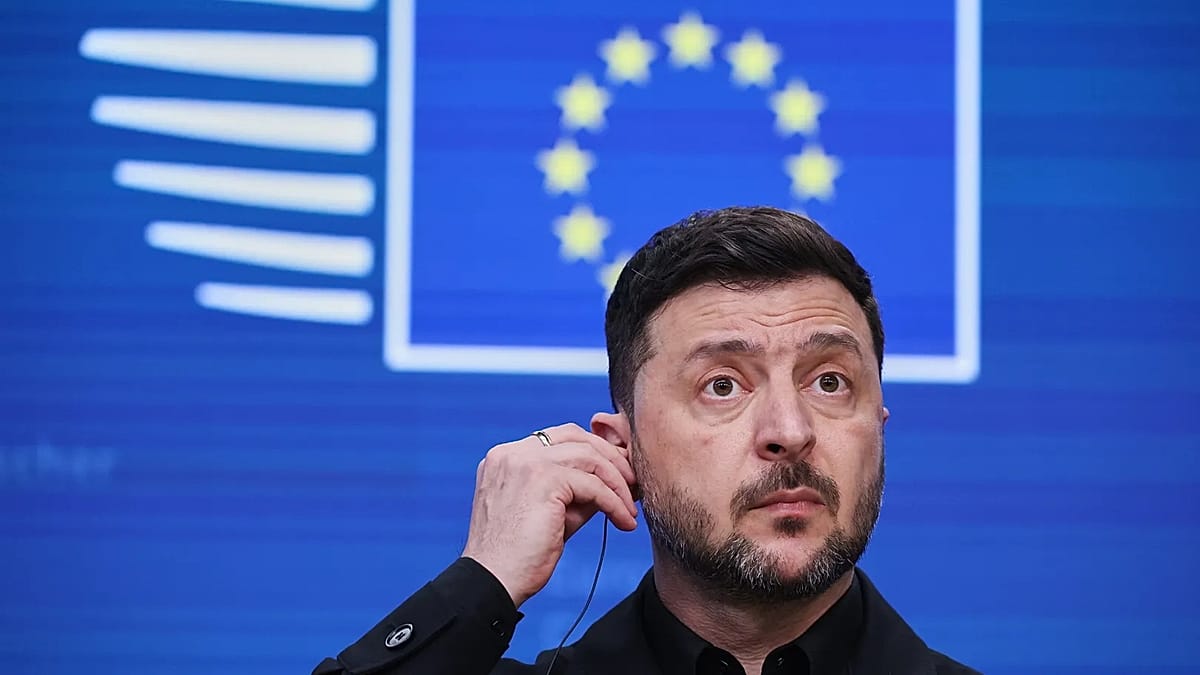
As European Union leaders gathered in Ayia Napa, Cyprus, for an informal summit on Thursday, the focus shifted from the recently unlocked €90 billion loan for Ukraine and a fresh round of sanctions against Russia to a more intractable problem: Hungary's persistent veto on Kyiv's EU accession. But Ukrainian President Volodymyr Zelenskyy made clear that anything less than full membership would be unacceptable.
Speaking to reporters via the presidential WhatsApp chat en route to Cyprus, Zelenskyy dismissed the idea of any symbolic or partial participation in the bloc. “Ukraine does not need symbolic membership in the EU,” he said. “Ukraine is defending itself and is definitely defending Europe. And it is not defending Europe symbolically – people are really dying.”
Zelenskyy framed Ukraine's fight as a defence of shared European values, arguing that the country therefore deserves full membership in the 27-nation union. He acknowledged that discussions were taking place at “different levels” about “various possible formats of Ukraine's membership in the EU,” but warned against settling for less.
“I would like to warn, first of all, our Ukrainian institutions: please do not look for symbolic EU membership for Ukraine. I do not support this. The people do not support it,” he said. “We have already had enough symbolic unions – Budapest Memoranda, symbolic security guarantees, NATO, a symbolic path to NATO. We deserve full membership in different alliances and, of course, in the European Union.”
Hungary's Veto and the Path Forward
Ukraine's accession process has been stalled since July 2024, when Hungary assumed the rotating six-month presidency of the EU Council and made clear it would not allow the opening of any negotiation clusters. Outgoing Prime Minister Viktor Orbán has maintained that blockade, keeping the process in deadlock even as other member states push for progress.
European Council President António Costa, speaking alongside Zelenskyy and European Commission President Ursula von der Leyen upon arrival in Cyprus, highlighted the significance of the two recent breakthroughs. By unblocking the €90 billion loan and the new sanctions package, Costa said, the EU had taken “two very important steps in order to achieve a just and lasting peace in Ukraine.” He added: “Now it's time to look forward and to prepare the next step, and the next step is to open the first cluster of negotiations for the Ukrainian accession to the European Union. We delivered on these two steps and we will deliver in the next step.”
Estonian Prime Minister Kristen Michal expressed optimism about a potential “fresh start” for Ukraine's accession. “So it will mean that you can start again and to be honest I cannot see any other way than Ukraine's future is in Europe. That is definitely so. That will mean that the question is only when, not if and how,” he told Euronews.
However, several EU leaders remain cautious about fast-tracking the process. Luxembourg's Prime Minister Luc Frieden stressed that while Ukraine belongs in the EU family, it must first meet the bloc's membership conditions. “There are no shortcuts,” he said, adding that the “EU must continue to function on its fundamental values.” Belgian Prime Minister Bart De Wever was more blunt: “It's not realistic for Ukraine to join the EU short-term.”
Ukraine's Deputy Prime Minister for European and Euro-Atlantic Integration told Euronews on Wednesday that Kyiv wants to proceed by the books, but without delays. The tension between the urgency of Ukraine's wartime situation and the EU's rigorous enlargement criteria remains a central challenge.
The summit in Cyprus also touched on broader security and geopolitical issues, including the Hormuz crisis and mutual defence commitments, as detailed in EU Leaders in Cyprus Tackle Ukraine, Hormuz Crisis, and Mutual Defence Clause. Meanwhile, the recent unblocking of the €90 billion loan, after Hungary lifted its veto, was a critical step, as covered in EU Finalises €90 Billion Ukraine Loan After Hungary Lifts Veto. The loan and sanctions were tied to the restart of the Druzhba pipeline, which had halted supplies to several EU countries, a development reported in Druzhba Pipeline Restart Unblocks EU Loan for Ukraine After Three-Month Halt.
Zelenskyy's firm stance reflects a broader frustration in Kyiv with what it sees as half-measures from Western partners. The reference to the Budapest Memorandum – a 1994 agreement in which Ukraine gave up its nuclear arsenal in exchange for security assurances that later proved hollow – underscores a deep-seated wariness of promises that lack concrete enforcement. For Ukraine, full EU membership is not just a political goal but a strategic necessity, one that its leaders argue the country has earned through sacrifice.