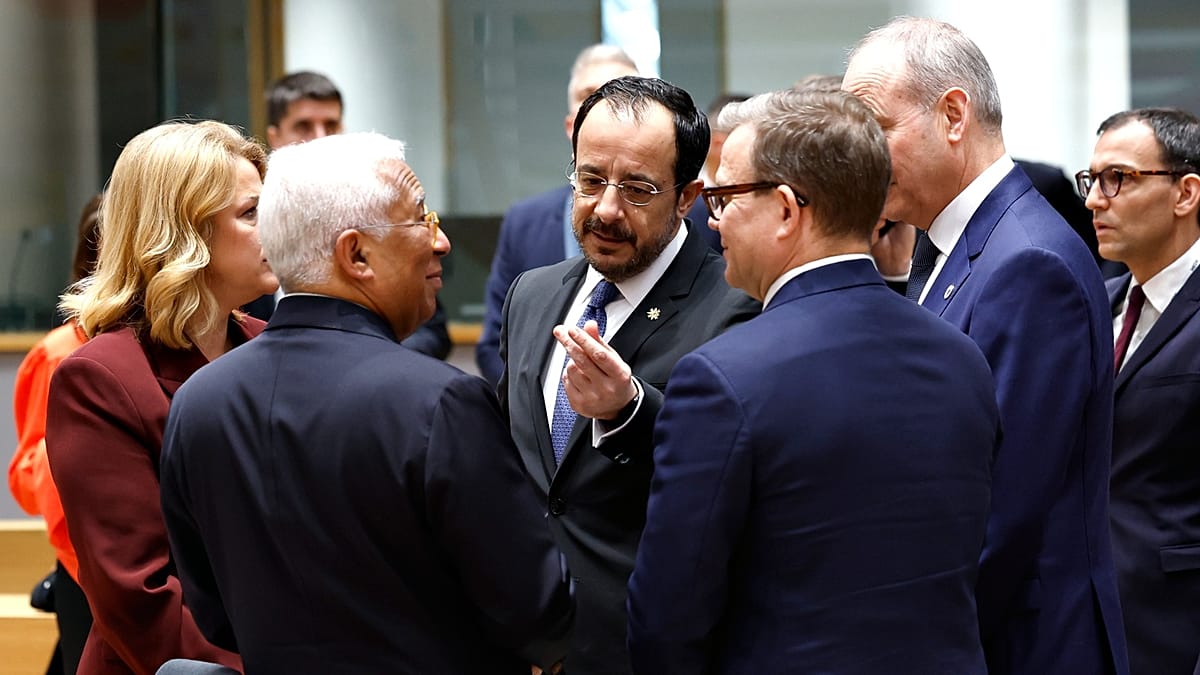
European Union leaders have convened in Cyprus for an informal summit that marks the start of a deeper internal debate on establishing a mutual assistance clause under Article 42.7 of the EU treaties. The clause, which obliges member states to aid any fellow member under armed attack, is being considered as a potential European complement—or alternative—to NATO’s Article 5, especially given repeated threats by US President Donald Trump to withdraw from the alliance.
The two-day meeting, hosted by Cyprus as holder of the rotating EU Council presidency, will also address Russia’s full-scale invasion of Ukraine, the war in the Middle East, the worsening energy crisis, and the future of the EU’s long-term budget. No formal decisions are expected due to the summit’s informal nature.
Orbán’s Absence and Ukraine’s Accession Hopes
A notable absence is Viktor Orbán, the longest-serving European Council member, who was decisively defeated in Hungary’s recent election and will step down as prime minister next month. Orbán’s office cited the power handover as the reason for skipping what would have been his final summit. Many EU leaders are relieved to move past an era marked by Orbán’s frequent use of his veto power to block EU action, including on the €90 billion loan for Ukraine and the 20th package of sanctions against Russia—both of which were unblocked earlier on Thursday after Russian oil resumed flowing through the Druzhba pipeline.
Ukrainian President Volodymyr Zelenskyy is expected to attend the leaders’ dinner in Ayia Napa on Thursday evening to press for his country’s EU membership bid, which many see as a post-war security guarantee. Although Orbán was the lead critic, other member states remain cautious about advancing enlargement, a divisive issue among voters. An innovative proposal to fast-track Kyiv’s process through a “reversed” methodology was rejected, and member states have asked for credible alternatives. Ukraine hopes to at least unblock the thematic clusters of negotiations. “Undoubtedly, this process requires unanimity, so that all of Europe’s voices are heard,” Zelenskyy said on Wednesday. “We also very much hope and believe that this issue will be resolved.”
Hormuz Blockade and Energy Crisis
The summit will also tackle the war in the Middle East and the closure of the Strait of Hormuz, where Iran and the United States have imposed duelling blockades. Europeans have floated the idea of a multinational force to escort commercial ships and demine the narrow waterway, but the plan remains at an early stage. The disruption has sent energy prices soaring across Europe, prompting fears of shortages and economic decline. Leaders will discuss new measures unveiled by the European Commission this week, including social schemes, tax reductions, investments in grids, and subsidies for clean technologies. Building on the experience of the 2022 energy crisis, the Commission is urging member states to provide targeted, temporary relief that can be phased out when prices fall. For more on the broader energy context, see EU Energy Chief Warns of Prolonged Price Hikes from Middle East Conflict.
Exploring a NATO-Like Protection
Cyprus President Nikos Christodoulides aims to use the summit to begin an in-depth reflection on Article 42.7. Cyprus is one of the few EU countries that does not belong to NATO and thus cannot rely on Article 5. The issue gained urgency after a Shahed drone struck a British military base on the island during the early days of the Iran war. “We have Article 42.7 and we don’t know what is going to happen if a member state triggers this article,” Christodoulides told AP. A senior EU official said the idea is for leaders to freely debate the clause’s compatibility with NATO and its practical dimensions. The EU treaties allow for various types of assistance, from economic and diplomatic to military. For insights on how Ukraine’s battlefield innovations are shaping European defence thinking, see Ukraine's Drone Innovation Exposes Europe's Slow Defence Adaptation.
Leaders will also discuss the future of the EU’s long-term budget, with the Commission proposing €2 trillion over seven years from 2028 to 2034. Most member states want to reduce the headline figure but disagree on which areas to cut.



