Saturday evening saw a sharp escalation in the Gulf as Iran carried out two waves of drone and ballistic missile strikes against four US military installations in Bahrain, the headquarters of the US Fifth Fleet. Bahrain's government confirmed the attacks, while Iranian media, including the semi-official Fars news agency, named Sheikh Isa and Juffair among the targets. Bahraini air defences intercepted several projectiles, and the interior ministry reported a fire at a civilian industrial compound, though no injuries were recorded. Local videos showed smoke rising from an unidentified location.
Shortly after the strikes on Bahrain, explosions were reported in Sirik in southern Iran, a pattern consistent with recent US retaliatory strikes on Iranian military sites. Earlier on Saturday, US Central Command (CENTCOM) denied Iranian claims that a surface-to-air missile had damaged an American F-16 fighter jet on Friday evening.
The attacks come as the long-simmering "no war, no peace" confrontation between Washington and Tehran appears to be approaching a critical juncture. Iran has intensified its military operations in the Gulf and the Strait of Hormuz, while preparing a flotilla of oil tankers to break the US naval blockade that has strangled its oil exports.
Attacks on shipping in the Strait of Hormuz
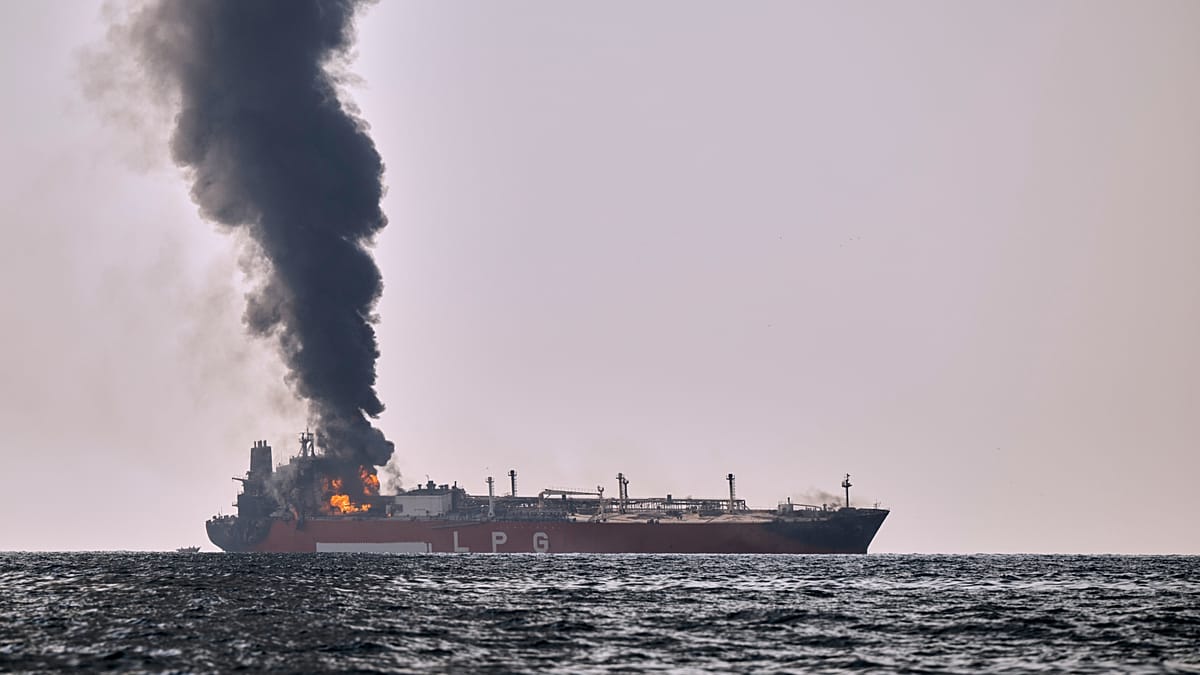
At least three oil tankers were attacked in or near the Strait of Hormuz on Saturday, in what appears to be the latest Iranian strikes on commercial shipping through the strategic chokepoint. The UK Maritime Trade Operations (UKMTO) reported that two tankers were struck by projectiles while exiting the Persian Gulf, with no casualties reported. The Iranian navy, in a statement carried by state media, said a tanker hit a naval mine east of the strait and caught fire. State media also claimed that the military conducted its most "intense and varied" operations yet in the strait overnight to stop vessels.
Iran's army spokesman, Brigadier General Mohammad Akraminia, reiterated warnings to the US, saying that any attack on Iran would be met with "a decisive and immediate response" and that "we are much stronger than in the past." In a visit to troops in southern Iran, he added: "Any new aggression will be met with a decisive, immediate and effective response from the armed forces, and the defence of the country will not be limited to a specific geographical area." Iranian television for the first time showed ground troops deployed in defensive positions along the southern coast.
Tanker convoy poised to break the blockade
More than 14 Iranian tankers are reportedly assembled off Kharg Island, ready to sail in the coming days to challenge the US blockade. Iran's deputy foreign minister, Kazem Gharibabadi, told Iranian media that the blockade "is a hostile act and we will take any necessary measures to break this economic siege." He also announced that Tehran had warned Washington that the convoy would sail soon.
President Masoud Pezeshkian described the situation as a "silent economic war" that is "tougher than a war with missiles," but insisted that Iran has the capability to withstand it. The Washington-based Institute for the Study of War noted that Iranian attempts to run the blockade "impose a series of dilemmas on the United States by either collapsing the blockade or returning to a war that imposes unideal political costs on the United States by straining its relationships with Gulf allies."
Diplomatic efforts continue, with Qatari mediators shuttling between Washington and Tehran. Gharibabadi said a Qatari delegation held talks with Iranian officials for about two hours on Friday evening before returning to Doha. US President Donald Trump told Fox News that he planned to make a "permanent" deal with Iran to prevent it from acquiring a nuclear weapon, and that he was never interested in regime change.
The crisis has broader implications for Europe, which relies heavily on Gulf oil and gas supplies. European allies, including the UK and France, have naval assets in the region and are closely monitoring the situation. The EU has repeatedly called for de-escalation and has sought to preserve the 2015 nuclear deal, which has been on life support since the US withdrawal. As the standoff intensifies, European leaders are urging restraint and a return to diplomacy, while also preparing for potential disruptions to energy supplies.
For now, the world watches as Iran prepares to test the US blockade, a move that could either force a diplomatic breakthrough or plunge the region into a wider conflict. The coming days will be crucial in determining whether the "no war, no peace" limbo gives way to a new reality.