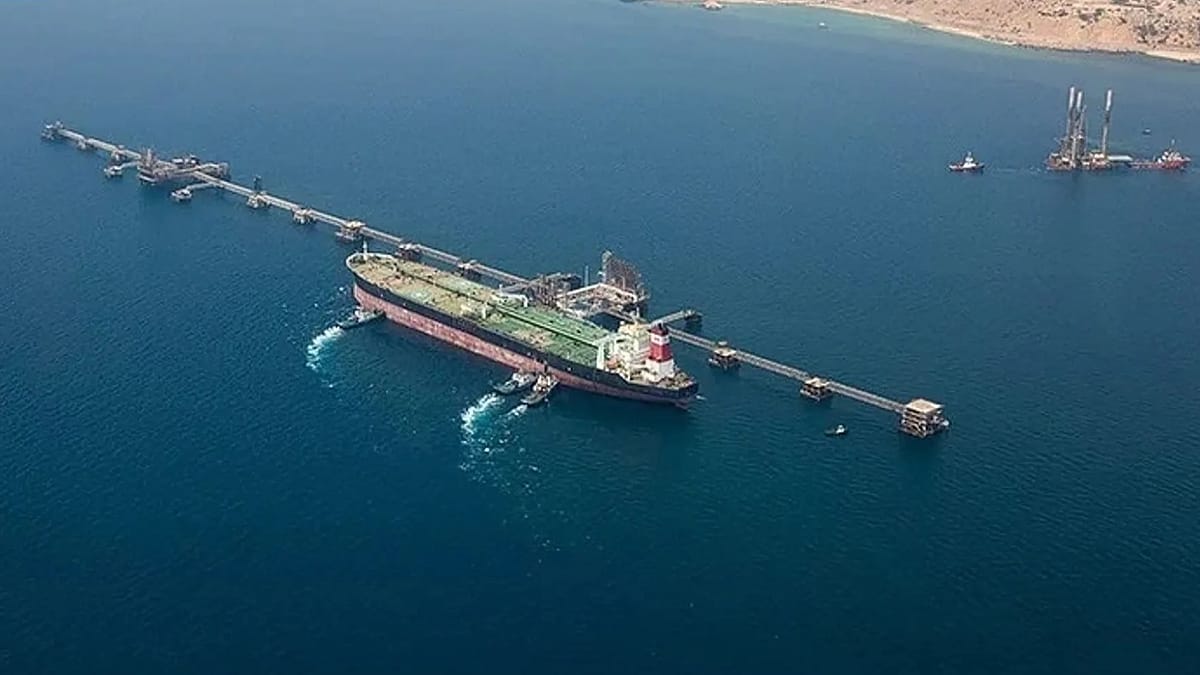
Iran has positioned more than a dozen oil tankers at Kharg Island, its main crude export terminal, in a coordinated attempt to break the US naval blockade that has halted most of its oil shipments. Satellite imagery and ship-tracking data reviewed by multiple outlets show that crews have been assigned and Iranian flags hoisted on at least 14 vessels, with a convoy expected to depart toward the Sea of Oman within days.
The move signals Tehran's determination to restore oil revenues that have been severely curtailed since Washington imposed a naval cordon in the Persian Gulf. Kharg Island, located in the northern Gulf, handles roughly 85 to 90 percent of Iran's crude exports and has storage capacity of about 30 million barrels, with deep-water berths capable of accommodating supertankers. The halt in loading operations has put mounting financial pressure on the Iranian government, which has few viable alternatives; the port of Jask, for instance, lacks the infrastructure to replace Kharg.
Ship-to-ship transfers and hidden origins
International media reported on Thursday that an Iranian crude cargo had already been transferred between two tankers in a ship-to-ship operation in the Persian Gulf, a tactic used to obscure the oil's origin. Satellite imagery showed the transfer took place near Kharg Island with automatic identification systems (AIS) switched off, a practice Washington has explicitly warned against. The US has said it would target vessels involved in such operations, raising the stakes for any tanker attempting to run the blockade.
Israeli media and outlets close to Iran-backed armed groups have reported that dozens of Iranian tankers are preparing to head toward China, moving closer to the blockade lines. A journalist with ties to Iran's Islamic Revolutionary Guard Corps (IRGC) issued a public threat, warning that any attack on Iranian tankers would trigger strikes on oil facilities across the Gulf. Mohammad Enayati Najafabadi, in a post on X sharing a piece by Iran's state-affiliated Fars news agency, said that disrupting an Iranian tanker's route "will lead to explosions at the oil facilities of the United Arab Emirates, Saudi Arabia, Qatar, Kuwait, Oman and Bahrain," though he described it as a personal analysis.
The Fars article itself invoked the Shahnameh, the Persian epic, using an image of the mythical hero Fereydoun defending Iranian ships at sea—a deliberate reference to the current standoff with the US.
Timing and political calculations
The convoy preparations come at a moment of apparent diplomatic lull. During a recent visit to China, where he met Xi Jinping and Vladimir Putin, US President Donald Trump signaled no urgency over Iran, suggesting the issue would not be addressed until next year. Iranian authorities appear to be exploiting that window to restore oil exports to Asian markets and ease pressure on state finances.
US Energy Secretary Chris Wright, speaking on Fox News on Thursday, claimed that energy flows through the Strait of Hormuz were increasing despite the tensions. Asked why petrol prices in the US had fallen even as the Iran standoff remained unresolved, Wright said conditions had in fact changed but were not yet visible to the public.
The situation carries significant implications for global energy markets and for European allies, which rely heavily on Gulf oil and gas. The EU has already been grappling with maritime security concerns, as evidenced by its recent naval mission boarding a suspected Russian shadow fleet tanker in the Mediterranean. Any escalation in the Gulf could disrupt shipping lanes and affect energy prices across Europe.
Iran's move also echoes past confrontations, such as the US strikes on an Iranian island after mines hit ships in the Strait of Hormuz, and the heavy fire exchanged as tanker attacks mounted. The coming days will test whether the convoy proceeds and how the US responds, with potential consequences for regional stability and global oil supply.