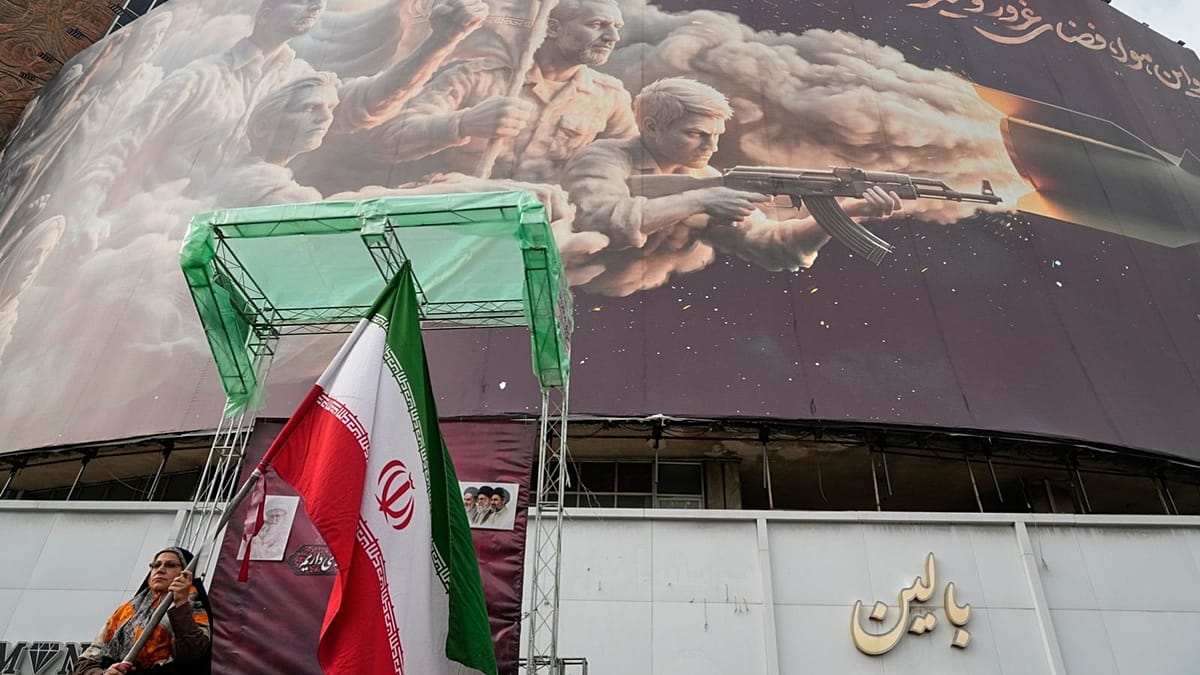
Iran's foreign ministry has condemned the US naval blockade of the Strait of Hormuz as an act of military aggression, vowing to respond with "every means" at its disposal. The statement came a day after US President Donald Trump threatened to send Iranian tankers attempting to breach the blockade "to the bottom of the sea."
Speaking at his weekly press briefing in Tehran, foreign ministry spokesman Esmaeil Baghaei described the blockade as a violation of the UN Charter and an "act of crime." He insisted that Tehran considers itself fully entitled to defend itself by any means necessary. "We will certainly not tolerate this situation and will use every means to counter US aggression," Baghaei said.
On Sunday, Trump told Fox News that any Iranian ship trying to break the blockade would face catastrophic consequences. "I hope they do it; they'll all go down to the bottom of the sea, just like the rest of their navy," he said.
Convoy uncertainty and mixed signals
In recent days, Iranian media outlets and figures close to the Islamic Revolutionary Guard Corps (IRGC) have called for a convoy of oil tankers to be dispatched to challenge the blockade. Some have even threatened to target Gulf oil facilities if the vessels come under attack. However, Iranian officials have not confirmed any concrete plan to do so.
The IRGC-affiliated Tasnim news agency acknowledged the wave of reports on Sunday, noting that no competent authority—whether in the armed forces, the Supreme National Security Council, or the government—had announced such a plan. Tasnim attributed the reports to proposals from individuals in the media and on social media. It added that "Iran's plans to break the blockade are certainly being drawn up," but that details remain confined to a narrow circle of security and military decision-makers.
Meanwhile, the United Kingdom Maritime Trade Operations (UKMTO) confirmed at least one incident involving an oil tanker in the Gulf of Oman on Sunday, saying military forces had been involved. No further details were released about the identity of the forces or the tanker's intentions. The US Central Command had not commented as of Monday.
Tehran's defiant rhetoric
At the same briefing, Baghaei was asked how Iran might respond to reported US planning for a potential attack. His answer was blunt: "The best scenario is for them to get the hell out of the region." He added that IRGC Air Force commander Majid Mousavi would deliver Iran's response "in a neat and elegant package."
Mousavi said on Sunday that IRGC aerospace capabilities had grown since the previous round of conflict, asserting that "the field is ours and we determine the battlefield." IRGC deputy commander-in-chief Major General Mostafa Izadi echoed that sentiment, saying Iran's missile range had been significantly upgraded and that any threat would draw an immediate response "without geographical limitations."
Parliament's National Security and Foreign Policy Committee chairman, Azizi, reiterated the same position, stating that Iran had determined it would face no geographical limitations in any future confrontation. Parliament Speaker Mohammad Bagher Ghalibaf cited remarks by Ayatollah Mojtaba Khamenei about the need to end the current situation, saying "sustainable deterrence" was the way out of the crisis. "We must remove the shadow of war from ourselves," Ghalibaf said, adding that Iran needed to fulfil "the directive of the Supreme Leader."
What will it take to reopen Hormuz?
Baghaei elaborated on remarks by Foreign Minister Abbas Araghchi, who had suggested the Strait of Hormuz could be reopened within two hours of the other side fulfilling its commitments. Baghaei said the comment was meant to signal Iran's readiness to act quickly, not to minimise the complexity of a potential agreement.
Tehran's conditions, he said, include lifting US sanctions, ending the naval blockade, and implementing commitments Washington accepted under the Islamabad memorandum of understanding. Trump has dismissed the Islamabad memorandum as a waste of time and declared it null and void, and has characterised ongoing negotiations with Iran as "a load of nonsense."
The standoff has drawn international attention, with a tanker incident reported in the Strait of Hormuz adding to tensions. European governments, which rely heavily on Gulf oil shipments, are watching closely. The bloc has repeatedly called for de-escalation and a return to diplomacy, but so far there is little sign of a breakthrough.
As the crisis deepens, the risk of miscalculation grows. Iran's leadership appears determined to project strength, while Washington shows no willingness to back down. For Europe, the stakes are high: any prolonged closure of the Strait of Hormuz would send energy prices soaring and could destabilise an already fragile global economy.