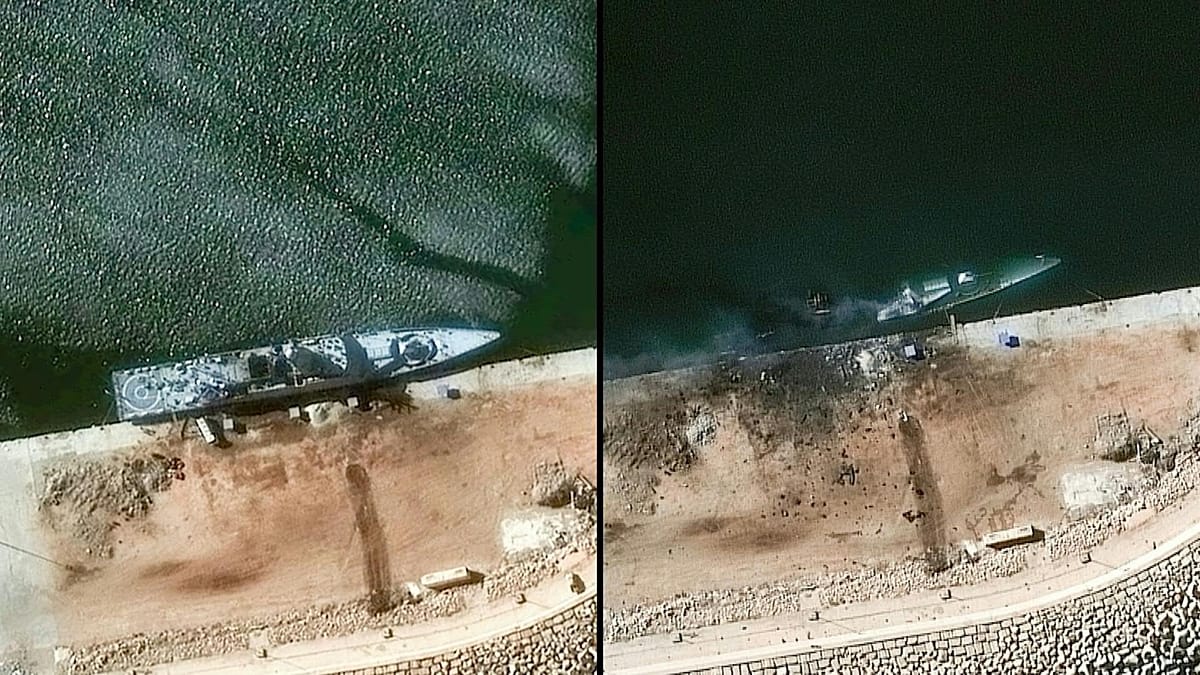
Fresh satellite imagery from the US intelligence firm Vantor has revealed the aftermath of an explosion that left a Russian naval vessel capsized at the port of Benghazi in eastern Libya. The images, released on Tuesday, show the ship docked at the port before the incident and largely submerged afterwards, marking a significant blow to Moscow's naval presence in the Mediterranean.
Libya's eastern-based government, which controls Benghazi, said the explosion occurred at dawn on Sunday while the vessel was stopping for fuel and supplies on its way back to Russia. Officials have not officially confirmed the cause, but suspicion has fallen on a drone attack, a scenario that aligns with a pattern of Ukrainian long-range strikes against Russian military assets.
According to Vantor's satellite analysis, the vessel appears to be the Russian navy's Merkury, a corvette that has been part of Russia's Mediterranean squadron. The ship's presence in Benghazi highlights the Kremlin's reliance on Libyan ports for logistical support, a practice that has drawn increasing scrutiny from Western and European security services.
Mediterranean flashpoint
The incident adds a new layer of complexity to the already volatile security situation in the Mediterranean. Russia has maintained a naval presence in the region for years, using facilities in Syria and, more recently, in Libya. The suspected drone strike, if confirmed, would mark one of the first successful attacks on a Russian warship in African waters, a development that could force Moscow to rethink its logistics and force protection.
European navies, particularly those of Italy, France, and Greece, have been monitoring Russian naval movements in the Mediterranean with growing concern. The suspected strike on the Russian ship at Benghazi port is likely to intensify these worries, as it demonstrates that even well-defended ports can be vulnerable to asymmetric attacks.
The Ukrainian government has not officially claimed responsibility, but Kyiv has previously used naval drones to target Russian vessels in the Black Sea and the Baltic. A drone strike that damaged a Russian cargo ship in the Gulf of Finland earlier this year showed that Ukraine's reach extends beyond its immediate neighbourhood.
Regional reverberations
Libya's eastern government, led by General Khalifa Haftar, has maintained close ties with Moscow, and Russian mercenaries have been active in the country for years. The attack on the Merkury could strain those relations, as Haftar's administration may be seen as unable to protect Russian assets on its territory.
Meanwhile, the UN has called for a probe into drone strikes on ships off Libya's Benghazi, reflecting international concern about the escalating use of unmanned systems in the region. The incident also comes amid a broader pattern of Russian aggression, including strikes that hit Austrian and Dutch embassies in Kyiv, which have drawn sharp rebukes from European capitals.
For European policymakers, the Benghazi incident is a reminder that the war in Ukraine has global ripple effects. As Ukraine develops longer-range drones, Russian assets far from the front lines are becoming increasingly exposed. This could lead to a more dispersed conflict, with attacks on Russian interests in Africa, the Middle East, and beyond.
The Merkury is not the first Russian vessel to suffer damage in a suspected Ukrainian attack. In recent months, several ships in the Black Sea have been hit, and the Russian navy has been forced to relocate some assets to safer ports. The loss of a warship in Libya, however, is a new and troubling development for Moscow, which has been trying to project power in the Mediterranean as part of its broader strategic ambitions.
As satellite imagery continues to reveal the extent of the damage, questions remain about the future of Russia's naval operations in the region. Will Moscow reinforce its presence, or will it pull back to avoid further losses? European defence officials will be watching closely, as any shift in Russia's posture could have significant implications for security in the Mediterranean and beyond.