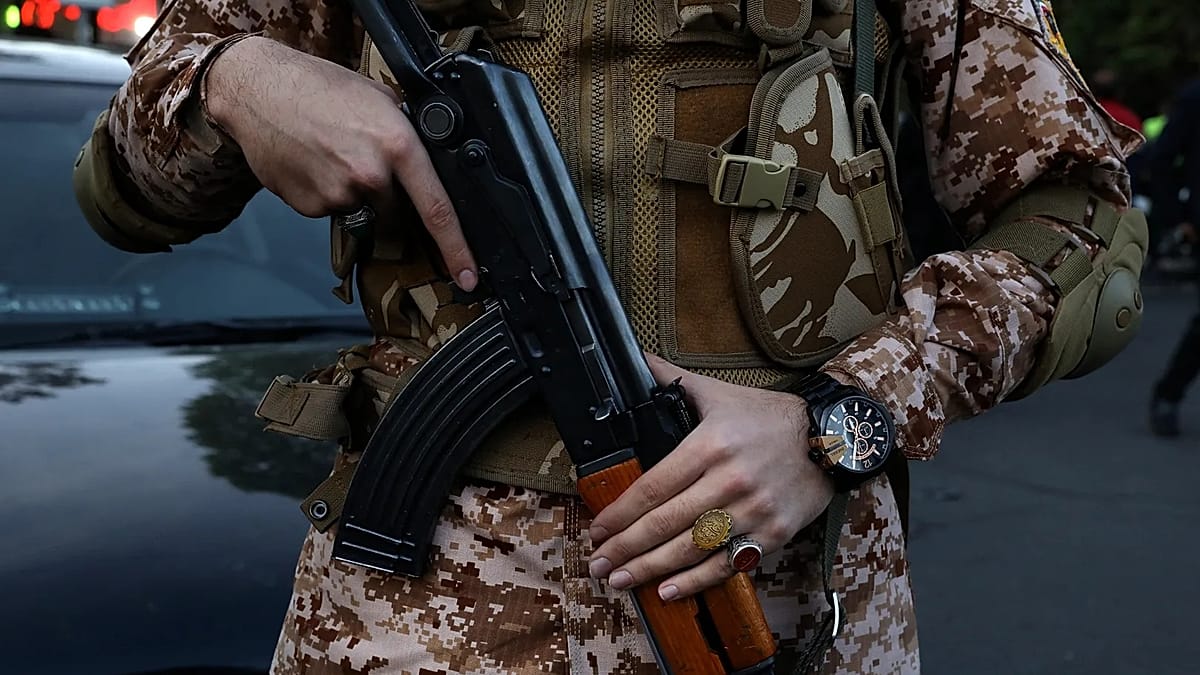
A senior commander in Iran's Islamic Revolutionary Guard Corps (IRGC) Navy has issued a stark warning: if the United States resumes military strikes, Tehran will transform its entire Gulf coastline into a battlefield. The threat, delivered on Wednesday by IRGC Navy political deputy Mohammad Akbarzadeh, underscores the fragility of the current ceasefire and the high stakes for European energy security.
"Our fighters today carry in their chests the urge for hand-to-hand battle with the enemy," Akbarzadeh said, according to the semi-official Tasnim news agency. He added that Iran's armed forces were at full readiness, though he described the prospect of renewed war as remote, attributing that to what he called the "weakness" of the opposing side.
The warning specifically referenced the stretch of coast from Chabahar, on the Gulf of Oman, to Mahshahr, at the northern end of the Persian Gulf — a distance of roughly 1,500 kilometres. The Strait of Hormuz, through which about a fifth of the world's oil passes, lies between these two ports. Any disruption there would have immediate consequences for European fuel prices and supply chains, particularly for southern EU member states such as Italy, Greece, and Spain.
Strait of Hormuz: A Strategic Flashpoint
Akbarzadeh also claimed that the United States had suffered a strategic defeat over the Strait of Hormuz. "They claimed that they could reopen the Strait of Hormuz, but after the closure of this waterway, even with all their power they could not accomplish anything," he said. "The Americans think they can speak to the Islamic Republic with the language of force, but apparently they still have not learned that one should not speak to Iranians with the language of threats."
A Pentagon official separately assessed that the US naval blockade had adversely affected some $5 billion (€4.3 billion) in Iran's oil revenues. The blockade, imposed after the collapse of the 2015 nuclear deal, has been a key point of contention in ongoing negotiations.
Negotiations between Tehran and Washington over an initial agreement are reported to be closer to a conclusion than at any point since the ceasefire took effect on 8 April. However, control of the Strait and the nuclear file remain the two areas where neither side has budged in their demands. Speaking from Moscow, where he attended a security conference, Deputy Secretary of Iran's Supreme National Security Council Ali Bagheri Kani said the two sides had not yet agreed on lifting the blockade.
The standoff has already had tangible effects on European travel patterns. The Iran conflict drives German holidaymakers to North Sea and Baltic coasts, as uncertainty in the Middle East reshapes tourism flows. Meanwhile, broader geopolitical tensions are prompting European leaders to reassess their security posture. European Commission President Ursula von der Leyen has warned of a Russian hybrid strategy in the Baltic region, as Baltic drone incursions highlight the Kremlin's use of non-conventional tactics.
For European policymakers, the IRGC's latest threat is a reminder that the Gulf remains a tinderbox. Any escalation could disrupt oil shipments, drive up energy costs, and test the EU's ability to coordinate a unified response. The bloc's reliance on Gulf crude — particularly for southern member states — makes the Strait of Hormuz a critical chokepoint. As negotiations continue, the question is whether Washington and Tehran can bridge their differences before the rhetoric turns into action.