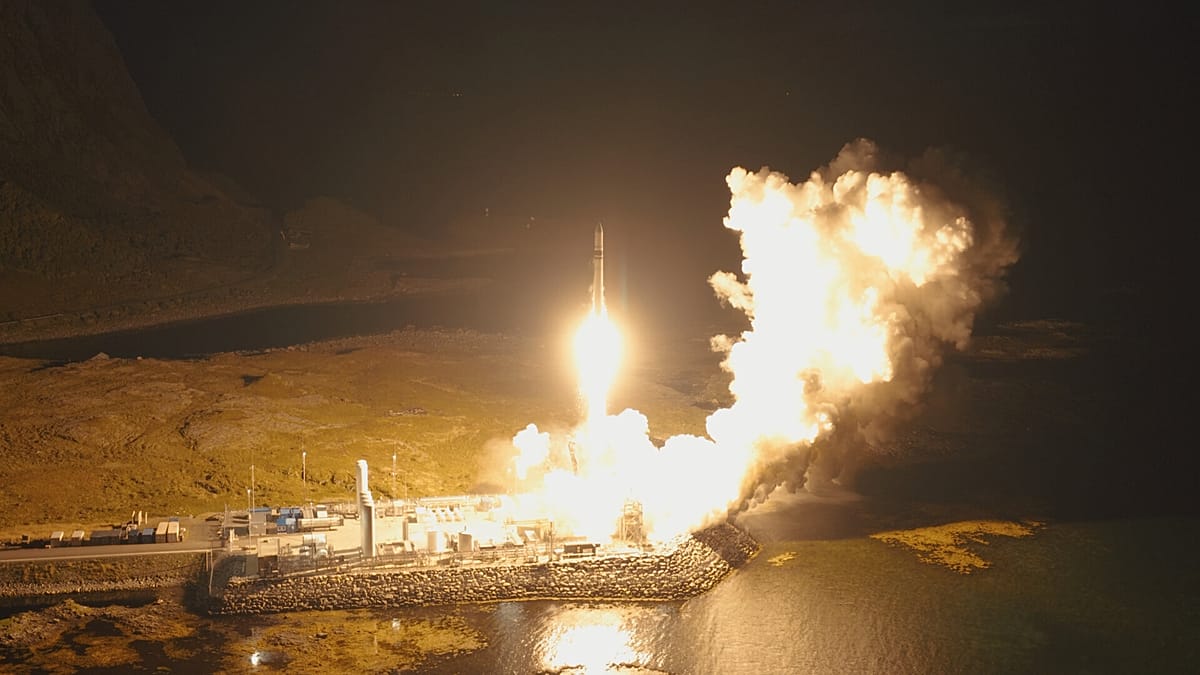
In a landmark achievement for Europe's commercial space ambitions, German startup Isar Aerospace successfully launched its Spectrum rocket into low Earth orbit on 5 September 2026. The two-stage vehicle lifted off from the Andøya spaceport in Norway, carrying six commercial and educational payloads, including CubeSats and a student experiment. This marks the first time a continental European company has reached orbit with its own launcher.
The flight, dubbed "Onward and Upward," was the rocket's second attempt. The first, in 2025, ended just 30 seconds after liftoff when the vehicle fell into the sea. This time, the 28-metre-tall, 2-metre-diameter rocket performed as designed, delivering its payloads to orbit before the second stage completed its mission.
A milestone for the European Launcher Challenge
Josef Aschbacher, Director General of the European Space Agency (ESA), called the launch "historic," noting that Isar Aerospace—founded only eight years ago—has taken a significant step toward a more diverse and autonomous European space sector. The mission was supported by ESA's Boost! programme, which funds commercial space transport initiatives, and the company had earlier benefited from ESA's Business Incubation Centre and won the first Microlauncher Competition organised by the German Space Agency (DLR).
In 2025, Isar Aerospace was selected to participate in the European Launcher Challenge, a programme requiring providers to achieve an orbital launch before 2027. With this flight, the company becomes the first to hit that initial milestone. Géraldine Naja, ESA's Director of Space Transportation, congratulated the teams and expressed hope for more launches from Andøya in the near future.
The success comes at a time of momentum for Europe's microlauncher ecosystem. Spanish company PLD Space has also begun securing contracts under the same challenge, and the broader goal is to reduce Europe's reliance on foreign launchers for satellite deployment. This drive for strategic autonomy is echoed in other sectors, as seen in Germany's industrial reform debates.
Isar Aerospace's achievement also highlights the growing role of commercial players in European space policy, which has traditionally been dominated by government agencies. The company's success could inspire further investment and innovation, potentially reshaping the continent's access to space.
While the European Launcher Challenge continues, with other companies like PLD Space vying for contracts, Isar Aerospace's breakthrough sets a new benchmark. The ability to launch small satellites affordably and reliably from European soil is seen as crucial for everything from Earth observation to communications and scientific research.
As Europe seeks to bolster its technological sovereignty, this launch represents a tangible step forward. The next challenge will be to scale up operations and demonstrate reliability, but for now, the team at Isar Aerospace can celebrate a historic first.