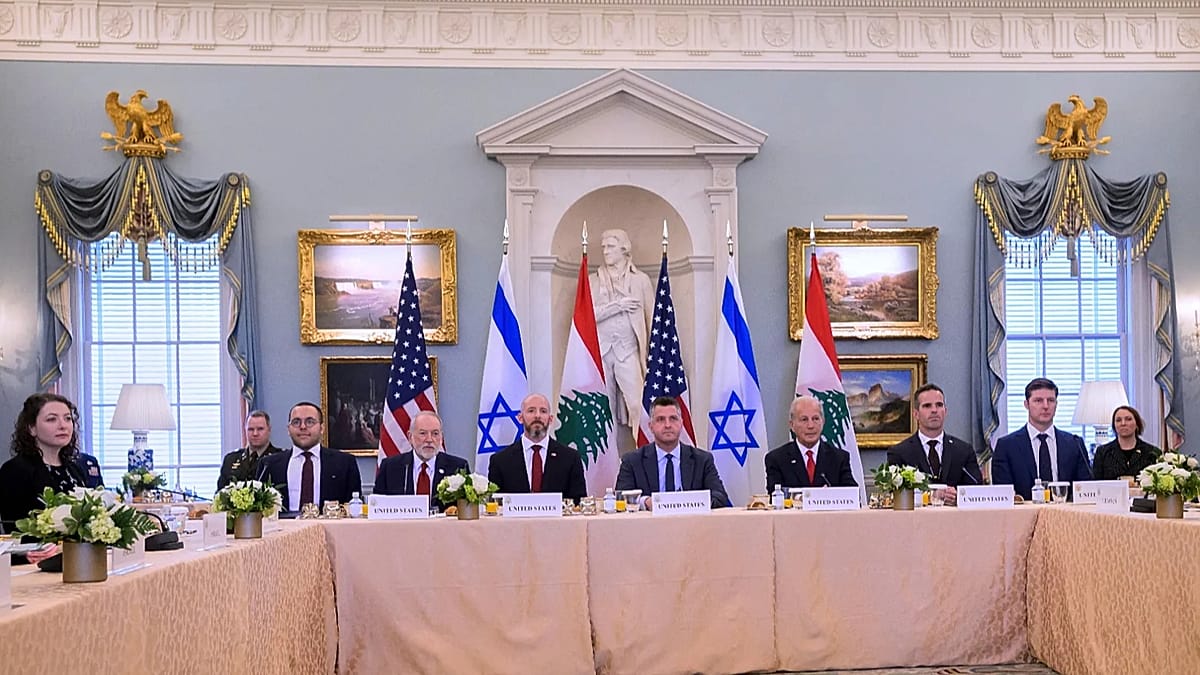
Israel and Lebanon reached a conditional ceasefire agreement on Wednesday, following the fourth round of direct talks in Washington mediated by the United States. The joint statement, issued after discussions between Israeli and Lebanese diplomats, stipulates a "complete cessation" of fire by the Iran-backed Hezbollah militia and the evacuation of its operatives from southern Lebanon.
The agreement, which does not establish formal diplomatic relations between the two countries, also creates "pilot zones" where the Lebanese armed forces will assume exclusive territorial control, excluding all non-state actors. This marks a significant step in a conflict that erupted on 2 March, when Hezbollah renewed attacks against Israel in solidarity with Iran.
Escalation Amid Diplomacy
The ceasefire comes as Israel has escalated its military operations, staging its deepest ground offensive into Lebanon in two decades. The timing underscores the fragile nature of the deal, which is meant to halt hostilities that have claimed numerous lives and displaced thousands. Previous attempts at a truce, including one scheduled for 17 April, have failed due to mutual accusations of violations.
US President Donald Trump has sought to separate the Lebanon conflict from broader tensions with Iran, but Tehran insists the two are linked. Iranian Foreign Minister Abbas Araghchi warned that any attack on Beirut would trigger a "full-scale resumption" of war, complicating the diplomatic landscape. For more on the interplay between these conflicts, see Trump Confirms He Called Netanyahu 'F***ing Crazy' Over Lebanon Strikes.
Hezbollah's Stance and Ongoing Violence
Senior Hezbollah official Mahmud Qomati stated on Tuesday that the group would "not accept a partial ceasefire," signaling potential obstacles to implementation. Despite the agreement, fighting continued on Wednesday, with Hezbollah claiming attacks on Israeli troops and Israeli airstrikes killing at least nine people in southern Lebanon. The Lebanese state-run National News Agency reported strikes on over 20 locations in the south, including a car on the main highway out of Beirut.
The health ministry reported that an Israeli attack near Tyre killed four Syrians and two Palestinians, though an Israeli military spokesperson denied responsibility, stating they were "not aware of any such attack." Another strike targeted an ambulance, killing two paramedics from the Risala Scouts Association, affiliated with Hezbollah's ally the Amal movement. Images circulated by the ministry showed a badly damaged ambulance with medical supplies scattered on the road.
The agreement includes a commitment to further talks the week of 22 June, aiming for a comprehensive resolution. However, the ongoing violence and Hezbollah's refusal to accept a partial ceasefire raise doubts about the deal's durability. For context on the broader regional dynamics, see Israel's Lebanon Campaign Risks Undermining US-Iran Nuclear Talks.
European observers, particularly in Brussels and national capitals like Berlin and Paris, are closely monitoring the situation. The conflict's potential to destabilize the Eastern Mediterranean and affect EU energy security and migration flows makes it a priority for European diplomacy. The European Union has consistently called for de-escalation and a political solution, but the lack of a unified stance among member states complicates its role.
The ceasefire's success hinges on Hezbollah's compliance and the ability of the Lebanese armed forces to assert control. With both sides accusing each other of violations, the path to lasting peace remains uncertain. The next round of talks in June will be critical in determining whether this conditional agreement can evolve into a sustainable ceasefire.



