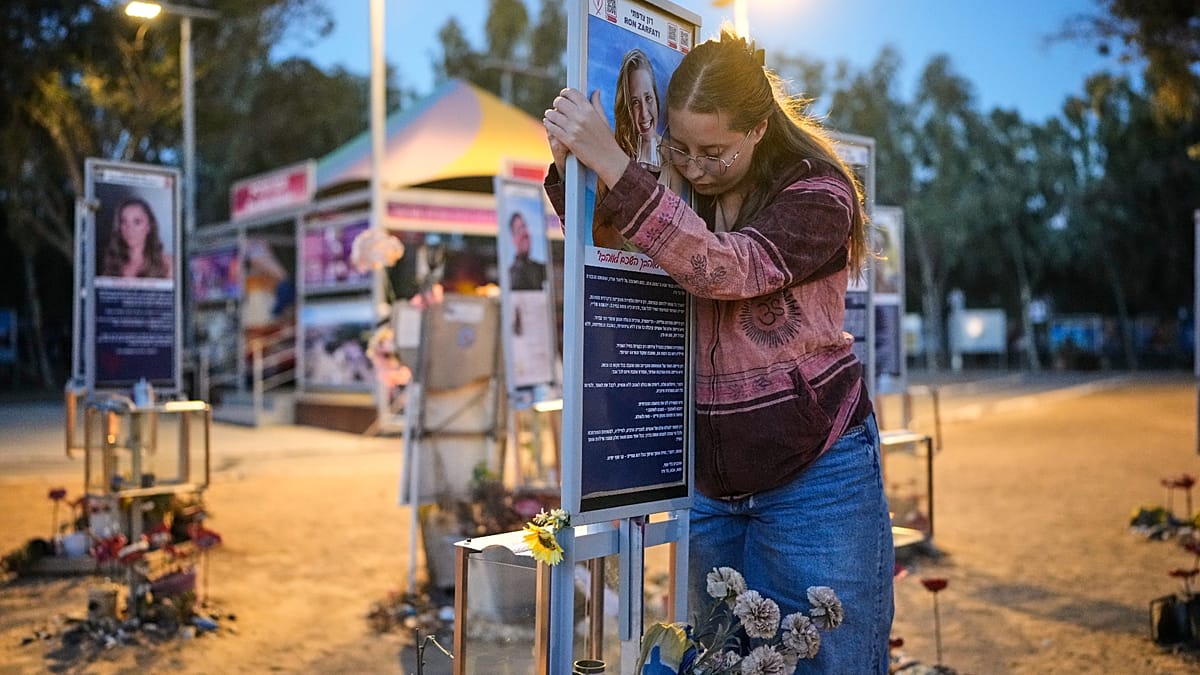
On Wednesday, hundreds of Israelis returned to the dusty fields of southern Israel where the Nova music festival once pulsed with electronic beats. Three years after Hamas-led militants stormed the gathering, killing hundreds and abducting dozens, the site has become a place of pilgrimage—a makeshift memorial of portraits, posters, and silent reflection.
Visitors moved slowly among the photographs of the young people who never came home. Some stood alone, staring at the faces; others embraced in small groups. The atmosphere was heavy with grief, but also with a sense of communal duty to remember.
Nearby, at the kibbutz of Kfar Aza, a more formal ceremony unfolded. The Israeli flag was lowered as mourners sang together, and one woman was seen wiping tears from her eyes. The events marked the third anniversary of the deadliest day in Israel's history, when about 1,200 people were killed and 251 taken hostage.
A somber milestone
This year's commemorations carry particular weight: they are the first since all hostages were either returned alive or their remains were recovered. For many families, the closure remains incomplete, but the absence of ongoing hostage negotiations has shifted the focus to remembrance and reckoning.
The October 7 attack triggered a devastating war in Gaza. According to Gaza health officials, more than 74,000 Palestinians have been killed in the ensuing conflict, which has also displaced nearly the entire population of the enclave and reduced much of its infrastructure to rubble.
The war has reshaped the Middle East and reverberated far beyond. In Europe, the conflict has fueled debates over immigration, security, and the limits of free speech, while also straining diplomatic relations between EU member states and Israel. The anniversary comes as air raid sirens sounded in Tel Aviv and other cities, a stark reminder that the threat of rocket fire persists.
For many Europeans, the images from the Nova site are hauntingly familiar—a music festival turned into a killing field, reminiscent of other attacks on civilian gatherings across the continent. The European Union has repeatedly condemned the October 7 assault and called for restraint in Gaza, but divisions remain over how to balance solidarity with Israel and pressure for a ceasefire.
As the sun set over the Negev, the names of the dead were read aloud, each one a story cut short. The ceremony at Kfar Aza concluded with a moment of silence, broken only by the wind and the distant sound of birds.
For the families and friends who gathered, the pain is as raw as ever. But there is also a determination to ensure that the world does not forget what happened on that October morning. As one mourner put it, "We are here to say: we remember, and we will keep remembering."
The anniversary also coincides with broader regional tensions. In recent weeks, Houthi missile attacks on Saudi Arabia and a UK trial over an alleged Iranian plot have underscored the fragility of the Middle East. Meanwhile, European leaders are grappling with how to respond to rising hybrid threats from Russia, a reminder that security challenges are interconnected.
For now, though, the focus is on the personal. At the Nova site, a woman placed a small stone on a portrait of her friend, a gesture of mourning that transcends language. The ceremonies were not just about the past, but about the future—a future that, for many, remains uncertain.