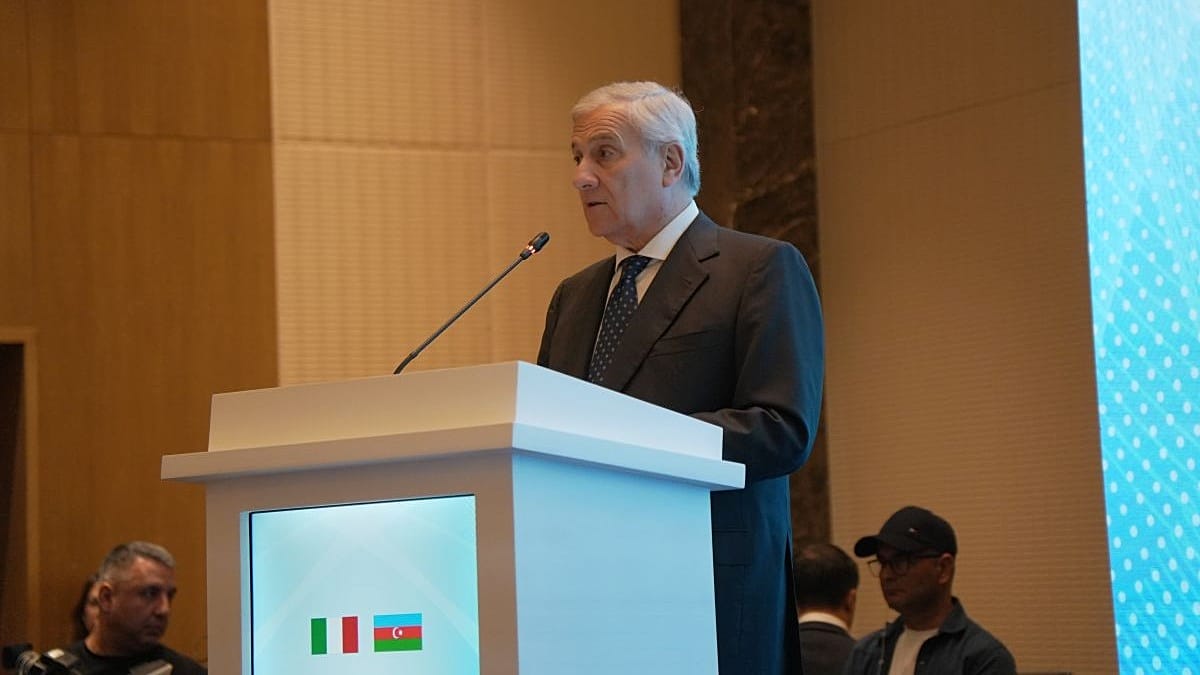
Italy is positioning itself as a key European partner for Azerbaijan, with Foreign Minister Antonio Tajani leading a business delegation to Baku to deepen economic ties and explore new opportunities along the emerging Middle Corridor trade route. Speaking at the Azerbaijan-Italy Business Forum on Monday, Tajani described the relationship as one built on "trust and common interests" and called for a "leap in quality" in bilateral cooperation.
The forum, co-chaired by Tajani and Azerbaijan's Economy Minister Mikayil Jabbarov, brought together business leaders from both countries to discuss investments in manufacturing, infrastructure, transport, technology, and critical raw materials. Italy is already Azerbaijan's largest EU trading partner and the top importer of Azerbaijani energy, and Tajani said the two countries should now aim higher.
Middle Corridor: a strategic link between Europe and Asia
Central to the discussions was the Middle Corridor, a rail and maritime network connecting China, Central Asia, and the Caucasus to European markets via the Caspian and Black Seas. With global supply chains facing disruptions in the Middle East, the corridor has gained renewed attention from EU member states seeking alternative routes. Tajani said Italian companies can contribute engineering expertise, technology, artificial intelligence, machinery, agri-food products, and railway systems to the project.
"We devoted considerable attention to connectivity and the diversification of energy and logistics corridors: from the Middle Corridor to the Green Energy Corridor, which could bring energy to Europe and is already attracting strong interest from our Italian companies," Tajani told Euronews. He added that the goal is to strengthen links between Europe and Asia, creating new growth opportunities for both countries.
The Italian foreign minister also met with Azerbaijani President Ilham Aliyev, describing the country on X as "a strategic partner of Italy with which we share a strong relationship built on trust and common interests."
Peace as a catalyst for investment
Tajani stressed that the recent peace process between Azerbaijan and Armenia is essential for regional stability and economic development. "Peace is a good choice for paving the way for new investments," he said, thanking Azerbaijan for its engagement in favour of peace, not only with Armenia but also in the wider region.
Italy has reaffirmed its full support for the peace process, which Tajani said is vital for unlocking the region's economic potential. The improved connectivity and stability have already translated into tangible results: Italian exports to Azerbaijan grew by 14% in the first eight months of this year.
Beyond energy: diversification and critical raw materials
While energy remains a cornerstone of the bilateral relationship, both sides are keen to diversify. Azerbaijan's Economy Minister Mikayil Jabbarov said the talks focused on economic diversification and non-oil sector development, including industrial parks and free economic zones. "Cooperation with Italian companies opens up very good opportunities for our companies," he said.
Jabbarov added that Azerbaijan aims to improve the competitiveness of locally produced goods and increase their access to foreign markets. "The initiatives are aimed at modernising industrial enterprises, expanding production capacity, facilitating access to international markets for industrial products, accelerating the adoption of digital technologies and strengthening business and investment ties," he explained.
Several agreements were signed during the forum, covering artificial intelligence, industrial production, construction, public transport, and investment cooperation. Italy's Leonardo, a major aerospace and defence company, signed a memorandum with Azerbaijan's Ministry of Economy on high-performance computing and AI. Italy's development finance institution, Cassa Depositi e Prestiti (CDP), also signed an agreement with Azerbaijan's Business Development Fund.
Tajani highlighted the importance of critical raw materials, noting that a Joint Declaration on Strategic Cooperation in Critical Raw Materials was signed in Rome in October. "If you want to compete at a global level, you need to reduce the price of raw materials," he said, suggesting that Italy and Azerbaijan could cooperate on sourcing these materials in Africa and elsewhere.
The Italian minister also encouraged Azerbaijani companies to invest in Italy, while Italian firms should look to export more to Azerbaijan. "It's also possible to invest in Italy for companies coming from Azerbaijan, but also for Italian companies to export to Azerbaijan," he said.
The deepening ties come as the EU seeks to reduce its dependence on traditional energy suppliers and secure new trade routes. Italy's proactive approach in Baku reflects a broader European interest in the South Caucasus as a gateway to Central Asia and beyond. As Azerbaijan's AI push gains momentum, and with Armenia planning grid links with its neighbours, the region is becoming a focal point for European investment.
For Italy, the partnership with Azerbaijan is not just about energy or trade—it is about building a long-term strategic presence in a region that is increasingly important to European foreign policy. As Tajani put it, "We must be ambitious."