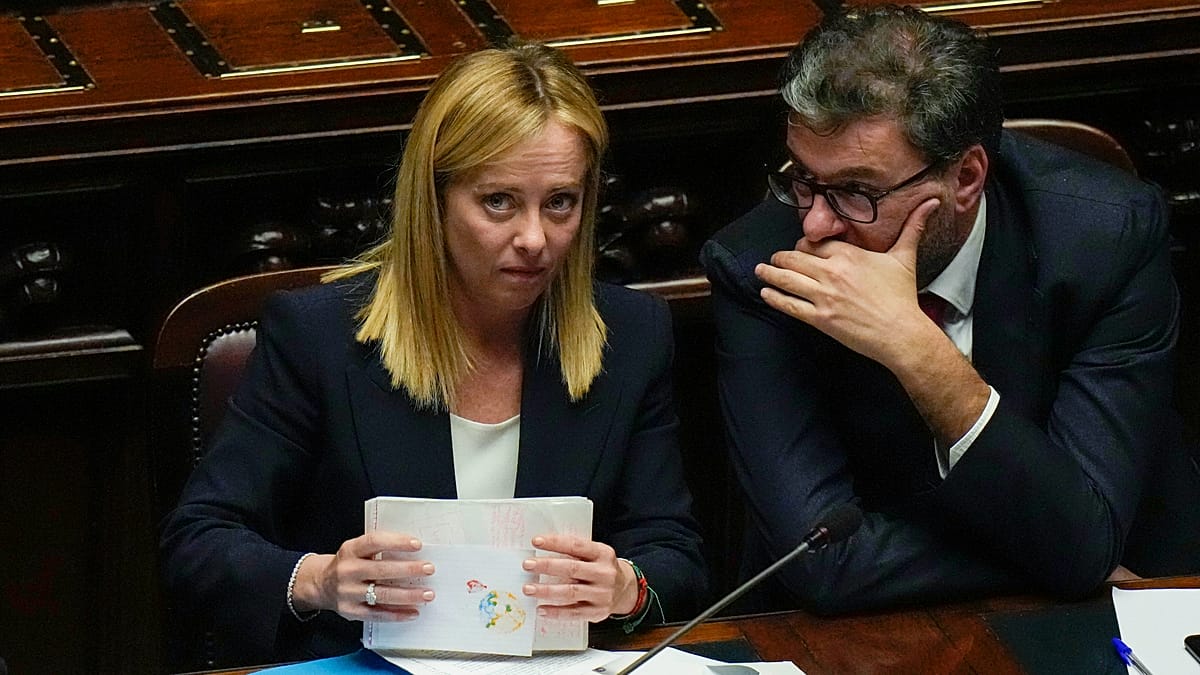
Italy's economy is showing signs of stronger-than-expected growth, with the government now projecting GDP expansion of close to 1% for 2026. Economy Minister Giancarlo Giorgetti, speaking at the Teha Cernobbio Forum, said the country had already secured 0.8% growth and could approach 1% if current trends hold. That would exceed the 0.6% forecast in the government's official planning documents.
Economist Pietro Reichlin of LUISS University, in an interview with Euronews, called the estimate "realistic" but cautioned against overinterpreting it. "Italy remains last in the EU," he said, pointing to persistent structural problems that keep the country's growth below the European average.
Revenue uptick offers limited relief
The brighter growth outlook comes alongside a notable rise in tax revenues. In the first seven months of 2026, Italy's state collected €346.1 billion in taxes, up €9.4 billion (2.8%) from the same period in 2025, according to the Finance Department of the Ministry of Economy and Finance. Direct taxes rose 3.2% to €200.7 billion, while indirect taxes grew 2.2% to €145.5 billion. Personal income tax (Irpef) brought in €138.5 billion (+2.7%), and VAT receipts reached €100.3 billion (+3.8%).
Excise duties on energy products, however, fell 8.5% year-on-year to €12.7 billion, partly due to temporary reductions aimed at cushioning high energy prices.
Reichlin noted that higher GDP typically translates into higher revenues, especially with positive employment data. "As GDP increases, revenues increase," he said, adding that more workers and higher wages broaden the tax base. But he warned that these gains are not enough to create meaningful fiscal space.
Why Italy lags behind its EU peers
The growth improvement is part of a broader European trend, Reichlin said, but Italy's performance remains weak compared with countries like Spain. "Growth, for example in Spain, is higher than ours," he noted. Spain's stronger expansion is partly driven by large migrant inflows that boost employment, a pattern also visible in other southern European states, including Italy.
Yet Reichlin stressed that employment growth "is not strong enough to allow us to offset" the core problem: very low productivity. "So more work, more workers, but with little added value," he explained. This productivity deficit, rooted in structural issues dating back to the late 1990s, limits wage growth and overall prosperity.
Demographics add another drag. Italy's ageing population and falling birth rates weigh on public finances through higher pension and healthcare costs, Reichlin said, making it harder to control spending.
Implications for the 2027 Budget Law
The revenue uptick cannot be automatically treated as available resources for the 2027 budget. The government must first determine how much of the increase is structural and sustainable. Reichlin cautioned against "illusions" about the upcoming budget, which he expects to be "very cautious" with "very little room for manoeuvre."
Even if Italy were to reduce the tax burden on labour and businesses, as international organisations recommend, such measures would need to be offset by other revenue sources, and "it is not clear where these could come from," he said.
The 2027 budget will therefore be a balancing act, as Italy seeks to keep its deficit under control while addressing long-standing economic weaknesses. The EU's budget challenges and discussions on bloc-wide taxes add another layer of complexity to fiscal planning across the continent.
Reichlin concluded that without tackling productivity and demographics, Italy's growth will remain modest, and the country will continue to trail its European partners. The upcoming budget law, he said, will reflect these constraints, offering little beyond cautious management of public finances.