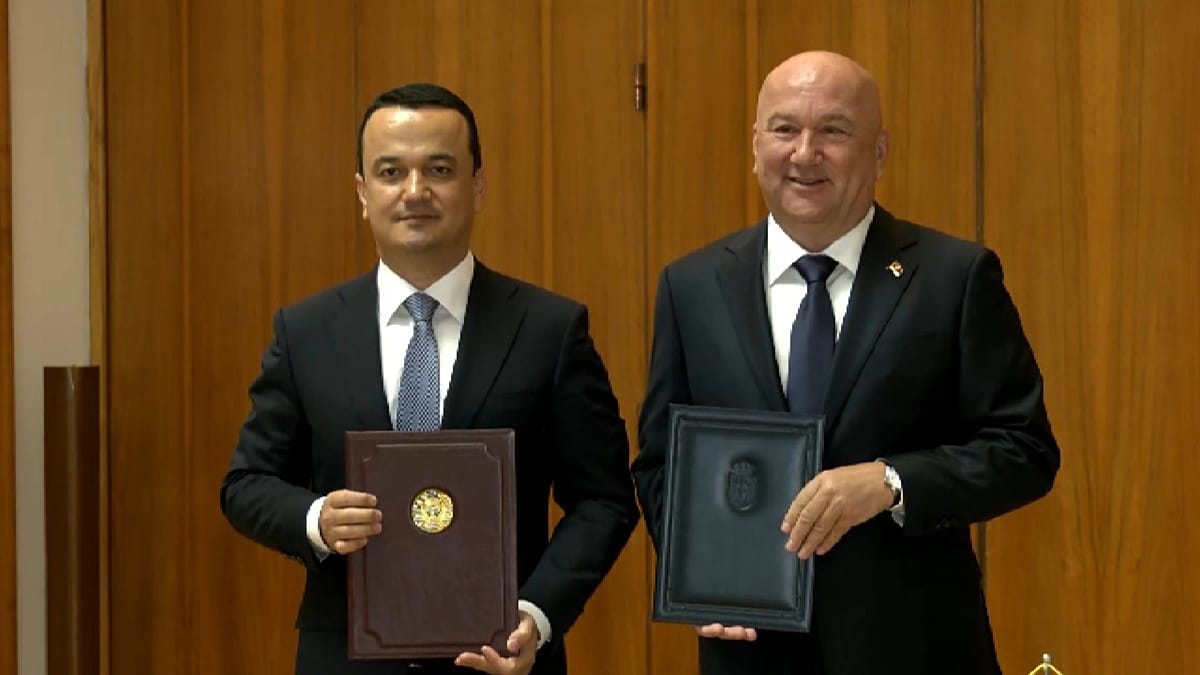
Belgrade hosted the inaugural session of the Serbia-Uzbekistan Joint Commission for Economic Cooperation on Monday, just hours before Uzbek President Shavkat Mirziyoyev arrived for a two-day official visit. The meeting brought together Serbian Minister Nenad Popović, who oversees international economic cooperation, and Uzbekistan’s Minister of Investment, Industry and Trade, Laziz Kudratov.
According to Euronews Serbia, the talks centred on boosting bilateral trade and investment, forging direct links between companies, and identifying sectors ripe for joint ventures. The two sides also discussed a potential free trade agreement and new investment projects, signalling a broader ambition to deepen ties beyond the current modest trade volumes.
Trade on the rise
Bilateral trade reached approximately $41.9 million (€36.1 million) in 2025, a record for the two countries. Figures from the Serbian Chamber of Commerce show a 27% increase from the $32.9 million recorded in 2024. Serbian exports accounted for $26.39 million of last year’s total, while imports from Uzbekistan stood at $15.46 million.
“Our task is to turn this strong political momentum into concrete results: increased trade, new investments, joint projects, and a stronger presence of Serbian companies on the Uzbek market,” Popović said.
Agriculture leads the expansion
Agriculture and food production are emerging as the fastest-growing segments of the relationship. Serbian exports of agricultural and food products to Uzbekistan rose by 54.1% between January and July 2026, according to figures presented at the meeting. Officials identified seeds and planting material, agricultural machinery, and food-processing equipment as areas with further growth potential.
But the two governments are looking well beyond agriculture. The sectors discussed include mechanical and electrical engineering, pharmaceuticals, textiles, construction, energy, transport and logistics, as well as information technology, artificial intelligence, robotics and digitalisation.
At the end of Monday’s meeting, Popović and Kudratov signed a protocol outlining priority areas and next steps. They also agreed that the commission would become the main institutional mechanism for following up on agreements and developing new economic initiatives.
Free trade talks on the table
One of the potentially most consequential steps is the prospect of a bilateral free trade agreement. “We are also beginning talks on a free trade agreement, which, together with duty-free trade, would lead to increased trade in goods,” Kudratov said.
The idea predates Mirziyoyev’s visit. Serbian and Uzbek officials had already discussed launching negotiations on a free trade agreement during talks in Tashkent in May. For both sides, the objective is to move beyond a bilateral trade relationship that remains small compared with the size of their economies.
Uzbek economic officials have argued that Serbia could provide Uzbek companies with a gateway to Central and Southeast European markets, while closer ties with Uzbekistan would give Serbian firms greater access to one of Central Asia’s largest markets.
Mirziyoyev visit adds political momentum
The commission met shortly before Mirziyoyev’s arrival in Belgrade, where he was due to hold talks with Serbian President Aleksandar Vučić. The Uzbek presidency said the visit would focus on trade, investment and joint projects in transport, mechanical engineering, light and food industries, agriculture, pharmaceuticals and information technology. Organised labour migration is also on the agenda.
On Tuesday, the two presidents are scheduled to sign a joint statement establishing a strategic partnership between Serbia and Uzbekistan, alongside a broader package of bilateral documents. A Serbia-Uzbekistan business forum is also planned in Belgrade.
The visit follows Vučić’s trip to Uzbekistan in October 2025 and comes as Serbia prepares to open an embassy in Tashkent, another sign of the rapid expansion of political contacts between the two countries. This deepening relationship occurs against a backdrop of EU criticism over Serbia's handling of the Mladić funeral, but Belgrade appears to be diversifying its international partnerships.