For British artist Jake Andrew, music is not just heard—it is seen. Every note, chord, and rhythm translates into a vivid palette of colors, shapes, and textures that he captures on canvas. This rare neurological condition, known as synaesthesia, allows him to experience sound as a visual phenomenon, and his paintings offer a glimpse into that multisensory world.
Andrew's preferred instrument to paint is the cello. "It's dark, but it doesn't feel ominous," he explains. "It's got this kind of like... and then edge of.... Does this make any sense? Like the edge of the tube itself, of where the sound comes from has these kind of like almost dust particles that come off it." His descriptions reveal a deeply personal and intricate visual language, where even the texture of sound is tangible.
His synaesthesia extends beyond music to everyday sounds. A passing motorbike appears dark purple to him, while a friend's dog's bark takes on a lime-green hue. These automatic associations are not just passive; they are an integral part of how he perceives and interacts with the world.
Live painting: where sound meets canvas
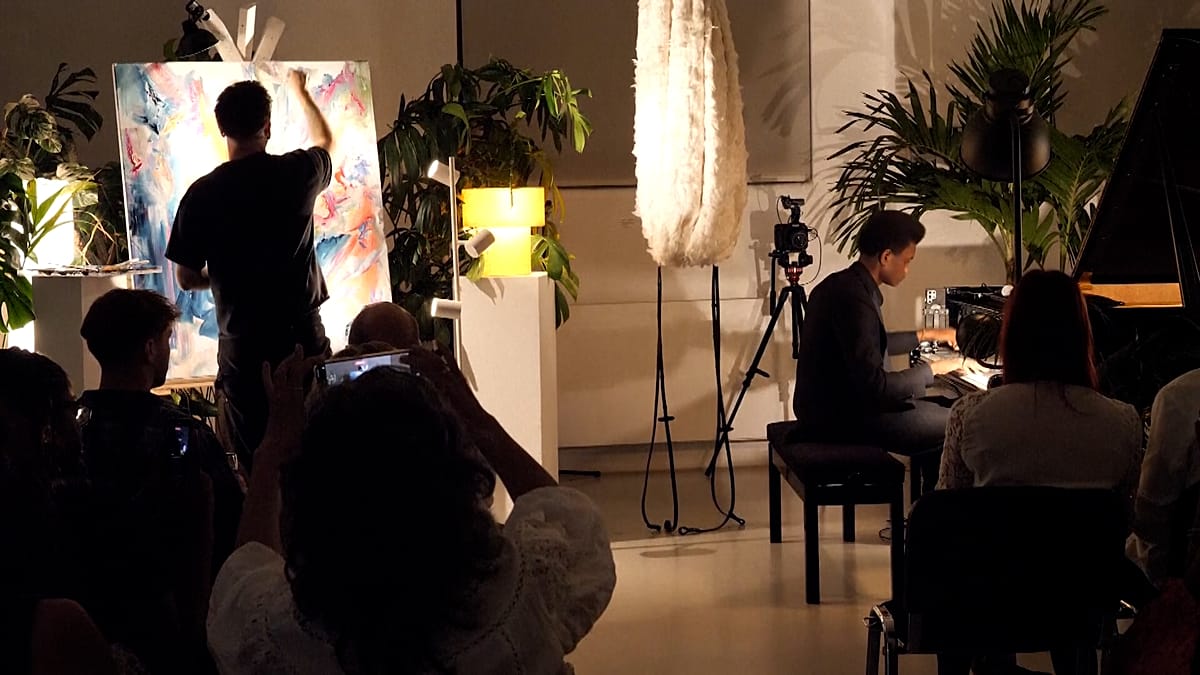
In September, Andrew brought his unique ability to a live performance at the Handbag Factory in Vauxhall, London. Pianists Camden Stewart and Karim Kamar improvised around their original compositions while Andrew translated the music into paint in real time. The event was a fusion of auditory and visual creativity, offering the audience a rare opportunity to witness the meeting point of two art forms.
The results do not always follow familiar associations between color and mood. A minor key, often perceived as sad or somber, does not necessarily produce a dark painting. "E minor, that's usually dark blue, slow legato movements where it's kind of like swirling," Andrew says, illustrating how his visual responses are nuanced and personal.
Experts in the field, like Jamie Ward, professor of cognitive neuroscience at the University of Sussex, note that sound-to-color synaesthesia, or chromesthesia, can involve more than just colors. "It's the shapes, it's the movement, it's texture and all of these things, and how it's organised in space as well," Ward explains. This complexity is evident in Andrew's work, which often features dynamic forms and layered textures.
While sounds can sometimes interrupt Andrew's thoughts, he embraces his condition as an inseparable part of his life. "It's not a curse, though. I can't imagine what it would be like to not have it," he says. His attitude reflects a broader acceptance of neurodiversity, and his art serves as a bridge between those who experience the world differently and those who do not.
For the musicians involved, collaborating with Andrew has been a fascinating process. "That's like asking me 'what does a fourth dimension look like?' I can't even fathom it," one of them remarked, highlighting the profound challenge and reward of translating sound into a visual medium.
Andrew's work is part of a growing interest in synaesthesia and its artistic potential. Similar explorations can be seen in other European artists, such as Merike Estna's live painting at the Venice Biennale, which also challenges traditional boundaries between art forms. Museums across the continent are increasingly spotlighting such innovative approaches, as seen in the Prado and Rijksmuseum's joint effort to highlight women artists.
As Andrew continues to explore the intersection of sound and vision, his paintings offer a unique perspective on how we perceive and interpret the world. His work not only enriches the European art scene but also invites audiences to consider the myriad ways in which our senses can intertwine.