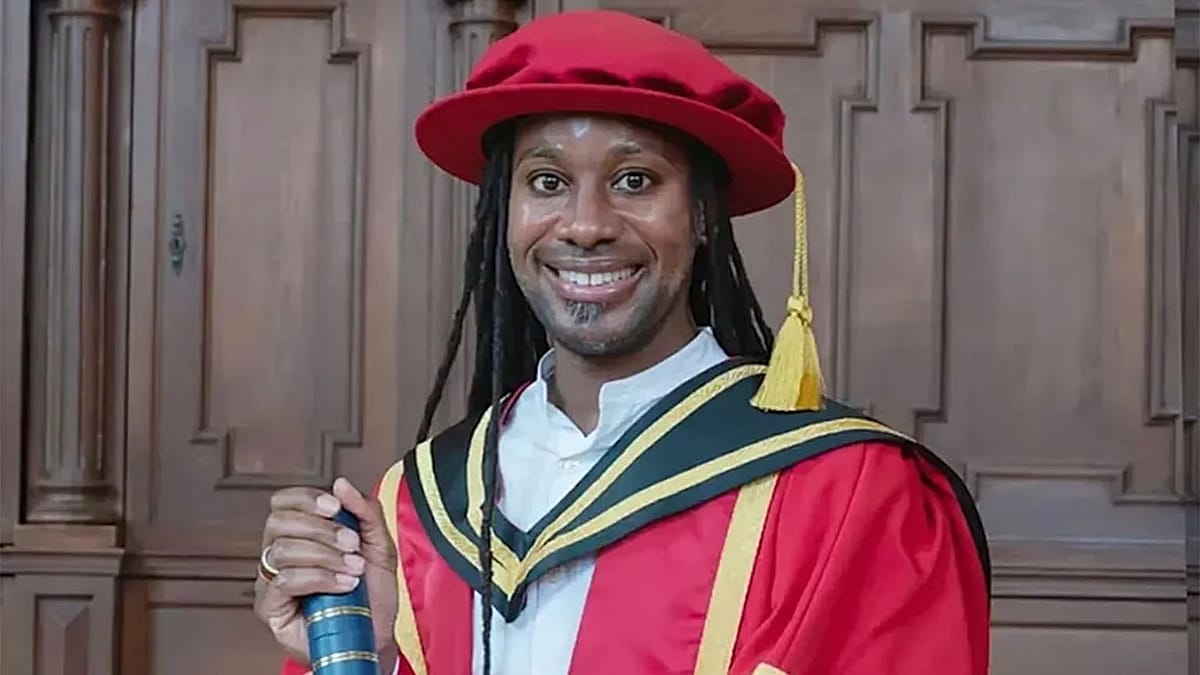
Jason Arday, the British academic who resigned from the University of Cambridge earlier this month amid a plagiarism controversy, has died. He was 41. UK media reported on Friday that police found him unresponsive at an address in Battersea, south London, and pronounced him dead at the scene.
The Metropolitan Police confirmed the death, saying officers were called to the property on Friday afternoon. No further details have been released, and an investigation into the circumstances is ongoing.
Arday had stepped down from his roles as professor of sociology of education at Cambridge and fellow at Jesus College with immediate effect. His resignation came just days after the university announced an inquiry into allegations that he had plagiarised parts of his PhD thesis and other publications.
His appointment in 2023 as Cambridge's youngest Black professor had made national headlines and was seen as a milestone for diversity in British academia. But within months, questions began to surface about the originality of his doctoral work and the accuracy of some of his claimed achievements.
Arday and his supporters argued that much of the scrutiny was motivated by racism. In a letter posted online after his resignation, he said he was leaving because continuing would be unbearable. "It is simply the decision of someone who has reached the limits of what any person should reasonably be expected to endure," he wrote. He insisted the resignation should not be "mistaken for an acceptance of the narratives that have surrounded me."
The university had initially defended him vigorously. In June, Cambridge issued a statement condemning what it called "a vile campaign to undermine his credibility," and said that plagiarism claims regarding his thesis and journal articles had been investigated and dismissed by the relevant institutions and journals.
However, the pressure did not subside. New allegations emerged, and the university opened a formal review. Arday's resignation marked the culmination of a scandal that has deepened over recent weeks, raising broader questions about academic integrity and the treatment of high-profile minority scholars.
A career marked by promise and controversy
Arday's rise was extraordinary. Born in London to Ghanaian parents, he overcame a diagnosis of autism and a speech delay in childhood to pursue an academic path. He held positions at the University of Roehampton and Durham University before joining Cambridge in 2023.
His research focused on widening participation in higher education and addressing racial inequality. He was a vocal advocate for decolonising the curriculum and increasing access for underrepresented groups.
The plagiarism allegations, first reported by the Daily Mail, centred on passages in his PhD thesis that appeared to be lifted from other scholars without proper attribution. Arday denied any wrongdoing, and his defenders noted that PhD theses often contain extensive quotations and that the accusations were being weaponised against him.
The case has become a flashpoint in British academia, with debates about how to balance accountability with fairness. Some have pointed to the disproportionate scrutiny faced by Black academics, while others argue that the integrity of research must be upheld regardless of race.
Arday's death has prompted an outpouring of tributes from colleagues and students. Many have remembered him as a passionate educator and a trailblazer who inspired countless young people. "He was a brilliant mind and a kind soul," one former colleague told the BBC. "This is a devastating loss."
The university has yet to comment on his death. The plagiarism inquiry, which was ongoing at the time of his resignation, is now likely to be discontinued.
For those who followed his career, the tragedy is compounded by the circumstances. Arday had spoken openly about the toll the controversy had taken on his mental health. In his resignation letter, he described the period as "difficult" and said he had reached the limits of what he could endure.
His death raises renewed concerns about the pressures faced by academics in the public eye, particularly those from minority backgrounds. It also serves as a reminder of the human cost of public disputes, even when they are conducted in the name of scholarly integrity.
As the news spreads, many are reflecting on a life that was both celebrated and contested. Jason Arday leaves behind a legacy of advocacy and scholarship, and a cautionary tale about the fragility of reputation in the digital age.