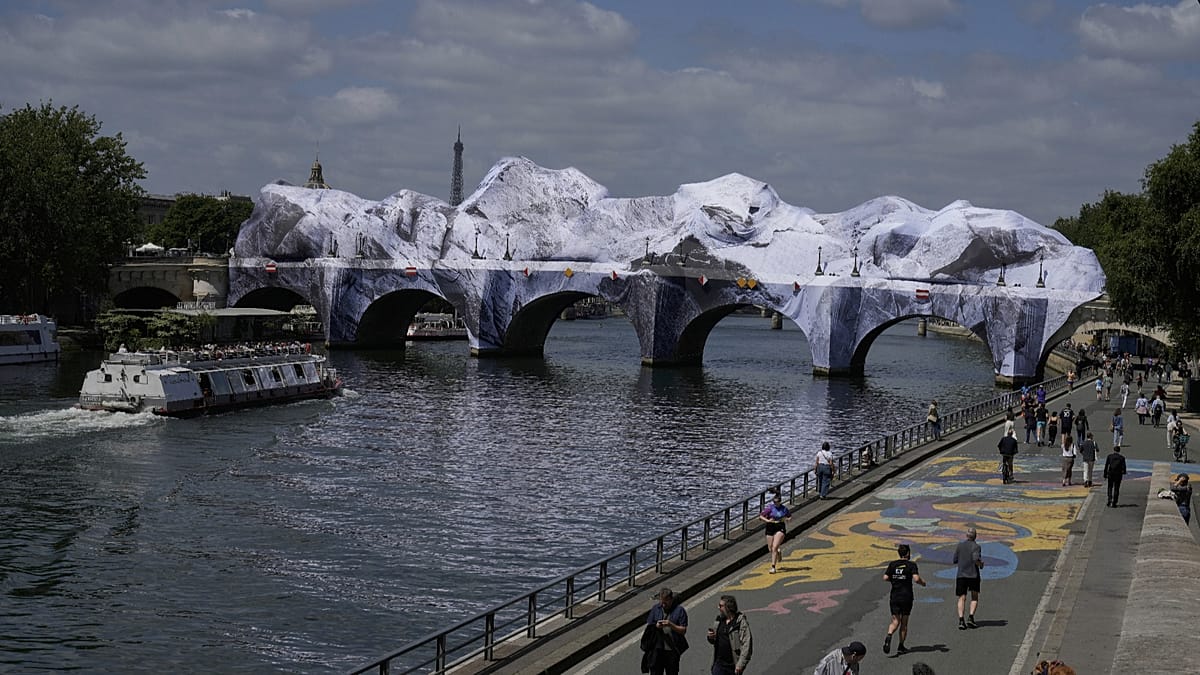
Parisians and visitors can now walk through a vast artificial cave without leaving the city centre. The French artist JR, known for his large-scale photographic interventions, has wrapped the Pont Neuf — the oldest standing bridge across the Seine — in an inflatable structure that mimics a limestone cavern. Titled Cavern, the installation opened to the public on 16 June after a ten-day delay caused by strong winds and heavy rain.
The work stretches 120 metres in length, 20 metres in width, and rises between 12 and 18 metres above the bridge deck. Inside, visitors encounter photorealistic stalactites and stalagmites printed on the fabric walls, while an ambient soundtrack of dripping water and echoing drips — composed by Thomas Bangalter, formerly of Daft Punk — reinforces the illusion of being underground. The subdued lighting and enclosed space are designed to make the surrounding city disappear, transporting pedestrians far from the bustle of the capital.
An Immersive Walk Through the Heart of Paris
The cavern sits on one of Paris's main pedestrian routes, linking the Samaritaine department store on the Right Bank to the Hôtel de la Monnaie on the Left Bank, a short walk from Notre-Dame Cathedral. It is accessible on foot 24 hours a day, seven days a week, and entry is free. The installation will remain in place until 28 June.
“It is a truly total immersion: the sound, the subdued light and this feeling of being shut in, yet somehow still a certain freedom,” said Marie-Christine, a visitor who came specifically to see JR's work. For Sébastien Depond, the visual detail was the highlight: “You feel as if you can see and even touch the stalactites.”
Fiona, a German tourist who stumbled upon the installation while crossing the bridge, described the experience as unexpected but memorable. “We were just passing by and we thought, ‘Oh, that looks interesting.’ I had seen a few videos on social media, but we hadn’t come especially for it. It was really interesting to walk through this space and remember, ‘Oh yes, I’m walking on a bridge.’”
A Delayed Opening and a Nod to Art History
The opening was originally scheduled for 6 June, but powerful gusts and heavy showers four days earlier tore several large holes in the inflatable shell, forcing a postponement. JR, who has completed public art projects in locations from the favelas of Rio de Janeiro to the border wall between the United States and Mexico, acknowledged the irony of the setback occurring in his hometown. “In all my projects in public space over more than 25 years, I have always run into huge difficulties,” he told AFP. “It was often at the other end of the world, so people didn’t notice. Here it is in the heart of my city, of our city, so people were able to see the (reconstruction) worksite out in the open, right in the public square.”
The Pont Neuf has a history of being wrapped. In 1985, the artist couple Christo and Jeanne-Claude famously enveloped the bridge in fabric, drawing millions of visitors. JR's Cavern offers a different kind of transformation — one that turns a landmark into a sensory experience rather than a sculptural object.
Despite the weather-related delays, JR is confident the structure can withstand summer heat. “We carried out tests during the heatwave two weeks ago and the cavern was always 15°C cooler than outside. So it behaves like a real cave, or almost,” he said. The installation is part of a broader trend of large-scale public art in Paris, which has also seen the Musée d'Orsay Opens Gallery Addressing Nazi-Looted Art Legacy and other cultural initiatives across the city.
For those unable to visit in person, the ephemeral nature of the work — it will be dismantled after just 12 days — adds to its appeal. JR's Cavern is a reminder that even the most familiar urban spaces can be reimagined, if only for a moment.