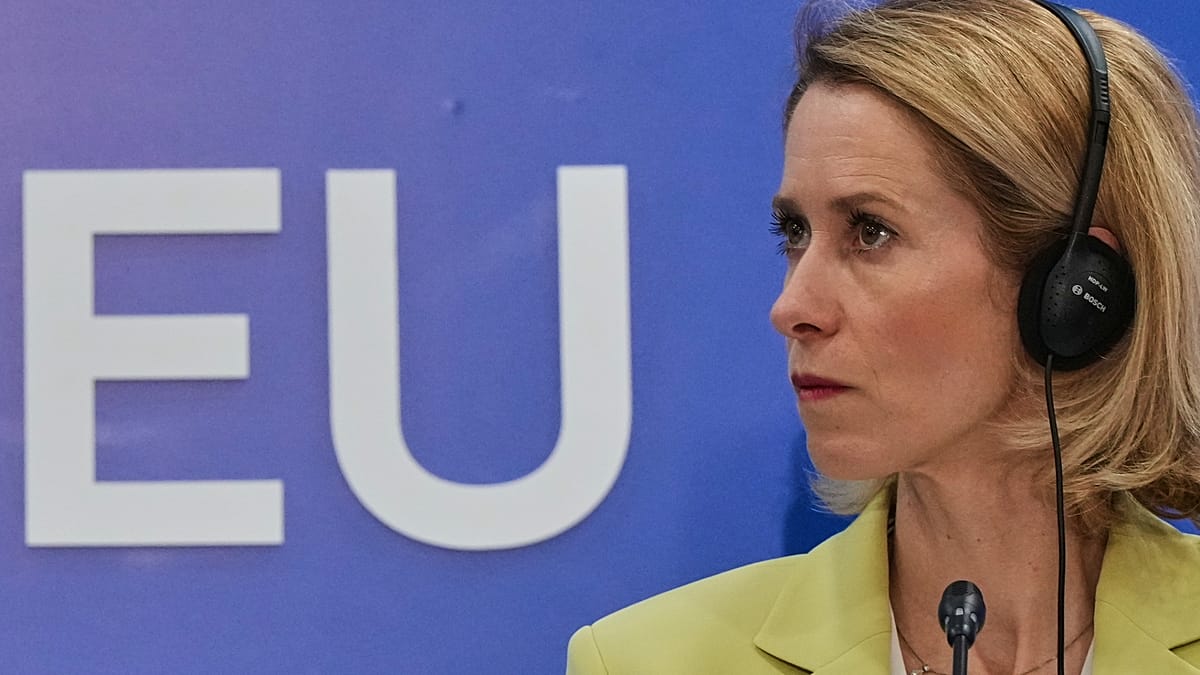
EU foreign policy chief Kaja Kallas has publicly backed her own diplomatic service in an internal email seen by Euronews, as debates among European capitals over the future of the bloc's foreign policy machinery intensify. The European External Action Service (EEAS) and the role of the High Representative for Foreign Affairs and Security Policy are under increasing scrutiny, with EU governments seeking to make the bloc's foreign policy more agile in a volatile geopolitical landscape.
Paris has taken the lead in sketching out potential reforms, circulating a discussion paper that outlines several options. Some proposals would curtail the powers of the High Representative, currently held by Kallas, while another would expand her authority in key policy areas. The French-led paper reflects a broader push to reassess how the EU projects its influence abroad.
Three Scenarios for Reform
The first scenario would dilute the High Representative's role by transferring key foreign policy competences to the European Commission. This would mark a significant victory for Commission President Ursula von der Leyen, who has increasingly positioned herself as a central figure in external affairs, describing her approach as that of the 'geopolitical Commission.'
The second scenario would assign a more operational role to the European Council, meaning member states would take a hands-on role in running external relations rather than merely setting political direction. Under both scenarios, the High Representative's influence would be significantly reduced.
A third option moves in the opposite direction, strengthening the EU's chief diplomat by granting greater oversight of portfolios held by European commissioners in areas with major geopolitical implications, such as trade. This would effectively expand Kallas's remit beyond traditional foreign policy.
In her private email to EEAS staff, Kallas pushed back against the prospect of a diluted role, stressing that 'the roles and responsibilities of the EU institutions are clearly defined in the treaties. That framework remains unchanged.' An EU official echoed this sentiment, telling Euronews that 'any major institutional reform would require changes to the EU treaties, which are not currently under serious consideration.'
The timing of the debate is not coincidental. A second EU official noted that the idea of overhauling the EEAS has circulated for some time but gained momentum because the service recently opened its top post of secretary general, triggering what amounts to an institutional interregnum. Any restructuring would also be linked to ongoing talks over the bloc's next seven-year budget, though diplomats consider it unlikely that significant changes could happen before the next legislative term.
The EEAS is working on its own options paper, and a first ministerial-level discussion is expected at the next informal Foreign Affairs Council meeting in Ireland on 2 September. Meanwhile, Kallas is scheduled to meet France's Minister for Europe and Foreign Affairs Jean-Noël Barrot on Friday, a meeting that was arranged before the French document became public and coincides with a two-state solution conference led by France.
This internal debate comes as the EU faces unprecedented geopolitical challenges, from Russia's war in Ukraine to tensions in the Middle East. The outcome of these discussions could reshape how the bloc coordinates its foreign policy, with implications for everything from sanctions enforcement to diplomatic engagement. For more on related EU foreign policy issues, see Kaja Kallas Presses Ireland on Alumina Exports to Russia Amid Sanctions Loophole and Zelenskyy Intensifies Diplomatic Push to Force Russia into Peace Talks.