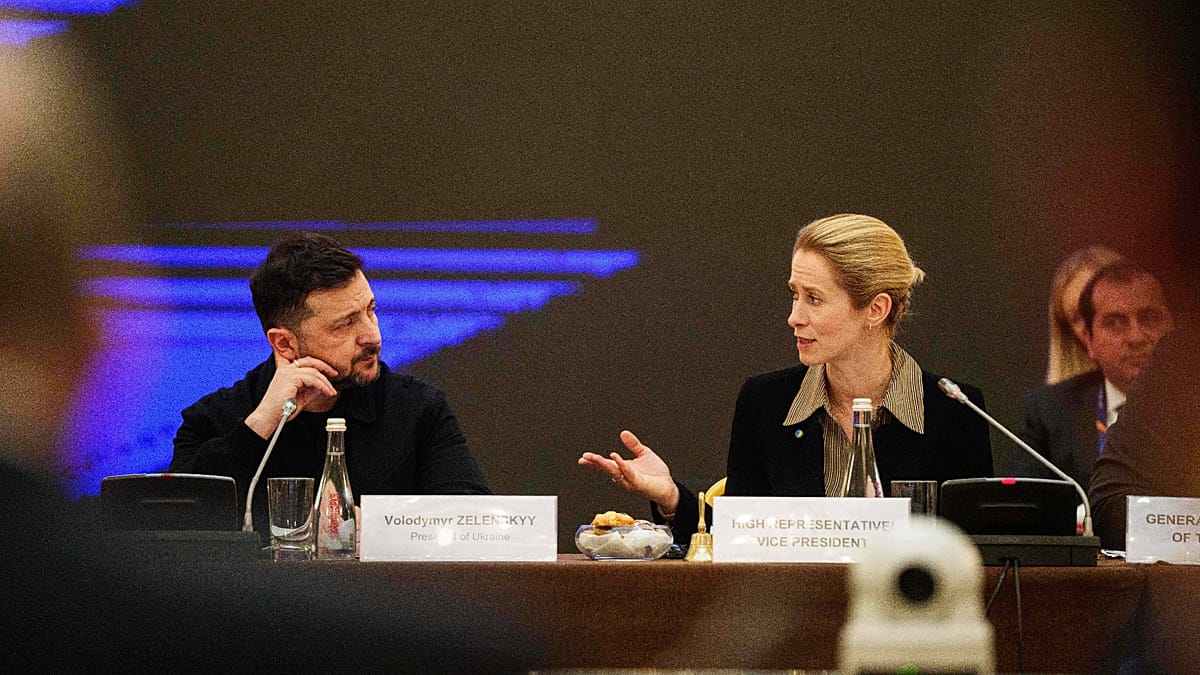
The European Union's top diplomat, Kaja Kallas, has publicly backed Ukraine's campaign against Russian oil refineries, arguing that these strikes fall within Kyiv's right to self-defence under international law. In an exclusive interview with Euronews, the EU High Representative for Foreign Affairs and Security Policy said the attacks are a direct response to Moscow's aggression, because revenue from oil sales finances the war that kills Ukrainian civilians every day.
"If we look at international law, it is clear that [hitting refineries] is in defence of Ukraine because that is where the funding comes from for this war to kill Ukrainian people every day," Kallas said. Her remarks come as Washington pushes for a limited ceasefire on energy infrastructure, a proposal that Kyiv has reluctantly accepted but now says it will abandon.
Energy ceasefire unravels
US President Donald Trump announced an "energy ceasefire" under which Russia and Ukraine would stop targeting each other's energy facilities. The deal followed a separate arrangement for Russia to supply more than 300,000 tonnes of diesel to global markets amid rising fuel prices. But Ukrainian President Volodymyr Zelenskyy has now declared that the pause is over, telling the Financial Times: "The block (on attacking refineries) is out. We're done."
Kallas stressed that the war has a clear aggressor and a clear victim, and that the United States should focus its pressure on Moscow rather than on Kyiv. "If we look at the big picture, the majority of the financing for this war comes from oil," she said. "That is why Ukraine is also targeting them, while Russia is targeting the energy infrastructure inside Ukraine, to cause as much suffering for the Ukrainian people in the upcoming winter."
The EU has repeatedly signalled it will continue to support Ukraine, which has not surrendered despite relentless attacks. EU leaders are set to discuss the energy crisis and Ukraine support at their summit in Brussels, where Kallas is expected to push for a unified European stance.
Ukraine's intensified campaign
Ukraine has significantly stepped up its strikes on Russian oil infrastructure. According to Ukraine's Defence Ministry, 12 major refineries were hit in September alone. The International Energy Agency (IEA) reported that by late August, only five of Russia's 32 major refineries had escaped Ukrainian drone attacks, with some facilities struck as many as 15 times since the full-scale invasion began in 2022.
Zelenskyy confirmed that Kyiv had halted strikes on Russian energy facilities for three days at Washington's request, but Moscow continued attacking Ukrainian infrastructure and killing civilians. He also accused US officials of threatening to suspend intelligence-sharing unless Ukraine stopped its attacks. The subsequent disruption of Starlink satellite services was presented as a technical problem, but Zelenskyy rejected that explanation. "It was not a technical problem, it was the will," he said.
The Kremlin responded with sarcasm. Spokesperson Dmitry Peskov asked: "What was announced? What are the boundaries of the energy ceasefire? What does it mean? Was any of this specified?" His remarks suggest that no formal agreement is in place, despite Trump's announcement.
European perspective
Kallas's defence of Ukraine's strikes reflects a broader European view that Moscow's war economy must be targeted. Italian Prime Minister Giorgia Meloni has called Trump's diesel deal "very risky" and a legitimisation of Moscow, highlighting divisions within the transatlantic alliance.
Meanwhile, NATO Secretary General Mark Rutte is pressing allies to boost air defence for Ukraine, as Russian strikes on Kyiv and other cities continue. Overnight attacks on Kyiv killed one person and wounded 20, underscoring the urgency of the situation.
Kallas's comments also come amid concerns that Washington's approach is shifting. She has previously warned that Trump's Russian diesel deal hands Putin a strategic win, and she has argued that Russia's gamble to bypass Europe in US talks will fail.
For now, the EU remains committed to supporting Ukraine, but the path forward is fraught. As Kallas put it, the quickest way to stop the strikes on refineries is to end the war itself. Until then, Ukraine will continue to defend itself by targeting the economic engine of Russia's aggression.