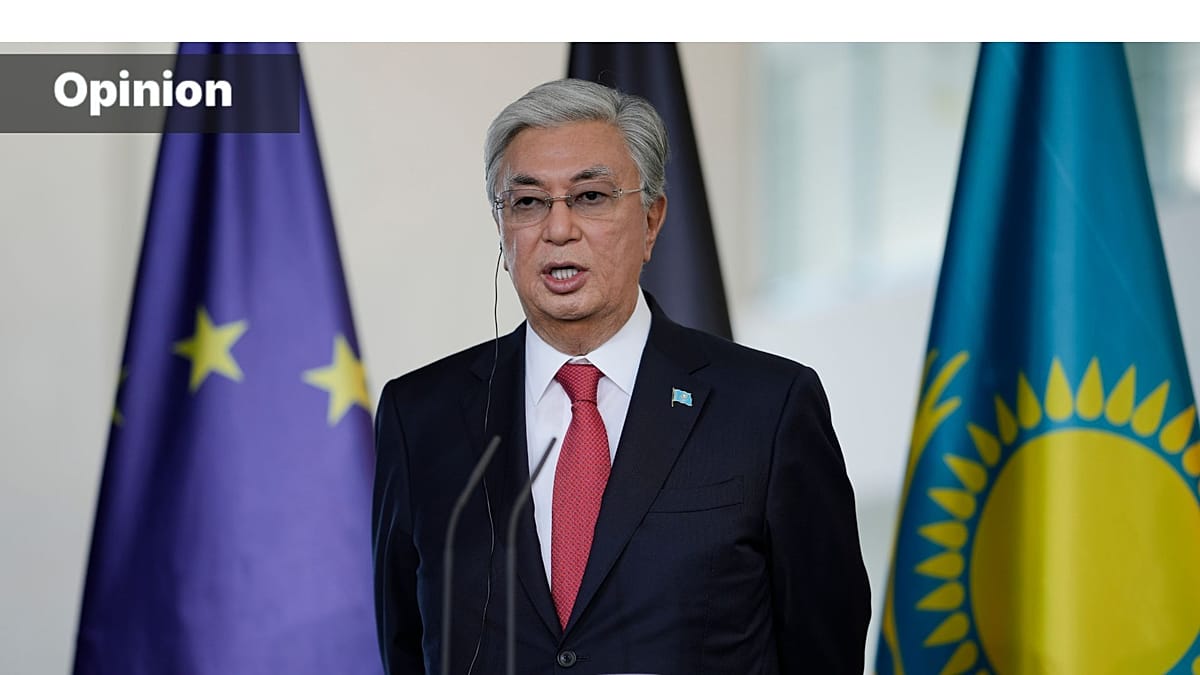
Ten years after the Enhanced Partnership and Cooperation Agreement (EPCA) came into force, the European Union remains Kazakhstan’s largest trading and investment partner. Thousands of European companies operate across the Central Asian nation, generating returns for Europe while helping to modernise and diversify the Kazakh economy. Yet President Kassym-Jomart Tokayev, writing for European Pulse, argues that this foundation is no longer sufficient in a rapidly shifting global landscape.
“I return to Brussels with an open motivation and a clear conviction: the partnership between Kazakhstan and the European Union matters more today than ever before,” Tokayev writes. “And that is why it must be strengthened.”
Three Strategic Goals for a New Chapter
Tokayev identifies three key objectives for the next phase of cooperation: strengthening resilience, expanding connectivity, and creating new opportunities for citizens. These goals reflect a world where geopolitical assumptions have collapsed. Resurgent competition is reshaping trade, technology, and investment flows. Global supply chains are newly vulnerable, and economic interdependence is increasingly viewed through the lens of national security.
“As Europe knows well, in such circumstances countries can either retreat into rival blocs or build new partnerships of mutual respect and shared interest,” Tokayev notes. Kazakhstan, situated at the intersection of continents, has long pursued a foreign policy aimed at connecting them.
This connecting role is backed by growing economic heft. In 2025, Kazakhstan’s economy expanded by 6.5%, with GDP reaching $306 billion. The IMF projects it will exceed $360 billion in 2026. A larger, more dynamic Kazakhstan, Tokayev argues, means a stronger partner for Europe at the heart of Eurasia.
Energy, Agriculture, and Critical Raw Materials
Energy security exemplifies the mutual trust already in place. Kazakhstan supplies nearly 13% of the EU’s petroleum-oil imports and 16% of its natural uranium. Tokayev asks why this model cannot be replicated in agriculture, where Kazakhstan is a major grain producer with strong potential for European markets seeking diversification. European know-how and investment could support higher-value-added agricultural processing in Kazakhstan.
The global transition toward sustainable growth also offers opportunities. Critical raw materials, renewable technologies, and energy efficiency are shaping future competitiveness. Kazakhstan can bring significant resources and industrial potential, provided Europe meets it with expertise, technologies, and investment. “Both our economies will grow, both will be more resilient,” Tokayev writes.
He calls for evolving the economic relationship beyond the traditional commodity-extraction-for-investment model toward a partnership that creates value at every stage through advanced processing, technology transfer, research partnerships, and joint ventures. The EBRD’s recent €255 million loan to boost Kazakhstan’s mineral processing capacity is a step in this direction.
Connectivity and the Middle Corridor
Connectivity is another pillar. Kazakhstan is developing the Middle Corridor between Europe and Asia, which aligns with the EU’s Global Gateway strategy. Tokayev sees this not merely as a faster route for goods but as the backbone of an emerging system linking Europe’s markets with Central Asia’s resources and logistics potential. “True connectivity – think the canals, sea lanes, and highways of antiquity – has always created value through opportunity,” he writes.
The partnership must also embrace digital technologies. Kazakhstan has set ambitious goals for digitalising public services, developing data-driven governance, and investing in artificial intelligence. Tokayev commits to close cooperation with European tech companies to ensure technological progress remains inclusive, secure, and human-centred. Kazakhstan’s deployment of AI in schools to bridge the urban-rural education gap illustrates this commitment.
Citizen Benefits and Visa Facilitation
Above all, a strategic partnership must tangibly benefit citizens. Significant progress is being made on a visa system that will enable easier travel for students, researchers, entrepreneurs, and families. Tokayev also calls for raising the bar on education, science, and innovation, building on Kazakhstan’s participation in EU programmes.
Tokayev’s message is clear: in an uncertain world, dependable partners are invaluable. Kazakhstan and Europe are already fellow travellers. The next chapter of their partnership, he argues, should deepen that journey together.