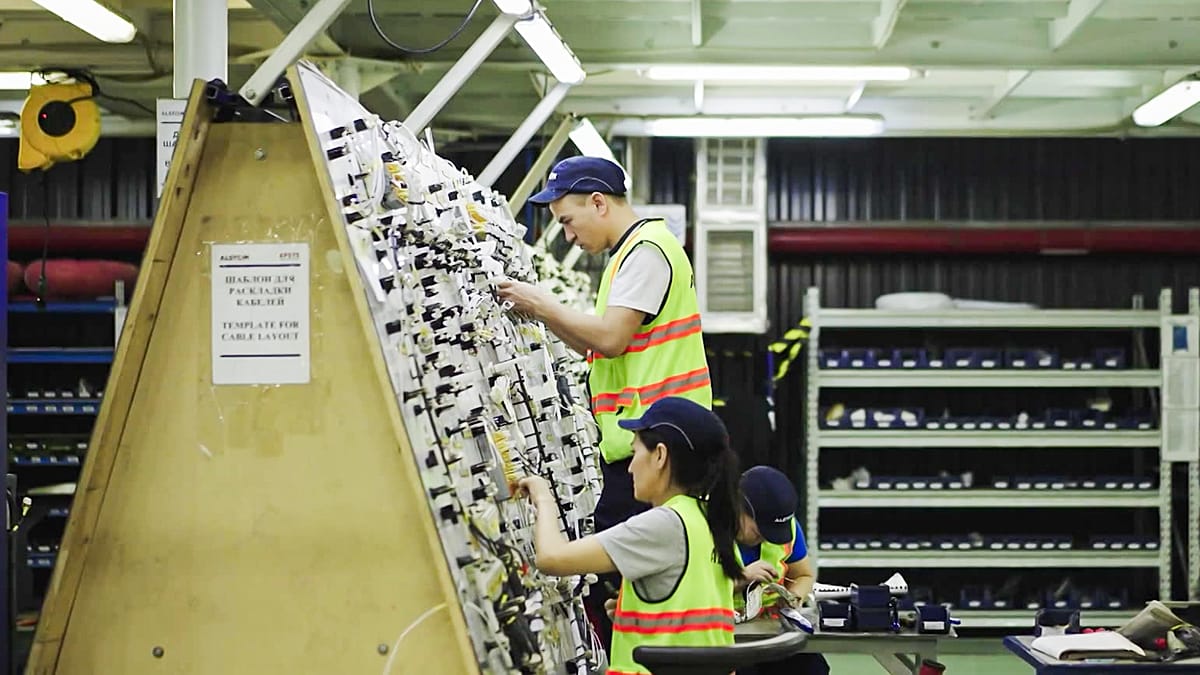
Kazakhstan is making a determined push to move beyond its traditional reliance on raw materials, with manufacturing now outpacing mining for the second consecutive year. The Central Asian country attracted around €16.5 billion in greenfield investment last year, accounting for nearly 90% of all such investment in North and Central Asia, according to the UN Economic and Social Commission for Asia and the Pacific (ESCAP).
The shift is visible in the latest data. In the first five months of the year, the non-oil economy grew by more than 5%, while industrial output reached €52 billion, up 2.5% year-on-year. Manufacturing accounted for 46.5% of industrial output, narrowly ahead of mining, according to the Ministry of Industry and Construction.
Azamat Panbayev, chairman of the industry committee at the ministry, said the trend reflects stronger performance at existing enterprises and the launch of new production facilities across the country. He stressed that the change is not due to weaker oil production — Kazakhstan produced a record 99.5 million tonnes of oil last year.
Investment pipeline and incentives
This year, Kazakhstan plans to implement more than 200 industrial projects worth over €2.5 billion across metallurgy, machinery manufacturing, construction materials, chemicals, and food processing. In the first half of the year, 77 projects worth around €526 million have already been commissioned.
Beyond these, the country has a pipeline of large-scale investments. Two automotive plants in Almaty and Kostanay, with a combined annual capacity of 190,000 vehicles, were completed last year. Work continues on expanding the country's largest steelmaker in the Karaganda region, and new production of gold, copper, potash, and mineral fertilisers is planned in western Kazakhstan.
Officials point to a stable legislative environment and investment incentives as key draws. The Astana International Financial Centre, which operates under English common law, offers corporate income tax incentives and other preferences. The state also provides long-term financing and guarantees through the national holding Baiterek, and helps promote investors' products both domestically and internationally.
Special economic zones as a magnet
Special Economic Zones (SEZ) are central to the strategy. More than 43% of industrial land within Kazakhstan's SEZs is occupied by investment projects, with 1,159 projects in total. The government is investing heavily in infrastructure, including raising over €1.1 billion from the Islamic Development Bank to improve the zones' operational efficiency.
Adilet Bektembayev, deputy chairman of QazIndustry, the state operator for manufacturing development, noted that the government has already invested around €1.1 billion in infrastructure on these sites, which has attracted over €14 billion worth of projects.
New legislation is expected to make the zones more attractive. Investors will be able to apply through a one-stop-shop system, with documents submitted electronically and distributed automatically to relevant authorities. The government is also considering involving professional developers and international operators to replace the current state-led management model, which Bektembayev says would raise competitiveness.
Sectors with the strongest potential
QazIndustry identifies three manufacturing sectors as the most promising. Machinery manufacturing is already well established, with local assembly of Korean and Chinese automotive brands, and a strong presence of American, French, and Swiss companies in railway engineering.
The chemical industry is another priority. A major polypropylene production project has been completed, and a hydrogen peroxide facility is under development. Light industry is also attracting attention, with a Chinese investor currently implementing a textile manufacturing project.
With manufacturing now outperforming mining for a second year, Kazakhstan sees higher-value production as key to reshaping its economy. Whether the transition gains further momentum will depend on continued investment in industrial projects, special economic zones, and export-oriented manufacturing.