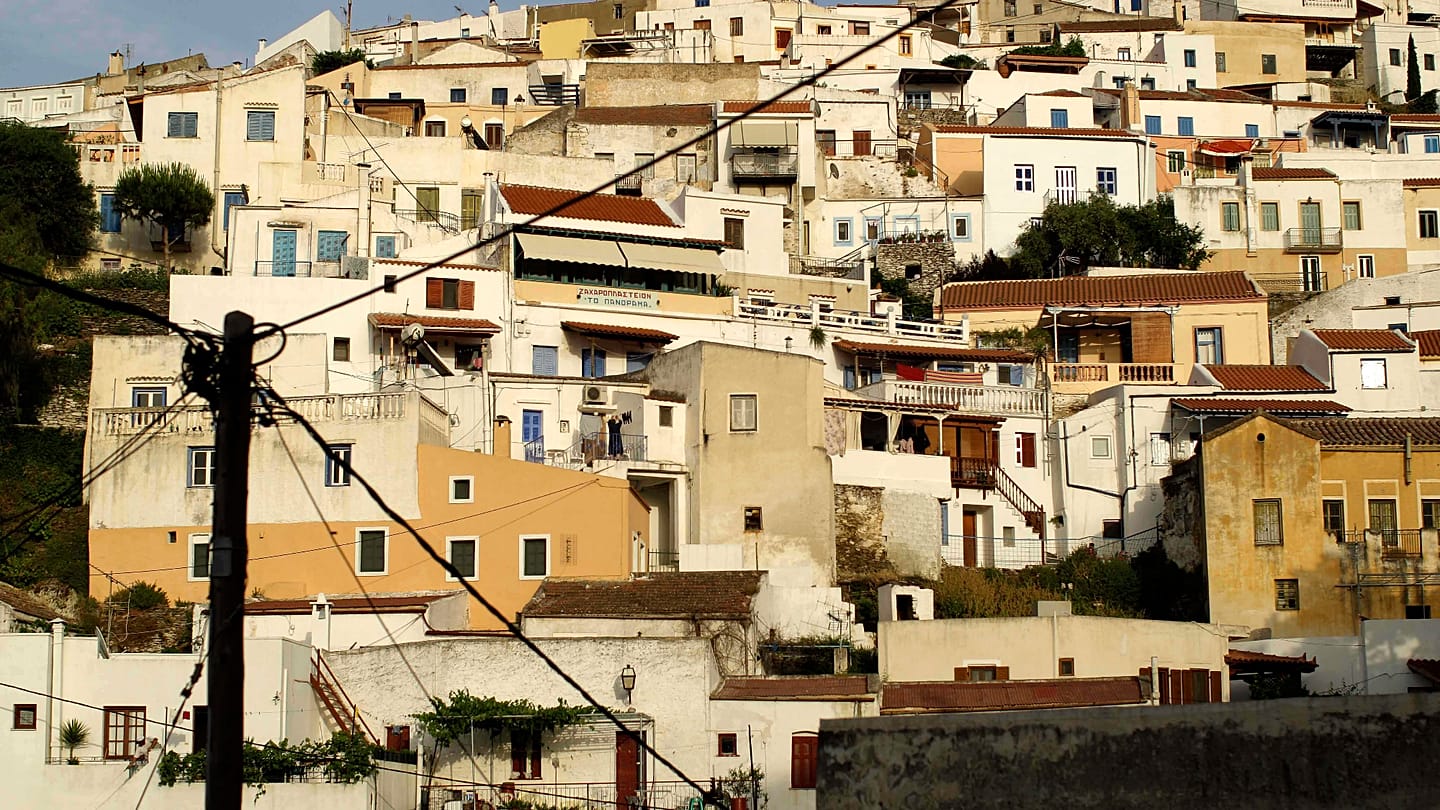
On the Cycladic island of Kea, a short ferry ride from Athens, the built environment tells a story of resilience and adaptation. With a permanent population of roughly 2,500, Kea has managed to hold onto its architectural character even as summer visitors multiply. The island's villages—Ioulis, Korissia, and Vourkari—offer a visual contrast to the stark white-and-blue stereotype of the Greek islands, instead presenting a palette of earthy stone, ochre, and terracotta.
A palette rooted in the landscape
Unlike the gleaming cubic houses of Santorini or Mykonos, Kea's traditional homes are built from local granite and schist, often left exposed or painted in muted pastels. Doorways and window frames are frequently picked out in deep blues, greens, or reds, a practice that likely evolved from natural pigments available on the island. The effect is a harmonious blend with the rocky terrain, punctuated by bursts of colour that catch the Mediterranean light.
Architectural historian Maria Papadopoulou, who has studied Cycladic vernacular buildings, notes that Kea's style reflects a pragmatic approach: “The thick stone walls keep interiors cool in summer and warm in winter, while the small openings reduce glare and heat. The colours are not merely decorative; they are part of a system of orientation and identity.”
Watermills: an engineering legacy
Perhaps the most distinctive feature of Kea's heritage is its network of watermills, which once harnessed the island's seasonal streams to grind wheat and barley. Many of these structures, now roofless and partially collapsed, dot the valleys near Ioulis. They are a reminder of a time when the island was largely self-sufficient, and their preservation has become a point of local pride.
In recent years, the municipality has undertaken restoration projects, supported by European regional development funds. One such mill, near the village of Ellinika, has been converted into a small museum, complete with working wooden gears. Visitors can see how the millrace channeled water to turn the wheel, a technique that dates back centuries.
Tourism and the pressure to modernise
Kea's popularity has grown steadily, particularly among Athenians seeking a weekend escape. The island's proximity to the capital—about an hour by high-speed ferry—has made it a convenient retreat. Yet this influx brings challenges. New construction, often in a generic modern style, risks eroding the very character that attracts visitors.
Local authorities have introduced strict building codes that mandate stone facades and traditional rooflines in designated areas. However, enforcement is uneven, and some landowners argue that the rules are too restrictive. The debate echoes across the Cyclades, where the tension between heritage preservation and economic development is a recurring theme.
Tourism remains a vital economic engine, as Greece's August tourism figures show, with foreign visitors leading growth. But for Kea, the goal is to attract a more discerning traveller—one who appreciates the island's quiet lanes and stone-built charm over beach bars and nightclubs.
A living heritage
Beyond the physical structures, Kea's architectural heritage is kept alive by its residents. Many families still maintain their ancestral homes, passing down knowledge of traditional building techniques. The island's annual “Kea Days” festival, held each September, includes workshops on dry-stone walling and lime plastering, drawing both locals and visitors.
As Greece grapples with broader issues of leisure affordability, Kea offers a model of sustainable tourism that prioritises cultural depth over volume. The island's architecture is not a museum piece but a living, evolving expression of its community.
For those who wander up the cobbled paths of Ioulis, past the Venetian-era towers and the old olive presses, the message is clear: Kea's beauty lies not in uniformity but in the layered history written in stone and colour. And as the island looks to the future, it does so with an eye on preserving what makes it distinct.