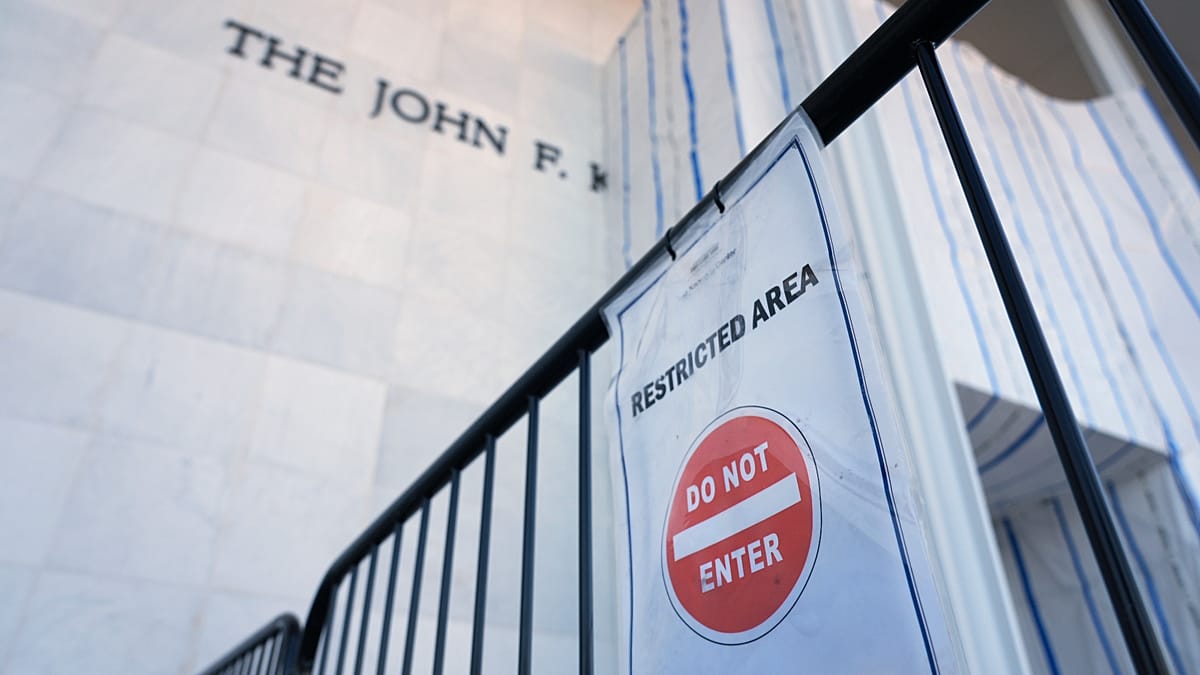
The John F. Kennedy Center for the Performing Arts in Washington, DC, will shut its doors for extensive renovations following a board vote on Tuesday, just hours after a federal judge once more blocked an attempt to rename the landmark venue after President Donald Trump.
US District Judge Christopher Cooper ruled that the Trump administration cannot install memorials or inscriptions honouring the president at the Kennedy Center without explicit approval from Congress. “Simply put, Defendants cannot install memorials for President Trump or anyone or anything else at the Kennedy Center without Congress’s blessing,” Cooper wrote in his latest decision.
Trump, who was installed as chairman of the Kennedy Center's board by loyalists last year, responded by reiterating that the $257 million (roughly €222.7 million) allocated by Congress for the repairs would only be released if the renaming were permitted to proceed. Federal courts have now twice ruled that such a condition cannot be met without legislative approval.
The dispute has thrown the future of one of America's most prominent cultural institutions into uncertainty. Since its opening in the 1970s, the Kennedy Center has hosted presidents, lawmakers, and artists from across the political spectrum, celebrating the best of American performing arts. The building, which began construction in 1965, is in dire need of modernisation; a partial ceiling collapse in its main hallway earlier this month intensified the urgency.
“The building is not currently built to last; the chairman knows that because he is among the best builders in the world,” said Brian Ballard, a Kennedy Center board member, in a statement.
A condition that divides
Trump's insistence on a physical recognition of his role in the renovation—reminiscent of his real-estate developer habit of emblazoning his name on buildings—has alienated long-time supporters of the institution and drawn repeated legal challenges. In August, the board voted to inscribe his name on the facade, reading “The John F. Kennedy Center for the Performing Arts Restored and Renovated By President Donald J. Trump.” If the Trump Kennedy Center Fund reached $100 million (about €86.7 million), a second inscription would be added: “Endowed by the Trump Kennedy Center Fund.” The plaza in front of the venue would also be renamed in his honour.
The Justice Department has appealed Cooper's latest ruling. Meanwhile, the board's decision to close the center for repairs—which could last several years—has raised concerns among fans and artists about the venue's long-term viability. Some worry the administration may push for demolition, especially after administration lawyers told the court last month that without presidential recognition, the Kennedy Center would struggle to raise private funds for the renovations.
The board meeting, held virtually, included tense exchanges between Trump and Representative Joyce Beatty, an Ohio Democrat who has led the campaign to block the renaming. Trump also announced on social media that he had personally contributed $17 million to an endowment supporting the institution.
This fight is a rare setback in Trump's broader effort to reshape the US capital in his gilded tastes. He has already demolished the East Wing of the White House to make way for a ballroom, plans a triumphal arch near Arlington National Cemetery, and is eyeing a golf course renovation along the Potomac River. The Kennedy Center dispute, however, shows the limits of executive power when it clashes with congressional prerogatives and judicial oversight.
For European observers, the episode underscores the fragility of cultural institutions when they become political battlegrounds. The Kennedy Center has long been a symbol of bipartisan support for the arts, and its closure—however necessary—will leave a void in Washington's cultural life. The coming months will reveal whether a compromise can be found, or whether the center becomes another casualty of America's polarised politics.