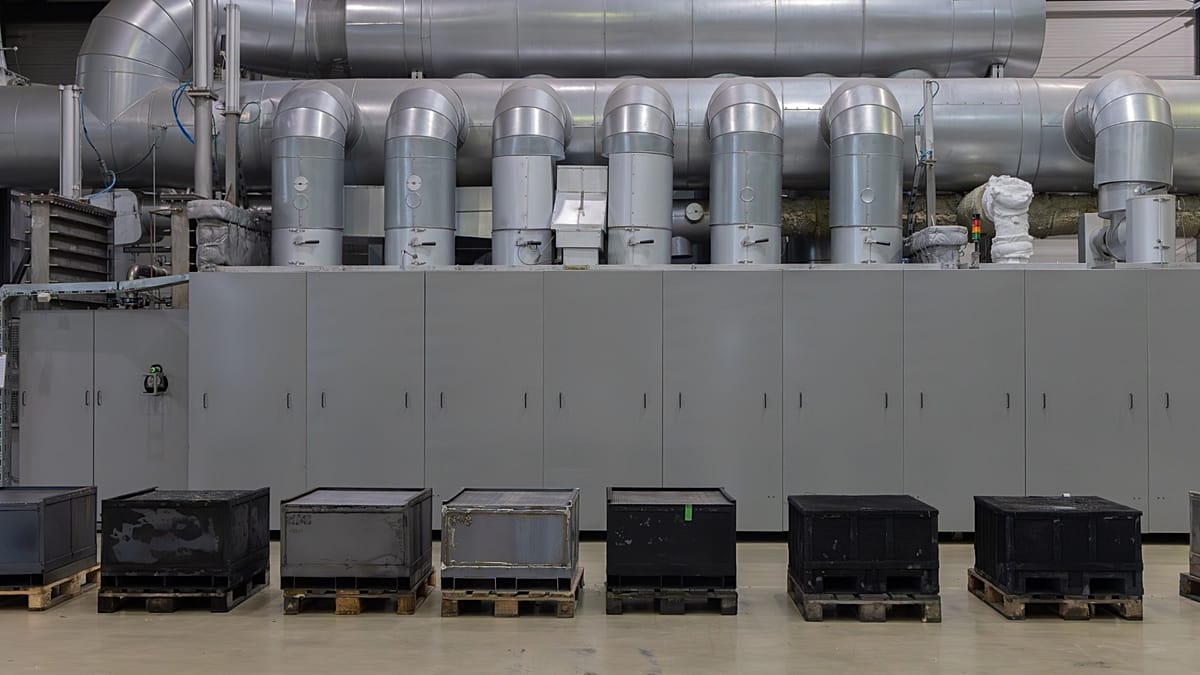
In Krefeld, a family-owned recycling firm is betting that water, not aggressive chemicals, can help loosen China's grip on Europe's lithium supply. Accurec Recycling GmbH, which has spent more than three decades in battery recycling, opened a new lithium recovery line in December 2025 that uses a thermal pre-treatment to make the metal soluble in water.
Simon Bremer, Accurec's head of development, told Euronews that the process, known internally as CLIMA, converts lithium into a water-soluble form while leaving the rest of the battery insoluble. He likened it to making filter coffee: pour water over the grounds, and the flavour compounds wash out, leaving the spent coffee behind.
The company currently processes about 5,000 tonnes of used batteries a year at its Krefeld site, with a second plant in Mülheim an der Ruhr. The new facility initially recovers 50% of the lithium in the batteries it handles, meeting the EU's 2027 recovery target. But Accurec is already scaling up: a €5.5 million investment will double the operating area and lift annual capacity to as much as 20,000 tonnes by 2027.
Europe's lithium gap
Europe remains heavily dependent on China for processed lithium. Bremer estimates that 65% to 70% of the battery-grade lithium chemicals used in the EU come from Chinese production. China has shown it can restrict exports of critical materials, as it did with rare earths and germanium, underscoring the vulnerability of European manufacturers.
Accurec does not claim its technology alone can solve Europe's raw materials challenge. But domestic recycling, Bremer argues, is a vital step toward diversifying supply and keeping valuable materials within the continent rather than shipping them abroad.
The company's process is also designed to be energy-efficient. Heat from the pyrolysis step is recovered and used to recrystallise the lithium salt, cutting energy use by nearly half and CO₂ emissions per tonne of lithium carbonate by more than 59%, according to Accurec.
The black mass bottleneck
Bremer points to a structural weakness in Europe's recycling industry: most plants produce only "black mass," an intermediate mix of lithium, nickel, and cobalt that still needs to be separated. With few facilities in Europe capable of that separation, much of the black mass is exported to Asia for further processing.
"The actual recovery of raw materials then takes place predominantly in China, and partly in Korea," he said. That means even recycled materials often leave Europe's supply chain, undermining the goal of a circular economy.
Accurec's new plant is designed to break that pattern by producing lithium carbonate directly from black mass. The company hopes its approach can complement broader EU efforts to secure critical raw materials, though Bremer acknowledges that policy support and investment in downstream processing are still needed.
As Europe pushes to electrify transport and store renewable energy, the question of where lithium comes from is becoming increasingly strategic. Battery storage is already proving its worth in places like Bulgaria, where it helped cushion a drought-hit power grid. But without domestic refining capacity, the continent risks swapping one dependency for another.
Accurec's expansion in Krefeld is a modest but concrete step toward closing that gap. Whether it can scale fast enough to make a real dent in China's dominance remains to be seen.