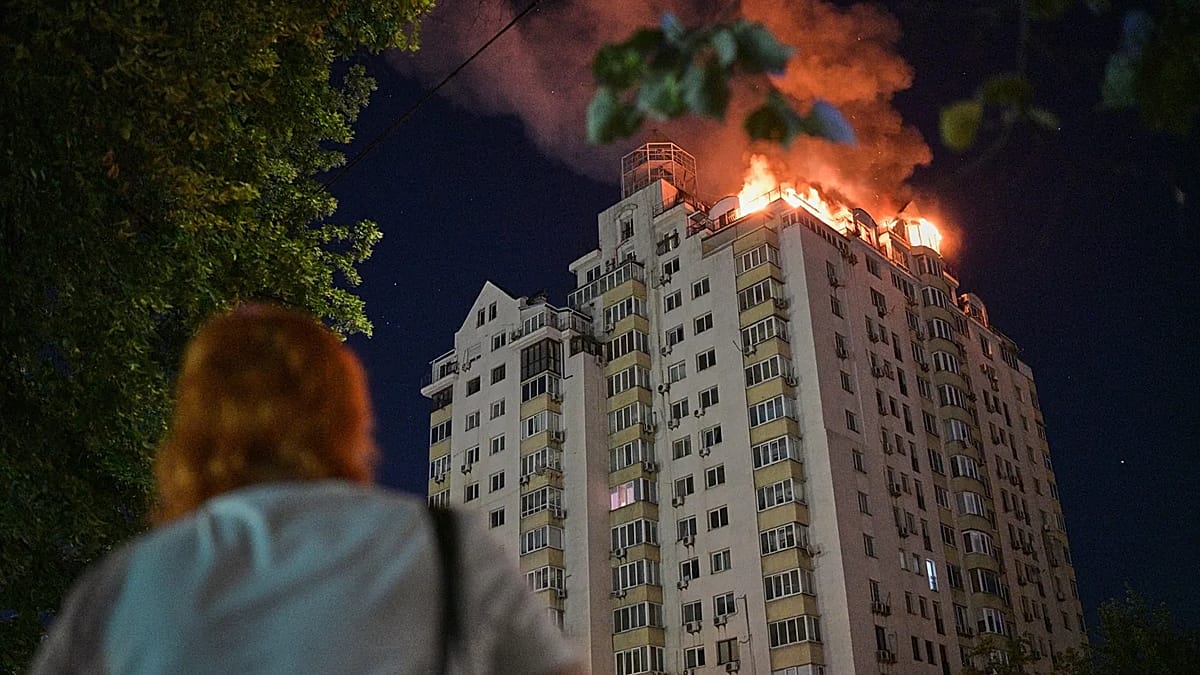
Ukraine's State Emergency Service announced on Friday that three additional bodies had been recovered from the rubble in Kyiv, bringing the official death toll to 30 following Russia's massive overnight assault on the capital earlier this week. The attack, which began on Wednesday night and continued into Thursday morning, involved a coordinated wave of missiles and drones that struck more than 20 locations across the city, injuring over 90 people. Kyiv's mayor described it as Moscow's "most massive attack" on the city since the full-scale invasion began.
Ukraine's air force reported that Russian forces deployed 570 air attack assets, including four Zircon hypersonic missiles, 24 Iskander ballistic missiles, and 496 Shahed-type drones. The scale of the barrage overwhelmed parts of Kyiv's air defense network, leading to significant damage in residential and civilian areas.
Humanitarian Warehouse Destroyed
The Ukrainian branch of the Red Cross confirmed that its humanitarian warehouse in Kyiv was completely destroyed in the strikes. The facility held approximately €1.5 million worth of aid and equipment, including medical supplies, food, and winter clothing intended for displaced families. The loss compounds the strain on humanitarian operations in a city already grappling with power outages and shelter shortages.
European officials reacted with outrage. EU High Representative for Foreign Affairs Kaja Kallas announced on Thursday that she would propose fresh sanctions targeting entities supporting Russia's military-industrial complex. "The more Moscow attacks civilians, the more sanctions must be imposed," Kallas said in a statement. The proposed measures are expected to be discussed at the next EU foreign ministers' meeting, with a focus on drone and missile component suppliers. This aligns with broader EU efforts to tighten restrictions, as seen in the EU's plan to sanction Russian drone manufacturers.
Regional Attacks Continue
Beyond Kyiv, Russian drone strikes hit the Romny area in Ukraine's northeastern Sumy region overnight Thursday. Oleh Hryhorov, head of the Sumy Oblast Military Administration, reported that a drone struck a residential building, killing two women and injuring one man. In the southeastern Zaporizhzhia region, 11 people were injured in separate attacks, according to Ivan Fedorov, the head of the Zaporizhzhia Oblast Military Administration.
Ukrainian President Volodymyr Zelenskyy used the attack to renew his call for accelerated deliveries of anti-ballistic missile defenses. Ukraine's stock of US-made Patriot interceptors is dwindling, and Zelenskyy warned that without adequate protection, Russian ballistic missiles will continue to inflict heavy civilian casualties. "If, of course, NATO still means anything to the allies, Europe must have its own sufficient capability to defend itself against all types of threats, including this one—Russian ballistic missiles," he said in a video address. The plea comes as NATO prepares for its upcoming summit in Ankara, where air defense commitments are expected to be a key agenda item, as highlighted in Kyiv Mourns After Russian Strike as NATO Prepares for Ankara Summit.
The attack also underscores the evolving nature of Russia's drone warfare. Moscow has increasingly deployed faster, jet-powered drones designed to overwhelm Ukrainian air defenses, a tactic detailed in Russia Deploys Faster Jet-Powered Drones to Overwhelm Ukraine's Air Defenses. The combination of ballistic missiles and advanced drones poses a growing challenge for Kyiv's defenders, who are already stretched thin across a 1,000-kilometer front line.
In response to the strikes, Ukraine has urged its Western partners to expedite the delivery of promised air defense systems. The urgency is echoed in Ukraine Urges Faster Air Defense Deliveries After Deadly Russian Strike on Kyiv, as each delay translates into more civilian casualties. The international community, including the EU and NATO, faces mounting pressure to translate outrage into concrete military support.