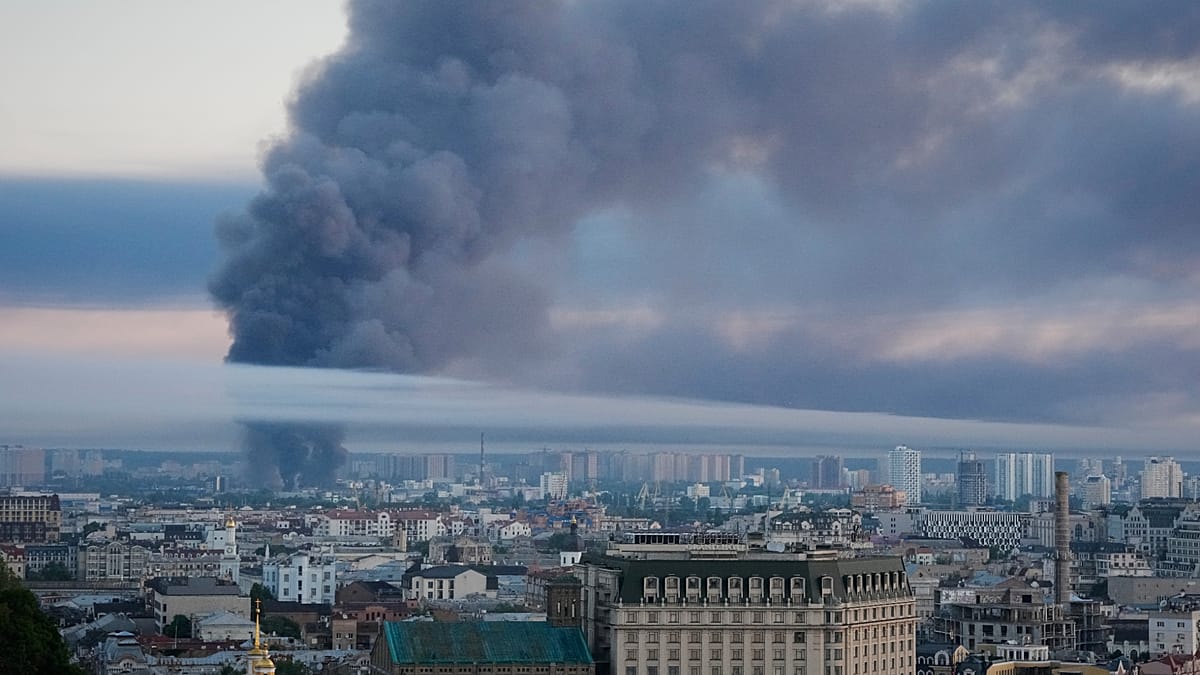
Russia is intensifying its aerial campaign against Ukraine by deploying a new generation of jet-powered drones that are significantly harder to intercept. These faster unmanned aerial vehicles (UAVs) are being used in mass attacks, often launched in hundreds within hours, placing increasing strain on Ukraine's already stretched air defenses.
According to Colonel Yurii Ihnat, spokesperson for Ukraine's Air Force, Moscow is now operating these jet-powered drones "virtually around the clock" alongside older propeller-driven models. The new drones can reach speeds of up to 500 km/h, far exceeding the 300 km/h maximum of Ukraine's interceptor drones. "These drones are no longer within the reach of interceptor drones," Ihnat stated. "That means mobile fire groups and anti-drone interceptors can no longer be relied upon. Missiles have to be used, and that is what the Air Force and other units of the defence forces are doing."
A Shift in Tactics and Technology
Ukraine's Commander-in-Chief, General Oleksandr Syrskyi, noted in early June that Russia is constantly adapting its UAV tactics, increasing both the quantity and quality of its drones. "The aggressor plans to raise the share of jet-powered strike drones to 50%," Syrskyi said, acknowledging that this makes it harder for Ukrainian defenses to "respond effectively."
Until recently, most Russian Shahed drones and other attack systems were neutralized by Ukrainian interceptors. However, Moscow has ramped up domestic production of Shahed-type drones, known as Geran, and focused on developing faster variants. In September 2025, Ukraine's military intelligence agency HUR revealed details about the Geran-3, a turbojet-powered drone capable of speeds up to 370 km/h with a range of 1,000 km. Unlike the propeller-driven Geran-2, the Geran-3 dives toward its target and detonates on impact.
By January 2026, HUR reported the first use of an even more advanced model, the Geran-5. This drone is approximately 6 meters long with a wingspan of 5.5 meters and features a Telefly jet engine that produces greater thrust than the Geran-3. Unlike earlier models based on Iranian Shahed drones, the Geran-5 is built in a conventional aerodynamic configuration. It carries a 90 kg warhead and has a claimed range of nearly 1,000 km, meaning it could reach any point in Ukraine. HUR also noted that Russia considered fitting attack aircraft such as the Su-25 with Geran-5s to extend their range.
The growing reliance on jet-powered drones is part of a broader Russian strategy to deplete Ukraine's missile stocks. As Ihnat explained, intercepting these faster drones requires expensive surface-to-air missiles, which are in limited supply. This tactic mirrors Russia's approach of using mass drone and missile barrages to overwhelm Ukrainian defenses, a pattern seen in recent strikes on Kyiv and other cities.
For European observers, the escalation underscores the ongoing vulnerability of Ukraine's airspace and the critical need for continued Western support. The conflict has also highlighted the broader implications for European security, as drone technology evolves rapidly. In parallel, Ukrainian drone strikes have targeted Russian oil infrastructure, as detailed in our report on the Russian petrol crisis, demonstrating the reciprocal nature of this aerial warfare.
As Russia pushes to make jet-powered drones a larger share of its arsenal, Ukraine's ability to adapt will be crucial. The shift not only challenges Kyiv's current defense systems but also signals a new phase in the technological arms race over the skies of Europe.