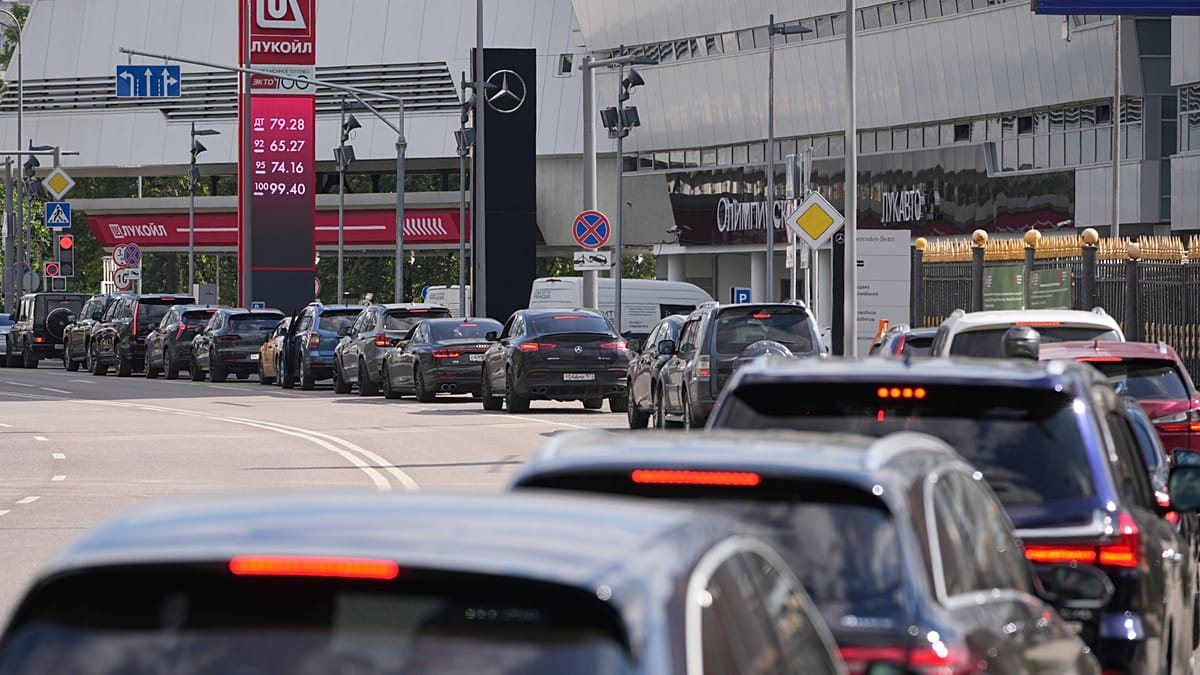
Russia's months-long petrol crisis has brought the consequences of its full-scale invasion of Ukraine home to ordinary citizens, as Ukrainian drone attacks continue to cripple refineries and disrupt fuel supplies nationwide. Queues at petrol stations are growing longer, public anger is mounting, and in many regions fuel is now rationed.
Social media is filled with videos of drivers expressing shock at the lines they encounter or arguing over empty pumps and rising prices. "Television says one thing, reality is another. People are queuing everywhere," said Andrei, a Moscow resident. Another Muscovite, Maxim, described spending hours in line: "A country that produces oil, yet there is no petrol. How is that even possible?"
Putin's Rare Admission
By the end of June, reports of restrictions on petrol sales had come in from more than half of Russia's regions. In some areas, authorities imposed strict limits on all petrol stations; elsewhere, major chains introduced caps on the amount they dispense. President Vladimir Putin made a rare public concession, admitting that Ukrainian "attacks on our facilities are undoubtedly creating problems" and that Russia was "seeing a certain shortage," while insisting the situation was not critical.
According to Christopher Weafer, chief executive of Macro-Advisory, around one-third of Russia's refining capacity has been knocked out. Weafer based his estimate on fragmented information and industry sources, as the Russian state does not make relevant data public. He noted that the crisis "comes at a critical moment for the Russian economy, as the agricultural season and especially the harvest period is now gathering pace," with the farm sector having "a high demand for diesel fuel."
Repairing damaged refineries is complicated by Western sanctions. Ukrainian strikes have targeted specialised imported equipment, and sourcing replacements or spare parts around restrictions has made repairs slow and expensive. Weafer said the Moscow refinery alone—which had supplied 40% of the capital and surrounding region's petrol—would take at least three months to fix.
The volume of crude oil processed into petrol in Russia in June fell by 25% compared with the same period last year, to 3.95 million barrels per day—the lowest level in more than two decades. Petrol production dropped by 17%, to 850,000 barrels per day (from 1.03 million barrels a year earlier), well below domestic demand. Russia exports only relatively small volumes of petrol.
Ukraine's 'Sanction-Style' Campaign
Since April, Ukraine has carried out more than 40 attacks on refineries, oil depots, terminals and other oil infrastructure in Russia and the Moscow-occupied Crimean peninsula. Ukrainian officials describe these strikes as a campaign intended to force Moscow to end the war by undermining its military logistics and supply lines. On Wednesday, Ukraine's Defence Forces struck the refinery in Ufa for the second time, President Volodymyr Zelenskyy announced.
"For the second time, our sanction-style responses to Russia prolonging the war have reached the refinery in Ufa—one of Russia's largest producers of lubricating oils. The distance is more than 1,300 kilometres from the front line," Zelenskyy wrote on Telegram. "Every day we implement our plan for applying Ukraine's long-range sanctions. This is a completely fair response to everything Russia is doing against us." He concluded: "Peace is needed, and this is what the Russian leadership must realise. Russia has to end its war—and its leaders have every opportunity to do so."
Officials in Moscow have blamed the shortages on panic buying and urged motorists to fill up only when necessary. Exports of petrol and aviation fuel were curtailed, and a ban on diesel exports was also under consideration. For more on Ukraine's strategy, see Ukraine Strikes Ufa Refinery Again as Zelenskyy Calls for Peace Through Pressure.
The crisis underscores the broader impact of the war on Russia's economy and society, as the conflict enters its third year. For context on the human toll, read Russian Strikes Kill Two in Kyiv After Zelenskyy Warns of Imminent Assault.