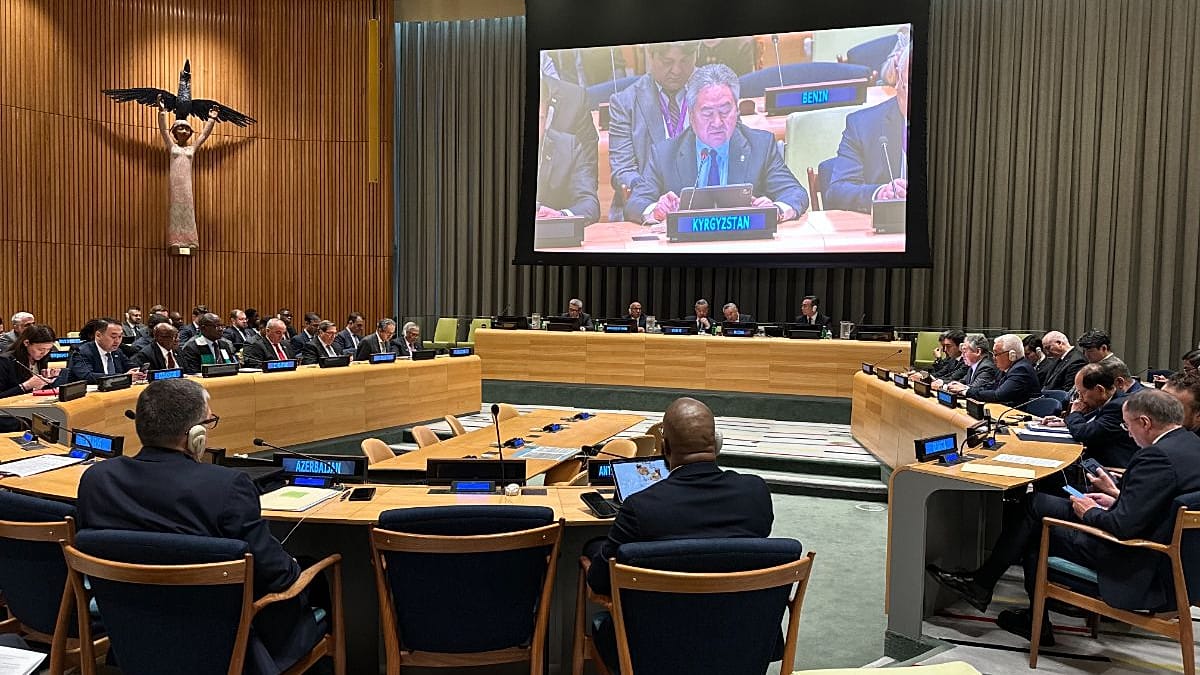
Kyrgyzstan's Foreign Minister Jeenbek Kulubaev has made a strong case for reforming the United Nations Security Council (UNSC), urging the inclusion of more seats for Asia, Africa, and Latin America. Speaking during his country's bid for a non-permanent seat on the council, Kulubaev emphasized that the current composition fails to reflect the geopolitical realities of the 21st century.
“The foreign minister advocated strengthening the central coordinating role of the UN, based on the principles of international law, sovereign equality of states, mutual respect, and non-interference in internal affairs,” the Kyrgyz foreign ministry said in a statement. “Special attention was given to the relevance of reforming the UN Security Council by expanding the representation of countries from Asia, Africa, and Latin America.”
Kulubaev’s remarks come as the UN General Assembly has debated Security Council reform since 1993, with formal negotiations dragging on for nearly three decades without a breakthrough. Africa and Latin America currently hold no permanent seats on the 15-member council, despite Africa representing roughly 25 percent of the UN’s 193 member states. Several proposals have been floated over the years, including expanding the council to up to 26 seats, with six additional permanent seats reserved for Africa, Asia, Latin America, and Western Europe. Other ideas include longer rotating terms for more countries.
The current five permanent members—the United States, the United Kingdom, France, Russia, and China—retain veto powers established after World War II. In October 2025, UN Secretary-General António Guterres told the council that reform was “imperative and long overdue,” noting that expansion was key for Africa, Latin America, the Caribbean, and the Asia-Pacific, which bear much of the burden of peacekeeping but have little formal power.
Kyrgyzstan’s Vision for a More Inclusive UNSC
Kulubaev argued that the UNSC should not be perceived as a “closed club” and that its decisions must take into account the interests of all countries. He stressed that no single state can address modern-day threats alone, from armed conflicts and violations of international law to climate risks, food and energy insecurity. “Multilateral diplomacy is critical,” he said.
In its reform pitch, Kyrgyzstan advocated for more equitable representation of developing, small, and landlocked countries. The foreign minister outlined key priorities should his country be elected to the UNSC, including advancing sustainable peace, preventive diplomacy, protecting vulnerable populations, climate security, and strengthening trust among states. “Kyrgyzstan views participation in the Security Council as an opportunity to make a practical contribution to strengthening multilateral cooperation, preventing conflicts, and enhancing joint international efforts to address traditional and emerging threats, including terrorism, transnational crime, cyber threats, climate change, and epidemics,” the foreign ministry said.
Kulubaev further noted that, if entrusted by the international community, Kyrgyzstan would serve as a reliable partner committed to international law, the UN Charter, and the dignity of every individual. The call for reform echoes similar demands from other Central Asian nations and aligns with broader global discontent over the council’s outdated structure.
For European readers, the debate over UNSC reform has direct implications. France, as a permanent member with veto power, has historically supported expansion, but the process remains stalled. The issue also touches on Europe’s role in global governance, particularly as the EU seeks to assert itself as a unified actor on the world stage. Meanwhile, the UK and France face pressure to cede some of their privileged positions to better reflect the continent’s diversity. The ongoing discussions about UN reform are part of a larger conversation about international institutions adapting to a multipolar world, where emerging powers from Asia, Africa, and Latin America demand a greater say.
As Kyrgyzstan pushes for change, the question remains whether the permanent members will agree to dilute their own power. The coming years will test the willingness of the international community to overhaul a system designed in 1945.



