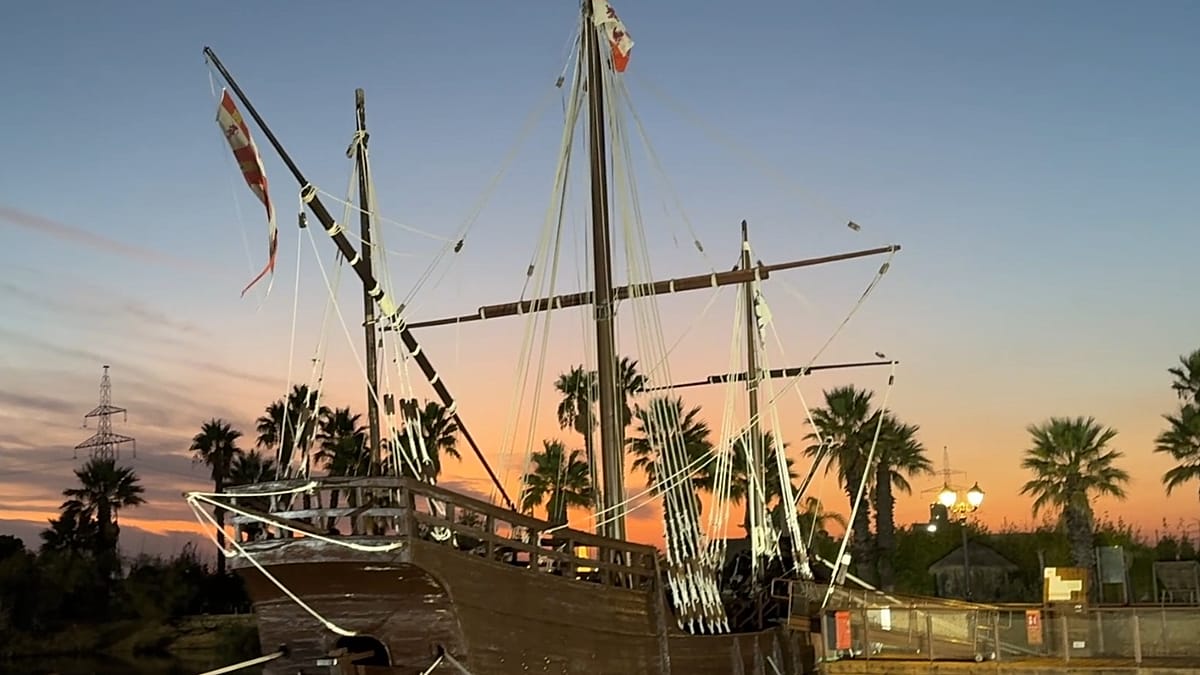
In the annals of European seafaring, few episodes carry the weight of the first Spanish foothold in the Americas. On Christmas Eve 1492, Christopher Columbus's flagship, the Santa María, ran aground on a reef off the northern coast of Hispaniola. The admiral turned disaster into a makeshift settlement, ordering his crew to dismantle the wreck and use its timbers to raise a fort he named La Navidad. Thirty-nine men stayed behind. By the time Columbus returned on his second voyage, all were dead and the fort was ashes. Five centuries later, archaeologists still cannot say with certainty where it stood.
A chain of errors on a calm sea
The loss of the Santa María was no act of God but a cascade of human mistakes. Columbus, exhausted after two days without sleep, had retired to his cabin, leaving the helm to a sailor who, seeing a placid coastline, handed the tiller to a cabin boy—a practice the admiral had expressly forbidden. Around midnight, the ship drifted onto a shoal so gently that few aboard noticed. The boy felt the rudder scrape, heard the sea hiss, and raised the alarm. Columbus leapt from his berth, but the tide was already falling.
He ordered the mainmast cut to lighten the vessel and sent Juan de la Cosa, the ship's master and owner, to carry an anchor out in the skiff. De la Cosa instead rowed toward the nearby Niña, a decision that sealed the Santa María's fate. The hull split, and Columbus transferred his crew to the Niña, waiting for dawn.
At first light, he sent messengers to Guacanagarí, one of the five Taíno chiefs on the island. The cacique, according to later accounts, wept at the news and dispatched his people in large canoes to help unload the ship. Columbus wrote to the Catholic Monarchs that he had never known "better people or better land."
With the vessel beyond repair, Columbus decided to leave a garrison. He believed gold was plentiful, and the loss of one ship made it necessary to reduce his fleet. Around 26 December, his men built a fort from the Santa María's planks and nails, large enough for 39 people. Historian Carlos Martínez Shaw notes that the ship's log itself records the breaking up of the hull and the fort's construction. To impress the Taínos, Columbus ordered cannon fire at the wreck. On 30 December, Guacanagarí seated him on a palm platform and placed his own crown on the admiral's head.
The 39 men, under the command of Diego de Arana, included a surgeon, three craftsmen, a gunner, a tailor, and the king's pantry steward, Pero Gutiérrez. Their mission was to trade with the Taínos and locate the gold mines. Columbus sailed for Castile in early 1493, leaving them to their fate.
What became of the first settlement
When Columbus returned on 27 November 1493, with 17 ships and some 1,500 men, he found the fort burned and the Spaniards dead, many disfigured. Guacanagarí blamed a rival chief, the so-called lord of the mines. Historians still debate whether the cacique who had welcomed them had a hand in the massacre. Columbus did not rebuild La Navidad; he founded a new settlement, La Isabela, elsewhere on the island.
The most promising archaeological lead emerged in 1977, when an American missionary doctor and amateur archaeologist, William Hodges, was shown elaborate Taíno pottery by his patients. He identified a site called En Bas Saline in northern Haiti, close to where the Santa María went down. The Florida Museum of Natural History, working with Haiti's Bureau National d'Ethnologie, excavated there between 1983 and 1988 and returned in 2003. They uncovered 276 square metres, revealing a large structure burned at the end of the 15th century. Researchers now believe En Bas Saline was Guacanagarí's village and the probable site of La Navidad.
Among the animal remains, they found the first trace of the black rat from the Old World on the island—a telling sign of European contact. Yet definitive proof remains elusive. No timber from the fort has been conclusively identified, and the exact coordinates of this pivotal chapter in European expansion continue to resist the spade.
The mystery endures, a reminder that even the most celebrated voyages leave traces that time can erase. For those who follow the arc of European exploration, La Navidad stands as a ghost on the map—a place where history began, and where archaeology has yet to catch up.