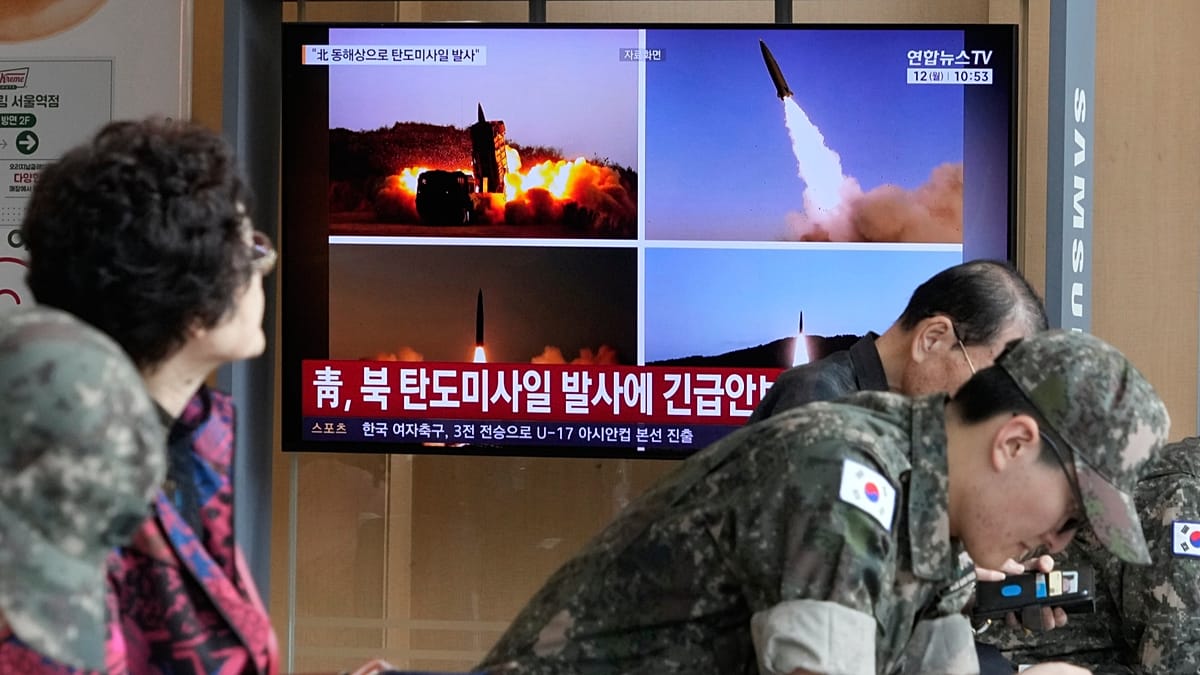
North Korea fired several ballistic missiles into the Sea of Japan on Monday, according to South Korea's Joint Chiefs of Staff (JCS), escalating tensions that have simmered since a landmine blast wounded three South Korean soldiers in the Demilitarised Zone (DMZ) last month.
The JCS said the missiles were launched from the Pyongyang area at around 09:20 local time (02:20 CET) and flew more than 900 kilometres before landing in the East Sea, as the Sea of Japan is known in the region. Japan's defence ministry separately confirmed the launch of at least one suspected ballistic missile.
"Our military has stepped up surveillance and vigilance against possible additional launches," the JCS said in a statement. South Korea's National Security Office convened an emergency meeting to review military readiness, while Seoul and Washington began analysing the exact specifications of the weapons.
DMZ landmine dispute fuels tensions
The latest launch comes after weeks of friction over an explosion in the DMZ that injured three South Korean soldiers. A joint Seoul-UN investigation concluded that North Korea had planted the landmines, a finding Pyongyang has angrily denied. Kim Yo-jong, the powerful sister of leader Kim Jong-un, dismissed South Korean demands for an apology as "despicable" and rejected an offer of medical equipment from Seoul.
On Thursday, she said Seoul must show "utmost respect" if it hopes to mend ties, adding that the North expects "consideration and sincerity" in every word and deed. The two Koreas remain technically at war, as the 1953 armistice that ended the Korean War was never followed by a peace treaty.
Missile tests and AI claims
The missile launch follows a series of duelling tests. On 3 October, Pyongyang test-fired an intermediate-range ballistic missile that Kim Yo-jong said employed unspecified artificial intelligence technology and was "capable of changing its flight orbit at a low altitude." Days later, Seoul announced it had successfully tested a domestically produced hypersonic glide vehicle (HGV), a weapon that rides rocket boosters into the upper atmosphere before gliding to its target. The presidential Blue House said the HGV offers "a new deterrence capability capable of striking key targets within the Korean Peninsula's operational environment."
The rising tensions come as US President Donald Trump's recent overtures to Pyongyang have raised concerns in Seoul that Washington's ally could be sidelined in potential nuclear talks. In October, North Korea launched several short-range ballistic missiles a day after Trump suggested he might meet Kim Jong-un this year.
For Europe, the Korean peninsula remains a distant but volatile flashpoint. The EU has repeatedly called for dialogue and denuclearisation, and any escalation could have global economic and security implications, particularly for supply chains and maritime routes in the region. As Seoul and Tokyo coordinate their responses, the international community watches closely.