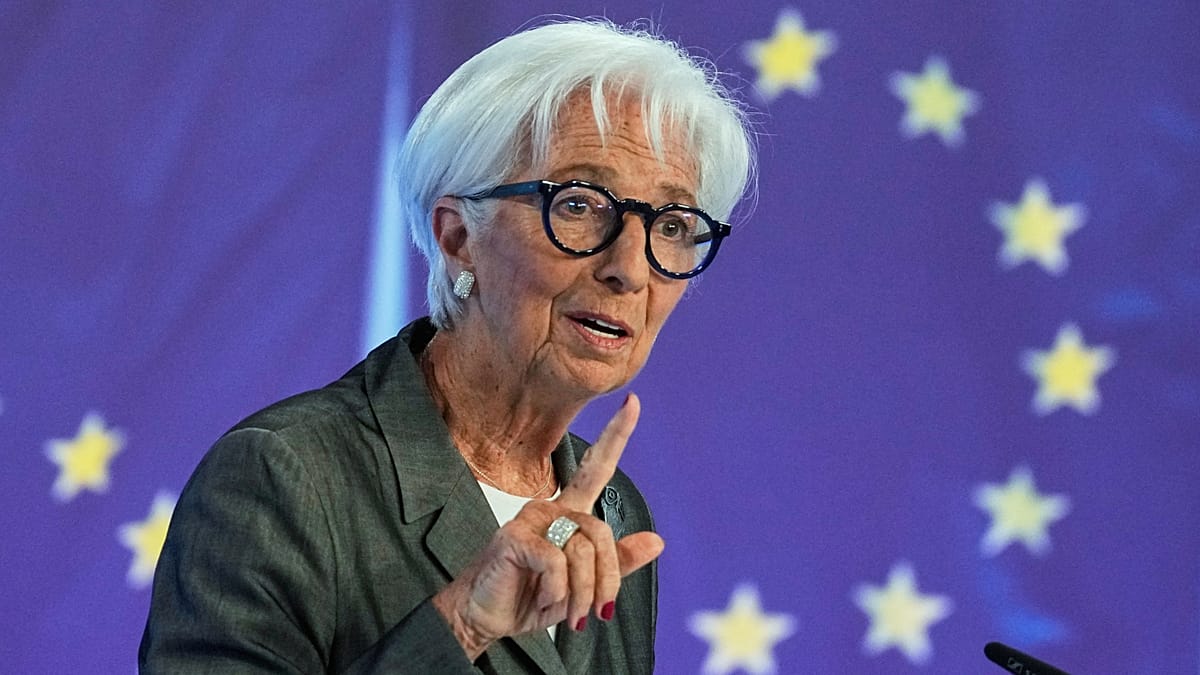
Europe cannot afford to repeat the mistakes of the first digital revolution, European Central Bank President Christine Lagarde warned on Wednesday, urging the bloc to dismantle the market fragmentation that is holding back its artificial intelligence ambitions.
Speaking to the International Business Council of the World Economic Forum in Geneva, Lagarde said the EU has the raw ingredients to compete with the United States and China in AI, but is being held back by legal and financial barriers that prevent companies from scaling across borders.
"Europe largely missed out on the first digital revolution, as the commercial gains from the spread of information and communication technologies were captured disproportionately elsewhere. We cannot afford to repeat that experience with artificial intelligence, the second digital revolution," she said.
Her remarks echo the landmark report by her predecessor, Mario Draghi, which in 2024 identified AI as Europe's last chance to rejoin the global technology race. The European Commission has since launched several initiatives to boost AI adoption in strategic sectors and to fund the construction of massive data centres.
Capital markets remain the weak link
Lagarde stressed that access to capital is the most pressing constraint on European AI investment. Unlike US firms, which can tap deep public markets, European companies rely heavily on bank credit, while national capital markets remain too small and fragmented.
"Legal fragmentation creates practical barriers for firms in terms of costs, timings and their ability to operate across borders," she said. As a result, a European company faces more hurdles to scale up than a US rival, and may end up turning to non-EU capital markets to solve the problem.
"Scale is particularly important as new technologies reshape the sources of productivity growth," Lagarde added.
The ECB president pointed to encouraging signs that European firms are already investing in AI. Euro-area companies expect to allocate around 9% of their total investment to AI this year, according to survey evidence she cited.
Europe also has a strong research base: it accounts for about 6% of the world's population but 15% of its researchers, and produces nearly one-fifth of the most-cited scientific publications globally.
The challenge, Lagarde argued, is converting that knowledge into commercial success that spreads the technology across the economy. "Too often, the barriers that prevent firms from scaling also hold back that diffusion," she said.
Reforms on the table
Lagarde called for speeding up key reforms currently under negotiation in Brussels, notably the Savings and Investment Union (SIU) and the proposed EU-wide company structure known as EU Inc.
The SIU is a package of legislation aimed at creating more integrated capital markets. Lawmakers hope to reach a deal by the end of the year, though significant divisions remain among member states, particularly over the centralised supervision of capital markets.
EU Inc. would offer an optional, EU-wide legal structure for companies, making it faster and cheaper for startups to incorporate and operate across borders, sidestepping the current patchwork of 27 national systems. That file is also expected to be approved by the end of the year.
Lagarde's intervention comes as the EU faces mounting pressure to keep pace in AI, with the US and China pouring billions into the technology. The bloc's fragmented single market has long been identified as a drag on innovation, and the ECB chief's warning adds to a growing chorus of voices calling for deeper integration.
For Europe to truly compete, Lagarde said, it must turn its research strengths into scalable businesses. The window of opportunity, she implied, is narrow.