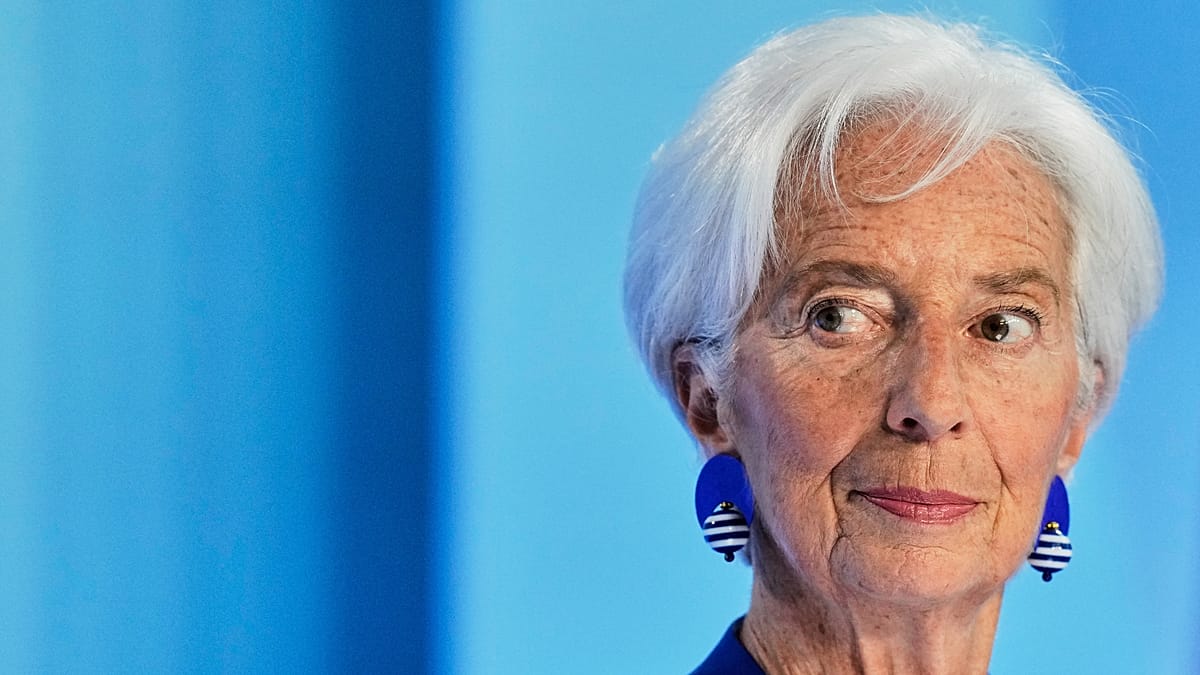
Christine Lagarde has announced she will leave her post as president of the European Central Bank on 7 February 2027, cutting short her mandate by almost nine months. The decision, confirmed on Thursday, comes amid persistent speculation that she could enter French politics ahead of the country's presidential election in April 2027.
In an exclusive interview with Euronews in July, Lagarde dismissed such talk outright. “I’m not a candidate for anything, but I’m very keen that Europe is protected, that Europe is the framework within which member states operate, including France,” she said. Her remarks were made as rumours swirled about a possible bid for the Élysée, fuelled by her past as a French finance minister and her high profile on the global stage.
An early exit from Frankfurt
Lagarde's departure will come more than half a year before her term was due to end in October 2027. The announcement adds an element of uncertainty to the ECB's leadership transition, coming at a time when the institution is navigating the final stretch of its inflation fight. The central bank recently held rates at 2.5%, with inflation still hovering near double the target.
Her early exit will trigger a succession process that is likely to become a focal point of intra-EU bargaining. The next president will need to balance the monetary hawks of the north with the more growth-oriented southern members, all while maintaining the ECB's credibility in global markets.
A career marked by firsts
Before taking the helm at the ECB in 2019, Lagarde served as managing director of the International Monetary Fund. Earlier, she was France's finance minister under President Nicolas Sarkozy, becoming the first woman to hold that portfolio in any G7 country. She steered France through the 2008 financial crisis, earning a reputation for steady crisis management.
Her tenure at the ECB has been defined by unconventional challenges: the pandemic, the energy shock from Russia's war in Ukraine, and the sharpest inflation spike in decades. While she has faced criticism from some quarters for being too slow to tighten policy, her defenders point to the difficulty of navigating overlapping crises.
What next for Lagarde?
In her July interview, Lagarde stressed the importance of reason prevailing in the run-up to the French vote. “I hope that reason will prevail,” she said, without elaborating on what role she might play. Her early resignation has only intensified speculation that she is preparing to enter the political fray, though she has consistently denied any such intention.
If she were to run for the French presidency, she would enter a crowded field. The current political landscape in France is fragmented, with no clear frontrunner for 2027. Lagarde's international stature and her record as a crisis manager could appeal to centrist voters, but her long absence from domestic politics might prove a handicap.
For now, Lagarde remains focused on her remaining months at the ECB. She is expected to oversee the final phase of monetary normalisation and to ensure a smooth handover to her successor. The search for that successor is likely to begin soon, with names such as François Villeroy de Galhau, the governor of the Banque de France, and Philip Lane, the ECB's chief economist, already being floated.
Her early exit also raises questions about the timing of the next ECB president's appointment. EU leaders will need to agree on a candidate, a process that often involves delicate horse-trading between member states. The decision will be closely watched by financial markets, which value predictability in the institution's leadership.
As Lagarde prepares to leave Frankfurt, her legacy is still being written. She has been a vocal advocate for European integration, often reminding governments that the EU is the framework within which they must operate. Whether she will continue that advocacy from a different stage remains an open question.