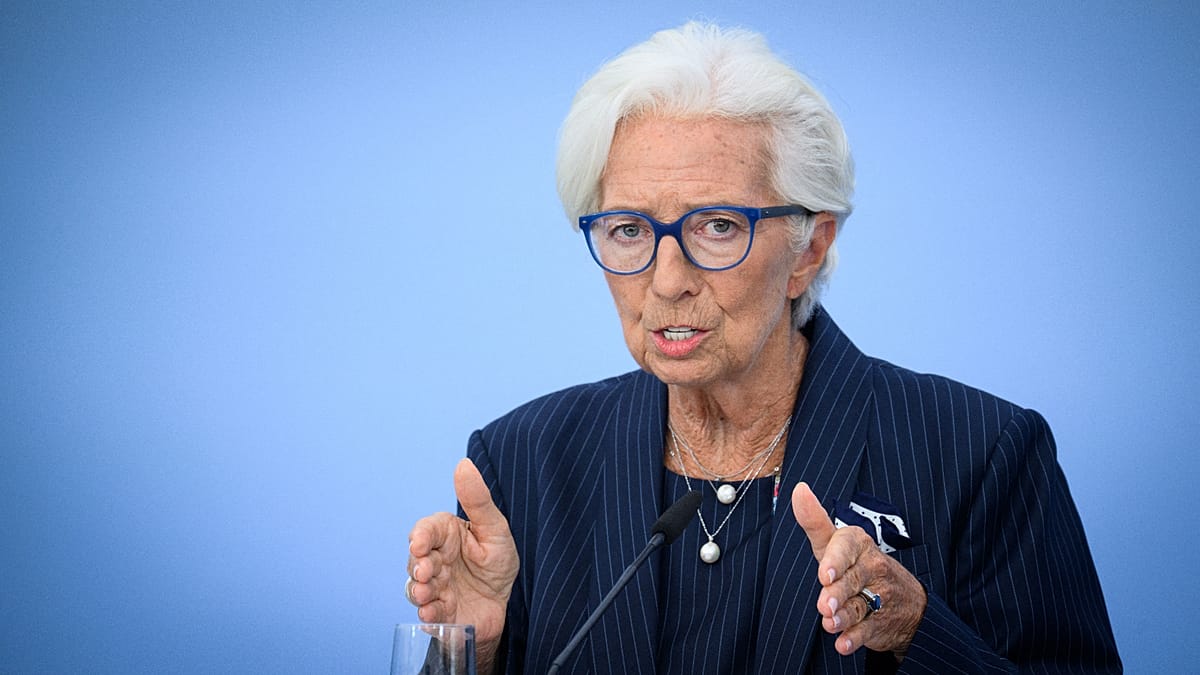
The European Central Bank (ECB) kept its deposit rate at 2.5% on Thursday, a decision overshadowed by President Christine Lagarde's announcement that she will leave her post in February 2027, several months before her term officially ends. The pause comes as inflation in the eurozone runs at 3.8%, nearly double the bank's 2% target, and as a sell-off in French government bonds pushes borrowing costs higher across the currency bloc.
The Governing Council, which sets rates for the 21 countries that use the euro, had already raised rates twice this year, most recently in September, as energy prices linked to the Iran war drove inflation up. The rates on the main refinancing operations and marginal lending facility remain at 2.65% and 2.90%, respectively.
In its statement, the ECB said energy prices had "continued to rise, posing upside risks to the inflation outlook and downside risks to the growth outlook." Underlying inflation has "remained broadly stable so far and wages do not show a material response at this stage," but the bank warned that the size and duration of the energy shock were "likely to drive up inflation and lower growth."
The central bank also acknowledged that financing conditions "have tightened since the Governing Council's last meeting, which is likely to weigh on inflation and growth," and repeated that it was "not pre-committing to a particular rate path." The decision to hold was widely expected, as inflation rose from 3.2% in August to 3.8% in September.
Lagarde's early exit
Lagarde's departure, announced just hours before the rate decision, will take effect on 7 February 2027, around nine months before her eight-year term ends. The ECB gave no reason, but reports since February have linked the timing to France's presidential election in April 2027. "I leave this institution with a sense of a good work done and an ECB that is fit for the future," Lagarde said in a separate statement.
Her exit sets off a race to lead the central bank, with Spain's Pablo Hernández de Cos and the Netherlands' Klaas Knot seen as frontrunners. Two other seats on the ECB's six-member Executive Board, including that of chief economist Philip Lane, also open up in the first half of next year.
France in focus
The decision lands in the middle of France's political and fiscal crisis. French 10-year borrowing costs climbed above 5% last week for the first time since 2002, and on Thursday the yield stood at around 5%, with the gap over German debt at roughly 155 basis points. Ratings agency Moody's kept France's Aa3 rating unchanged last Friday but with a negative outlook, while a divided parliament struggles to pass next year's budget.
As Euronews reported ahead of the meeting, Dutch bank ING estimated that the rise in bond yields since September had done the work of a 25 basis point hike in Germany, and closer to 50 basis points in France. "The bond market has taken over the ECB's job," it said in a note.
Lagarde has so far poured cold water on hopes of a rescue. Speaking in Bangkok earlier this month, she said that "the primary and first solution lies at home in France. And it has to do with fiscal policies." In Thursday's statement, the ECB repeated its standard line that the Transmission Protection Instrument (TPI), its never-used tool to buy the bonds of countries facing unjustified spikes in borrowing costs, is "available to counter unwarranted, disorderly market dynamics that pose a serious threat to the transmission of monetary policy."
The bank also left its balance sheet policy untouched, with its bond portfolios still shrinking as it no longer reinvests maturing debt, even though ING had expected a quiet pause in that run-down. The decision comes as the eurozone faces a delicate balancing act between containing inflation and supporting growth, with the French bond market turmoil adding an extra layer of uncertainty.