Latvia has quietly become a European hub for fibre optics, a high-tech niche where it exports more than 90% of its production. The country's focus on this versatile technology—made from synthetic quartz and capable of transmitting ultraviolet and infrared rays—has turned a small Baltic state into a key supplier for markets across the continent and beyond.
A medical revolution in Riga
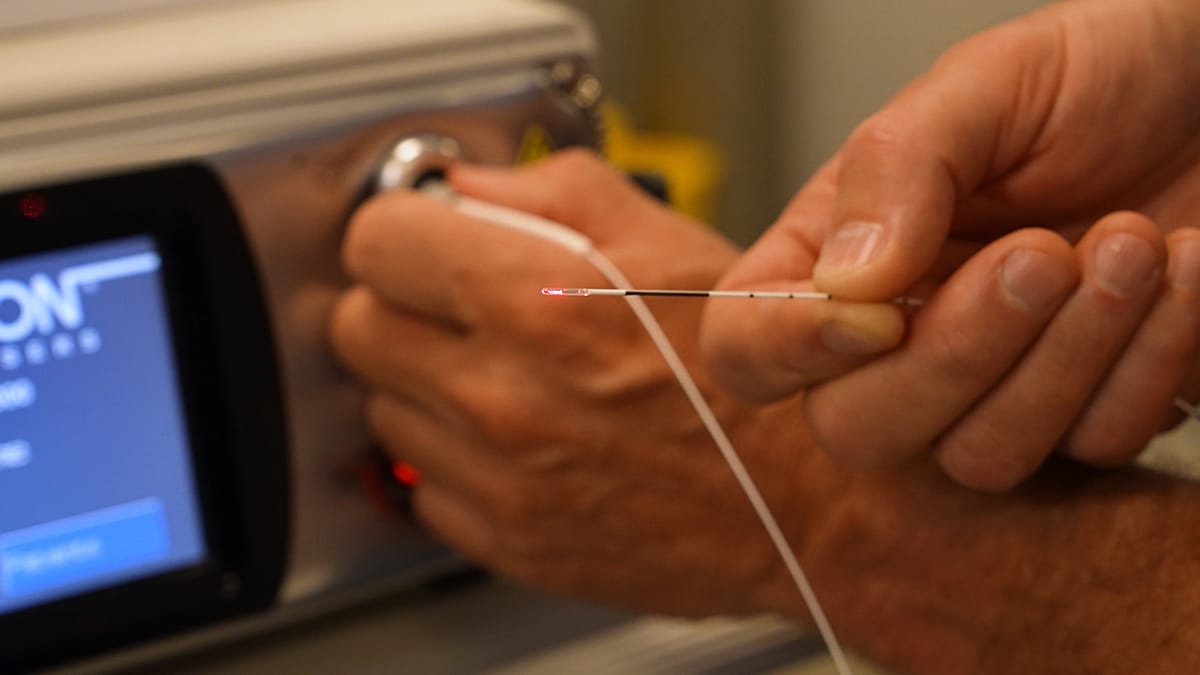
In Riga, Dr Ints Ūdris, a vascular surgeon and phlebologist, uses fibre-optic catheters in his daily practice. Since 2016, he has collaborated with Lightguide, one of Latvia's leading fibre-optic companies, to develop these ultra-thin devices. "It is just 0.5 millimetres in diameter," he explains, holding up a catheter. "It is very thin and can be inserted into a vein through a very small opening. This makes the procedure much less traumatic. There is no pain following the procedure. The patient can have a shower twenty-four hours later and, the following day, can even go for a swim."
The benefits extend beyond patient comfort. Fibre-optic instruments are used in proctology, plastic surgery, liposuction, urology, ophthalmology and cardiology, according to Ūdris. They also consume "approximately four times less energy than twenty-five years ago," he adds, making them more sustainable for healthcare systems.
Līvāni: the fibre-optic valley
The heart of Latvia's fibre-optic industry lies in Latgalia, a region bordering Lithuania, Russia and Belarus. In the town of Līvāni, a cluster of specialist companies has emerged, supported by the European project Optical Fiber Valley. At Lightguide, production reaches around 20 million metres of optical fibre a year, with products tailored to each customer's requirements and exported to more than fifty countries.
Santa Vucina, quality manager at Lightguide, highlights the versatility of their products. "In the case of simple medical devices, consisting of a single fibre and a basic connector, we manufacture around one million units a year," she says. "Fibre optics transmit light from point A to point B with virtually no loss, which makes it possible to carry high-energy or highly precise signals." Some of their fibres are as thin as a strand of hair, with cores around 50 micrometres in diameter—though they do not produce the ultra-fine fibres used in telecommunications.
Vucina acknowledges that their products could have military applications, though she notes, "We currently have no information to suggest that our products have been used in military technology, but it is a possibility."
European backing and future ambitions
The Optical Fiber Valley project has a total budget exceeding €5.4 million, with 40.4% funded by the European Cohesion Policy and the remainder from companies and associated organisations. This investment reflects a broader European push to support high-tech manufacturing in less central regions, a strategy that has paid off for Latvia.
The Latvian Investment and Development Agency (LIAA) actively promotes this sector, according to Vita Balode Andrews, head of the Export and Innovation Services Department. Demand for optical fibre in medicine and other fields is booming across Europe, and Latvia is well positioned to meet it.
By 2036, the fibre-optic sector is expected to account for 10% of Latvia's GDP—a remarkable projection for a country that has historically been more known for its timber and transit industries. The growth of this niche is a testament to how targeted investment and technical expertise can create a global competitive advantage.
Latvia's commitment to fibre optics is part of a wider Baltic trend of embracing technology and innovation. As the country continues to navigate its role within the EU, its success in this field offers a model for other smaller member states seeking to carve out their own economic niches.