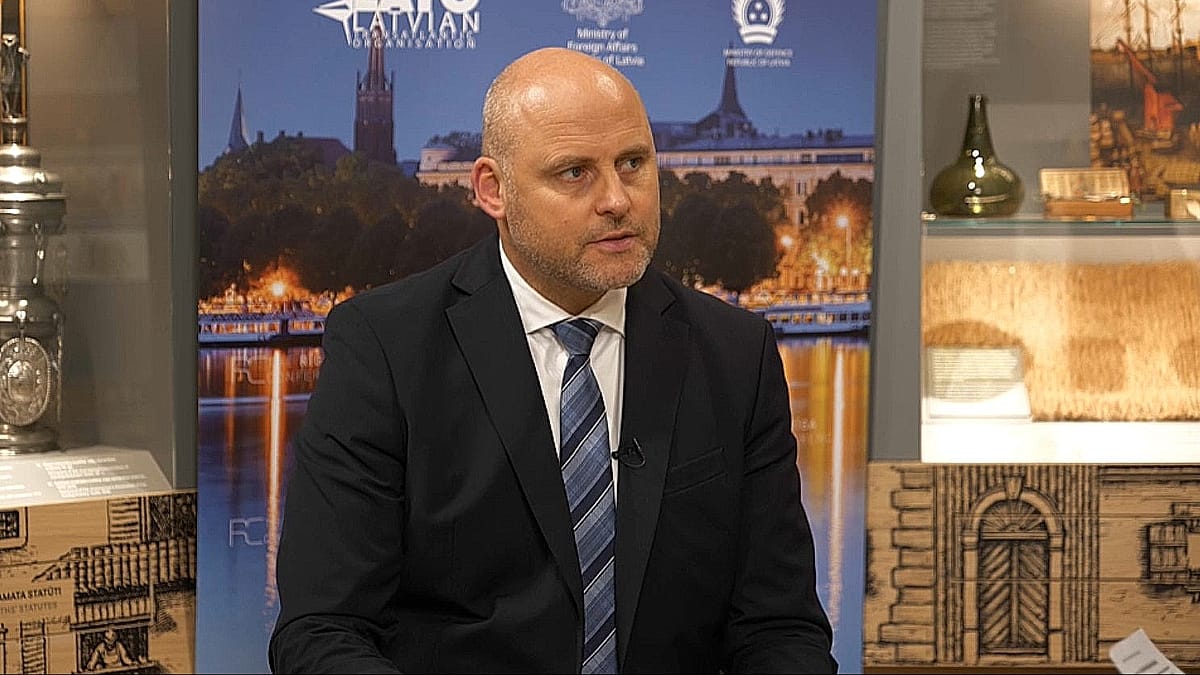
RIGA — In an exclusive interview with Euronews, Latvian Prime Minister Andris Kulbergs delivered a stark message to European capitals: complacency in the face of Russian aggression is not an option. "Nobody can be weak," he said, urging the European Union to maintain a posture of strength and readiness.
Kulbergs, who took office in 2024, framed the current security environment in existential terms. "The one who prepares for the worst has peace," he argued, echoing a sentiment long held in the Baltic states, which have repeatedly warned of Moscow's intentions long before the full-scale invasion of Ukraine.
The Latvian leader acknowledged that European politicians now share a "clear understanding" of the Russian threat and a "commitment" to security. However, he conceded that wider society across the continent is "still behind" — a gap that he believes needs to be closed urgently.
Deterrence by force
For Kulbergs, there is only one credible response to Russia: "to deter it by force." He dismissed notions of appeasement or dialogue as ineffective, pointing to Moscow's track record of disregarding international norms and treaties.
His comments come as NATO's eastern flank faces heightened hybrid threats, from cyberattacks to sabotage and disinformation campaigns. A recent analysis by European Pulse highlighted how NATO's deterrence is eroding as European nations struggle to respond cohesively to these challenges.
The urgency of Kulbergs' message is underscored by recent events near the bloc's borders. Ukrainian authorities reported that a Russian drone hit a passenger train near the Polish border, a stark reminder that the war is not confined to the frontlines. Meanwhile, Moscow has launched record-breaking drone barrages against Ukrainian cities, testing the resilience of both Kyiv and its Western backers.
Kulbergs' insistence on military deterrence aligns with the stance of other Baltic leaders, who have long advocated for a robust NATO presence in the region. The Riga Conference earlier this year underscored this resolve, with officials from across the Baltics calling for a unified strategy against hybrid warfare.
Yet the Latvian PM's remarks also reflect a broader frustration in Eastern Europe with the pace of Western decision-making. While Brussels has debated the use of frozen Russian assets to support Ukraine, concrete action has been slow, leaving Kyiv and its allies in a precarious position.
Kulbergs' warning is not just about military might. He stressed the need for societal resilience — countering disinformation, securing supply chains, and ensuring that European citizens understand the stakes. "If we are weak, we invite aggression," he said. "Strength is not just about weapons; it is about unity and determination."
As Europe heads into another winter of uncertainty, with energy prices and migration pressures adding to the strain, Kulbergs' message is a reminder that the continent's security cannot be taken for granted. The question, he implies, is whether Europe will heed the lesson before it is too late.