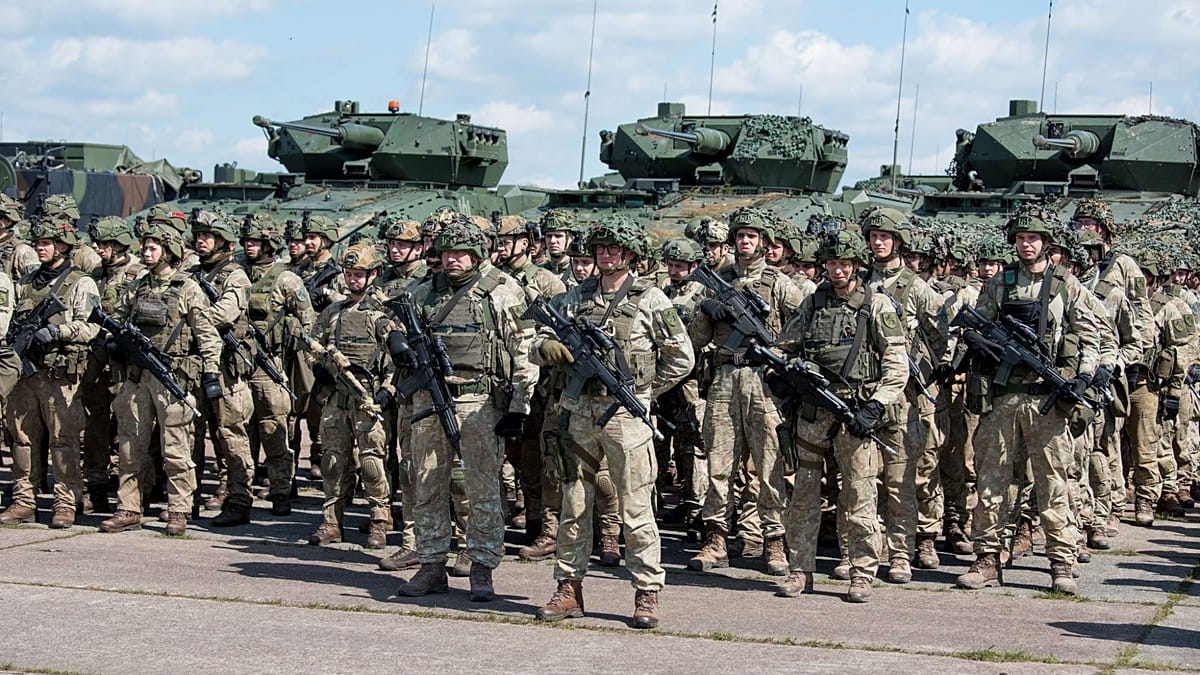
Less than an hour's drive from Vilnius, the ground shakes as German Leopard tanks fire at targets, drones buzz overhead, and Tiger helicopters roar across the training area. Nearly 3,000 NATO troops, including around 2,300 Bundeswehr soldiers, are simulating Lithuania's defense against a potential Russian attack during the six-week "Freedom Shield I" exercise. Since Russia's full-scale invasion of Ukraine, the prospect of a future attack on NATO territory has become a central concern for Europe, with allied intelligence repeatedly warning that Moscow could rebuild its military capabilities over the coming years.
Building Deterrence
In an interview with Euronews, Lithuania's Chief of the Defence Staff and Vice Chief of Defence, Rear Admiral Giedrius Premeneckas, emphasized that "we cannot point to a specific date or number of years and expect a Russian attack on Lithuania, the Baltic states or NATO." However, he noted clear efforts by Russia to reconstitute its armed forces, adding that the outcome of the war in Ukraine will determine the speed of that reconstitution. "We must be ready all the time," he said, listing increased military spending, improved interoperability, and investment in firepower as key measures.
"Those means will enable our countries to act in deterrence mode," Premeneckas told Euronews. "Russia never attacks a country that is prepared and strong," he claimed, explaining that "they're always looking for weak points, weak parts of the alliance." According to the Rear Admiral, security depends on building up military capabilities and "taking this threat seriously."
Historic German Deployment
To help deter that threat, Germany has taken the unprecedented step of permanently stationing an armoured brigade in Lithuania, close to the border with Belarus. In June 2023, German defence minister Boris Pistorius announced that "Germany is prepared to permanently station a robust brigade in Lithuania." The so-called "Lithuania" Brigade is expected to comprise around 5,000 personnel, including approximately 4,800 soldiers. During a recent visit to Pabradė during "Freedom Shield," Pistorius reaffirmed that the deployment remains on schedule, with the brigade expected to reach full operational capability by the end of 2027. So far, two battalions are scheduled to permanently deploy: the tank battalion 203 from Augustdorf in North Rhine-Westphalia and Germany's Panzergrenadier Battalion 122, based in Oberviechtach, Bavaria.
Most of these troops will be stationed in Rūdninkai, around 40 kilometres from Vilnius. The training area's location carries strategic significance due to its proximity to the Polish border and the so-called Suwałki Gap, which stretches 65 kilometres between Belarus and Kaliningrad. Military planners have long regarded it as one of the Alliance's most vulnerable areas. Additionally, the training grounds are merely 15 kilometres from the Belarusian border and the Belarussian training area "Hozhsky."
A Warm Welcome
Alongside Pistorius, Lithuanian defence minister Robertas Kaunas has repeatedly reiterated the importance of the German troops in Lithuania – a sentiment also emphasised by Premeneckas. "In Lithuania, the perception of German deployment is totally positive," he said, adding that many German soldiers have received positive responses to their presence. Euronews spoke to several German soldiers, who said they had been warmly welcomed by Lithuanians. "The people feel definitely thankful to Germany, to Bundeswehr for deploying such size unit on permanent basis to Lithuania, and it brings a sense of security, a sense of being part of strongest defensive alliance, being part of big family and not forgotten in such difficult and tense geopolitical situation," Premeneckas said.
A Nation Shaped by Occupation
In the 20th century, before regaining independence from the Soviet Union, Lithuania endured both Nazi and Soviet occupation. Although some Lithuanians initially viewed the advancing German forces as an end to the first Soviet occupation, Nazi rule quickly gave way to a brutal occupation marked by mass repression and forced labour. This history underscores the country's determination to maintain strong defenses. The German deployment is part of a broader NATO effort to strengthen the eastern flank, with other allies also contributing forces. Lithuania has also increased its own defense spending to over 3% of GDP, one of the highest in the alliance.
The exercises and permanent deployment are designed to send a clear signal to Moscow. As Premeneckas put it, "We must be ready all the time." The presence of German troops in Lithuania is not just a military measure but a political statement of solidarity. For many Lithuanians, it represents a tangible commitment from a key European ally. The brigade's arrival is also a logistical challenge, requiring new infrastructure and housing for soldiers and their families. But the benefits are clear: enhanced deterrence and a stronger bond between Germany and the Baltic states.
As the geopolitical situation remains tense, Lithuania's approach serves as a model for other frontline states. The combination of national investment, allied deployments, and regular exercises aims to ensure that any potential aggressor thinks twice. For now, the message from Vilnius is one of readiness and resolve.