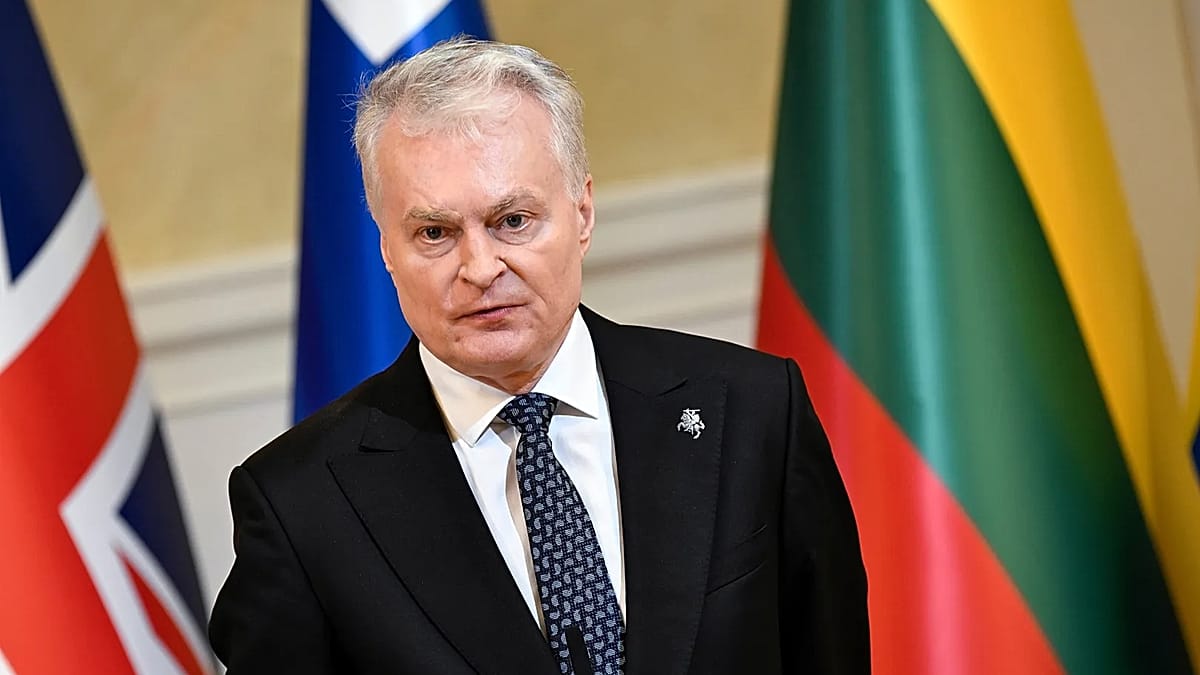
Lithuanian President Gitanas Nausėda announced on Wednesday that the Baltic country's top political leaders have agreed in principle to remove a constitutional ban on the deployment of nuclear weapons and foreign military bases on Lithuanian soil. The move follows Finland's recent decision to lift its own long-standing prohibition, which formally ended on the same day.
Speaking to state broadcaster LRT, Nausėda described Article 137 of Lithuania's constitution—which explicitly prohibits weapons of mass destruction and foreign military bases—as “outdated” and “obsolete.” He argued that the geopolitical landscape has deteriorated significantly since the document was drafted. “The geopolitical situation is getting worse. Our constitution was written when geopolitical circumstances were totally different,” he said.
Lithuania already hosts a NATO multinational battlegroup with a permanent presence of up to 5,000 German soldiers. But the country is encircled by nuclear-capable arsenals in the Russian exclave of Kaliningrad and in Belarus, Moscow's closest ally. The security calculus has shifted sharply since Russia's full-scale invasion of Ukraine in 2022, prompting Baltic states to reassess their defence postures.
Finland's precedent and Russian threats
Finland's parliament voted earlier this year to lift its ban on nuclear weapons, allowing the country to receive, transport, and facilitate the movement of nuclear arms on its territory as part of allied defence. The measure took effect on Wednesday. In response, Russian officials issued stark warnings, with state media quoting a deputy foreign minister saying Moscow could “destroy half of Finland” if nuclear weapons were stationed there.
Finland has also announced plans to partner with US defence firm Lockheed Martin to build Europe's first maintenance centre for multiple-launch rocket systems (MLRS) in Tampere. This underscores Helsinki's deepening military integration with NATO after joining the alliance in 2023.
Lithuania now faces a procedural choice: whether to amend its constitution through a parliamentary vote, as Finland did, or hold a national referendum. The latter would be more time-consuming and politically uncertain, but some lawmakers argue it would lend greater legitimacy to such a consequential change.
The debate comes amid broader European security concerns. Lithuania has been a vocal advocate for stronger NATO deterrence on the eastern flank, and its leaders have repeatedly warned that Russia's nuclear threats must be met with credible countermeasures. The country's energy sector has also been a bright spot: Denmark, Portugal, Lithuania lead EU as renewables hit 46% of electricity, highlighting Vilnius's push for energy independence alongside military resilience.
Meanwhile, the European Parliament is moving to strip the far-right AfD-led alliance of its EU party status, a development that could reshape political dynamics in Brussels. And as Europe grapples with a heatwave moving east, over 1,300 dead as Balkans and Ukraine brace for extreme temperatures, underscoring the continent's multiple challenges.
For Lithuania, the nuclear ban debate is a stark reminder of how quickly the security environment has evolved. Nausėda's push to amend Article 137 reflects a broader Baltic consensus that the era of post-Cold War certainties is over. Whether the change comes via parliament or referendum, the message to Moscow is clear: Lithuania is prepared to adapt its defence posture to meet the threats of a new era.