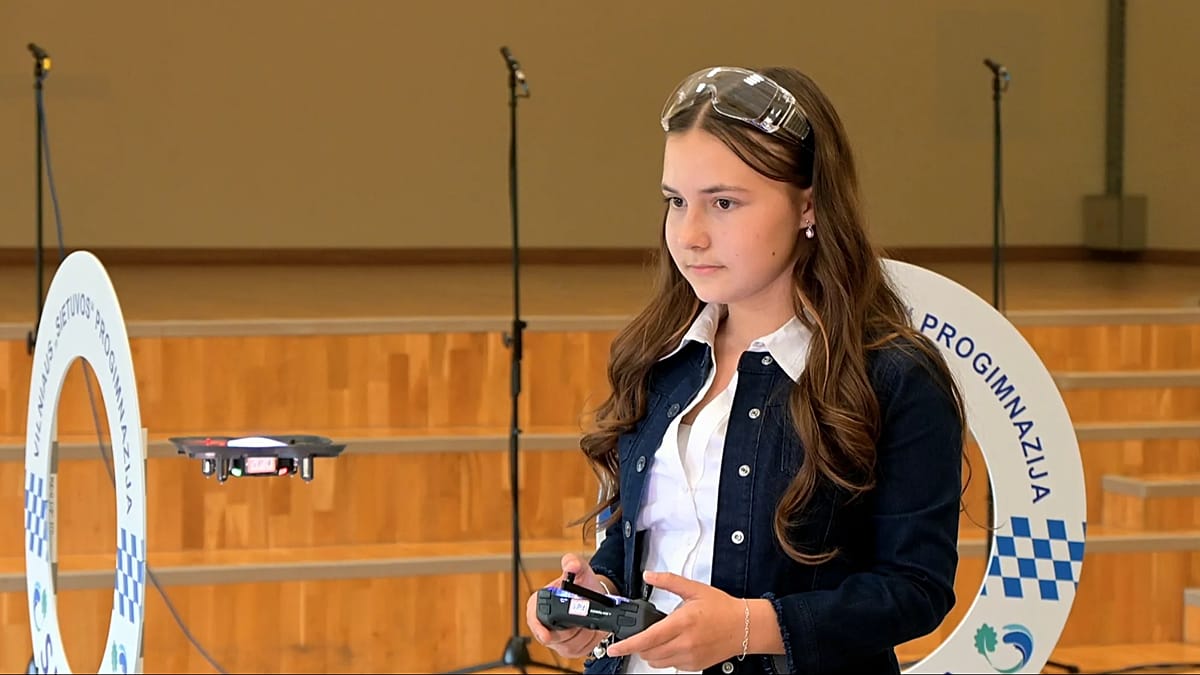
In a school hall in Vilnius, the whir of propellers fills the air as children guide small quadcopters through hoops and around obstacles. This is not an after-school club or a one-off workshop; it is a regular part of the timetable at Sietuvos Progymnasium, where pupils aged six to fourteen attend dedicated drone classes alongside maths, Lithuanian, and physical education.
The programme, which has been running in a handful of state schools across the Lithuanian capital, teaches children not just to fly drones but to build and program them. According to Vytautas Mitala, Vilnius's deputy mayor, the goal is far broader than piloting skills. “It's not just about flying drones,” he said. More important, he explained, are the lessons in programming, construction, map-reading, and the physics that make these unmanned systems work.
From classroom to career
The initiative is designed to strengthen STEAM education – science, technology, engineering, arts, and mathematics – and to give pupils a practical understanding of technology that will serve them in later life. Mitala believes that combining hands-on experience with technical knowledge can open up career paths that young people might otherwise never consider.
The drone classes are aimed primarily at pupils around Year 5, when they are about eleven years old. In Lithuania, 70 percent of teaching time is devoted to the compulsory national curriculum, leaving teachers free to use the remaining 30 percent as they see fit. Programming is introduced even earlier, in Year 1, so that by the time children begin building drones they already have a basic grasp of coding.
Mitala argues that early exposure is crucial. “You should introduce younger children to these fields, show them what is possible and spark their curiosity,” he said. The programme builds on subjects already taught in schools, but it has yet to be adopted citywide. So far, only a few state schools in Vilnius have integrated drone education into their regular curriculum; others use elements of the programme in lessons or offer drone activities as after-school clubs.
The economic rationale is clear. Vilnius wants to strengthen its position in biotechnology and establish a foothold in semiconductor manufacturing – sectors that demand technical skills which, Mitala insists, need to be cultivated from an early age. Companies have told him that introducing pupils to technical subjects only in their final year of school is “already a little too late.”
The long-term plan is to expand drone education to more schools across the city and make it a permanent part of the curriculum, with a programme spanning grades one to twelve already in the works.
Safety first, then competition
A visit to a drone class at Sietuvos Progymnasium, organised during a press trip by the Baltic office of Germany's Friedrich Naumann Foundation, reveals a structured lesson. Pupils begin in a classroom equipped with computers, a 3D printer, and a fleet of drones. They learn the pre-flight checklist: check the surroundings and the device, insert the battery correctly, ensure the flight area is clear of obstacles, and only launch with the teacher's permission.
Once the safety rules are mastered, the class moves to the hall, where an obstacle course awaits. Hoops, boxes, and instructions test their piloting skills as they compete to complete the course in the shortest time. The competition extends beyond the school itself – during the last academic year, 33 schools from across Vilnius were invited to take part in the so-called “drone games” at Sietuvos.
Matas and Kasparas, both 14, came second in the most recent competition. Matas told Euronews that he had started the drone course three years ago and that it was not easy – it had taken him that long to reach his current level of skill. His next goal is to learn to control a larger drone, which he says is more difficult “because of the movements.”
The drone classes come at a time when drones are increasingly associated with warfare and security threats. Recent incidents, including an attempted drone attack at Leipzig/Halle Airport, have highlighted the potential risks. Drones have also become a defining feature of modern conflict, as seen in the war in Ukraine and the US-Israeli strikes against Iran. But Mitala stresses that the school programme is not about militarisation. Instead, it is about helping children understand a technology that is becoming ever more important in civilian life, from delivery services to agriculture and emergency response.
Lithuania is not alone in this approach. The Baltic states are often seen as European pioneers in digitalisation, and similar drone education projects exist in Germany. As the technology continues to reshape both the economy and the battlefield, teaching the next generation how to build and control these machines may prove as essential as reading and writing.



