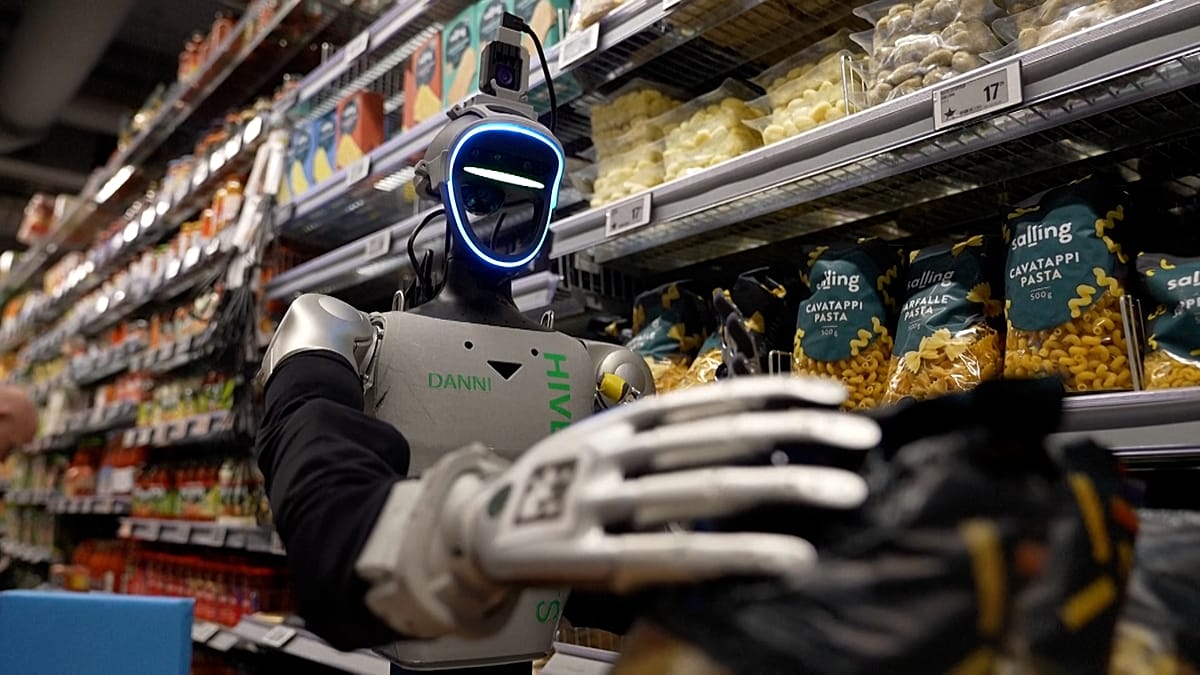
Danish retail conglomerate Salling Group has begun testing humanoid robots in its supermarkets, deploying them primarily during night shifts to take on the repetitive and physically demanding task of restocking shelves. The pilot, which uses machines developed by Hive Robots, is designed to reduce the burden on human staff and allow them to concentrate on customer-facing duties.
Salling Group, which operates the Netto, Føtex, and Bilka chains across Denmark, is among the first European retailers to experiment with bipedal robots in a live store environment. The company says the trial is not about replacing workers but about reallocating their time to tasks that require a human touch.
Why overnight restocking is a target for automation
Restocking shelves is one of the most labour-intensive and least rewarding jobs in grocery retail. It often happens after closing, when stores are empty and staff work unsociable hours. The work involves lifting heavy boxes, navigating narrow aisles, and precisely placing products — tasks that have historically been difficult to automate with traditional machinery.
Hive Robots' humanoid design is intended to fit into existing store layouts without requiring costly modifications. Unlike fixed robotic arms or automated warehouses, these machines can move through aisles and handle a variety of packaging shapes. The trial will assess whether they can operate reliably in the messy, unpredictable environment of a real supermarket.
The Danish initiative echoes similar experiments elsewhere in Europe. In the UK, Ocado has long used automated systems in its warehouses, while in France and Germany, retailers have tested shelf-scanning robots and automated inventory drones. But humanoid robots that physically restock shelves remain rare, making Salling Group's pilot a notable test case.
Staff reaction and the wider labour debate
Retail unions in Denmark have responded cautiously. While they welcome efforts to reduce heavy lifting and night work, they warn that automation must not become a pretext for cutting jobs or weakening working conditions. The Salling Group insists that no redundancies are planned as a result of the trial.
The pilot also comes amid broader discussions across Europe about the role of artificial intelligence and robotics in the workplace. The European Union's AI Act, which is gradually coming into force, sets rules for high-risk automated systems but does not specifically address humanoid robots in retail. National governments and employers are watching such trials closely to understand the practical and ethical implications.
For now, the robots will remain a small-scale experiment. Salling Group says it will evaluate the results over the coming months before deciding whether to expand the programme to more stores. The outcome could influence how other European grocers approach automation in the years ahead.
As labour tensions simmer elsewhere in Europe, the Danish trial offers a quieter test of whether machines can take over the graveyard shift — and what that means for the people who once worked it.



