As Germany prepares to permanently station thousands of troops in Lithuania, the Baltic state's foreign minister has underscored the deployment's importance in deterring Russian aggression. In an interview with Euronews, Kęstutis Budrys said the presence of the Bundeswehr's first-ever permanent combat brigade abroad is essential for preserving peace on NATO's eastern flank.
“We are not interested in having the extension of Russia on our borders for many reasons,” Budrys said, referring to neighbouring Belarus, which he described as a “tough neighbour.” Minsk, he noted, has engaged in hybrid activities against Lithuania, including instrumentalising migration, sending meteorological balloons into Lithuanian airspace, and harassing exiled opposition figures.
A historic deployment
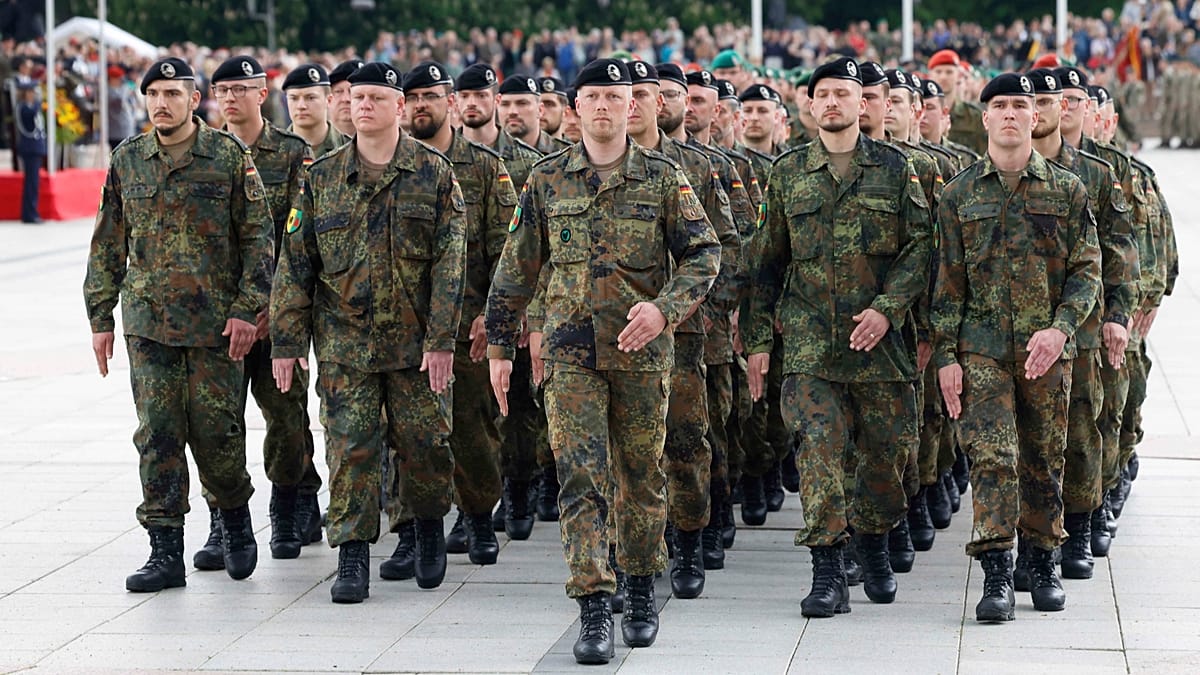
By the end of 2027, around 5,000 German soldiers will be permanently stationed in Lithuania, just a few kilometres from the Belarusian border. The unit, officially known as Panzerbrigade 45, will be the Bundeswehr's first permanent overseas deployment since its founding in 1955. The decision marks a significant shift for Germany, which had previously relied on rotational deployments as part of NATO's Enhanced Forward Presence (eFP) mission since 2017.
The change came after Russia's full-scale invasion of Ukraine in 2022. Vilnius called for stronger security guarantees, and then-Chancellor Olaf Scholz pledged to permanently station a brigade in the country. “I have promised our friends in Lithuania that Germany will lead a robust Bundeswehr brigade that will also be permanently present in Lithuania and, in the event of a crisis, be reinforced immediately by forces from Germany. This is solidarity in action between friends and allies,” Scholz told the Bundestag in June 2022.
Initially, Germany planned to station only a brigade headquarters in Lithuania, with combat units rotating from Germany. However, in the summer of 2023, after Wagner group chief Yevgeny Prigozhin's failed mutiny and the relocation of thousands of his fighters to Belarus, the strategy shifted. German Defence Minister Boris Pistorius and Chief of Defence General Carsten Breuer travelled to Lithuania to announce that the Bundeswehr would permanently station a fully operational combat brigade abroad for the first time. “It is our mission to play a decisive role in protecting NATO's eastern flank,” Pistorius said later that autumn.
Deterrence from the border
Budrys told Euronews that “deterrence should start from the border,” meaning that NATO must defend every centimetre of territory with “very exact forces” rather than relying on hypothetical reinforcements. He expressed gratitude for Germany's leadership, calling it an “example for others to follow.”
“We're so thankful for Germany taking this leadership and increasing its presence in Lithuania,” he said, adding that the deployment is the “key to peace and success.”
“No one is preparing here for war. We're preparing here to have a stable country, environment, secure for people to be, for the business to flourish,” Budrys added.
The Lithuanian foreign minister also stressed the importance of regional partnerships and collective instruments provided by the EU and NATO. “Our recipe and what we learned throughout these years is that regional partnership and partnership through EU and our NATO membership really helps in these situations,” he said.
Sviatlana Tsikhanouskaya, the exiled Belarusian opposition leader, told Euronews that Russia has turned Belarus into “a military backyard of Russia.” She pointed to the deployment of nuclear weapons and Oreshnik missiles, as well as the militarisation of Belarusian industry, with around 300 enterprises producing military goods for Moscow. “Lukashenka actually militarised our economy,” she said.
The permanent German brigade is part of a broader NATO effort to bolster the eastern flank. Each Baltic state has a lead nation: the UK leads NATO's enhanced Forward Presence in Estonia, Canada in Latvia, and Germany in Lithuania. The deployment is seen as a test of NATO's ability to adapt to new security realities, and a signal to Moscow that the alliance is prepared to defend its members.
As the Bundeswehr builds up its presence, the focus remains on deterrence rather than provocation. Budrys emphasised that the goal is stability and security, not conflict. “We're preparing here to have a stable country, environment, secure for people to be, for the business to flourish,” he reiterated.
The move also comes amid heightened tensions, with Russian strikes on Kyiv and other Ukrainian cities continuing to cause casualties and damage. The EU has recently channelled €1.4 billion from frozen Russian assets to Ukraine, underscoring the bloc's commitment to supporting Kyiv. For Lithuania, the German brigade is a tangible expression of that solidarity, and a cornerstone of its own security.