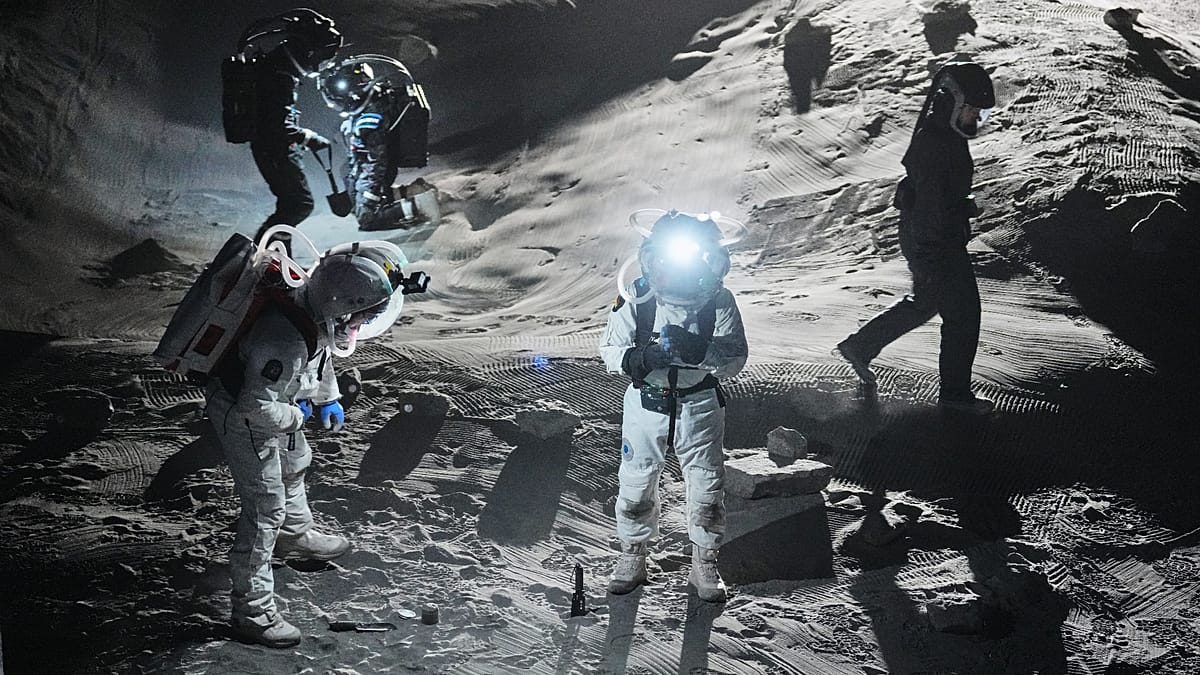
For decades, science fiction has painted a future where humans establish permanent homes on the Moon. Recent advances in lunar mapping and the discovery of water ice in shadowed craters have fuelled fresh speculation among space entrepreneurs about building bases or even cities. But a new study from the Harvard–Smithsonian Center for Astrophysics (CfA) pours cold water on those ambitions, at least for the foreseeable future.
The research, published in the journal Frontiers in Space Technology under the title “There Are No Cities on the Moon,” examines the fundamental constraints of water and energy that any lunar settlement would face. The team, led by senior astrophysicist Martin Elvis, modelled the needs of a city with a population of one million people, assuming an average water consumption of 500 tonnes per person per year.
Their conclusion is stark: the Moon’s known ice reserves, concentrated in permanently shadowed craters where temperatures hover between minus 163 and minus 246 degrees Celsius, are far too small to support such a population. Even if all available water were recycled with the efficiency of the International Space Station (ISS), which recovers about 98% of its water, a million-person city would run dry within roughly a century. Without recycling, it would last only a few years.
To make a settlement viable beyond that, the population would need to be capped at around 1,000 people—more a lunar village than a city. However, the study notes that if water recycling could reach 99.9% efficiency, a million residents could theoretically survive for about 2,000 years, provided other measures such as vertical farming or water imports were adopted.
Energy is not the problem
While water poses a severe challenge, energy would not be a limiting factor. The Moon’s polar regions feature High Illumination Areas where the Sun remains near the horizon, never fully setting. The rims of craters in these zones sit higher than the surrounding terrain, making them ideal for solar panel installations. According to the study, 1-kilometre-tall towers covered with photovoltaic panels could each generate about 3 gigawatts of power—enough to support both residential and industrial needs.
Moreover, silicon, a key raw material for solar cells, constitutes about 20% of the lunar surface, suggesting that manufacturing could be partially localised. Japanese construction firm Shimizu Corporation has already announced plans to install solar panels along the lunar equator, aiming to generate 13,000 terawatts—more than the entire current electricity consumption of Earth. The Moon’s thin atmosphere means solar generation is unaffected by weather, offering a consistent and reliable energy supply.
Despite these promising energy prospects, the water scarcity remains a fundamental obstacle. The study’s authors emphasise that current exploration technology can only probe a few metres below the surface, leaving open the possibility that larger ice reserves might exist deeper underground. If such reserves are discovered, the calculus could change.
For now, however, the dream of lunar cities remains firmly in the realm of science fiction. As Martin Elvis and his colleagues note, any serious colonisation effort would require either a dramatic improvement in water recycling technology or the discovery of substantially more ice than is currently known.
This reality check comes at a time when European space agencies and private companies are increasingly looking to the Moon as a stepping stone for deeper exploration. While the prospect of a lunar metropolis may be distant, the research underscores the importance of understanding resource limitations before committing to ambitious projects. As Europe's summer skies set record traffic and other terrestrial concerns dominate headlines, the Moon remains a tantalising but elusive frontier.