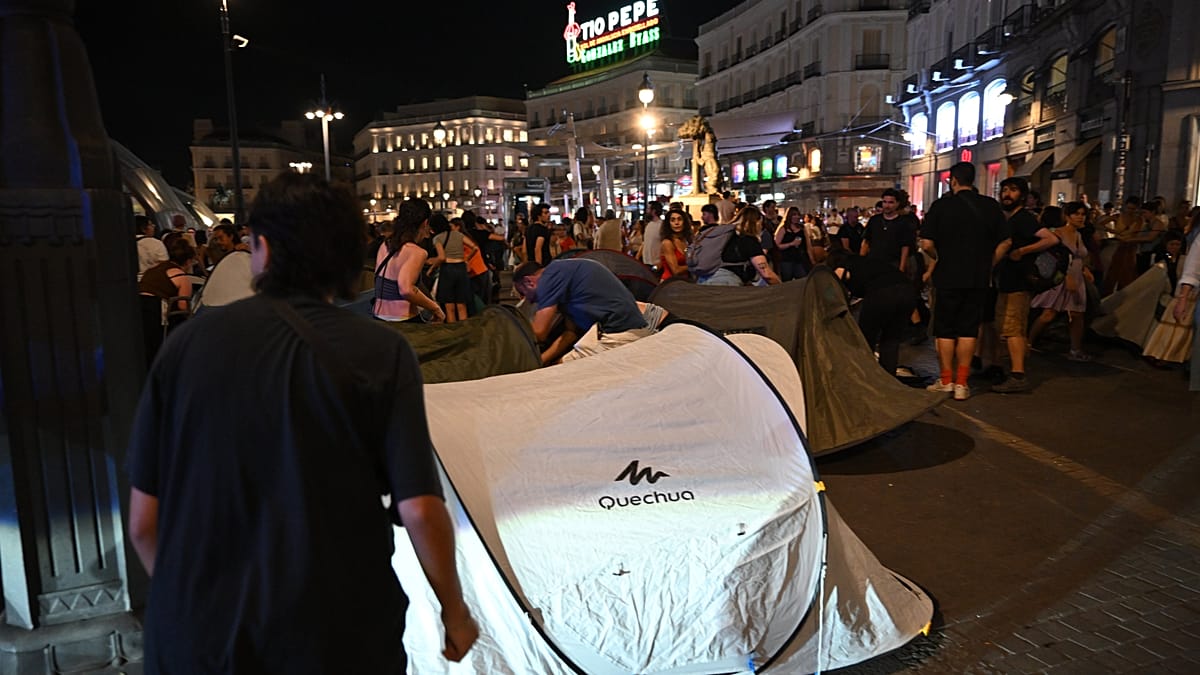
MADRID — Puerta del Sol woke on Sunday to roughly 150 tents spread across the square, as an encampment that began with about 100 structures continued to expand through the morning. Those taking part spent the night on yoga mats, in sleeping bags or directly on the ground, with small groups talking into the early hours.
The Civil Guard and National Police maintained a visible presence, though no incidents were reported. Campers described a calm atmosphere, with food and water stockpiled to sustain the protest over the coming days.
The initiative follows a call from the Madrid Tenants' Union, which urged people to camp in Sol once Saturday's march had ended. The organisation asked those unable to stay overnight to contribute sleeping bags, mats, food or water. One refrain heard across the square captured the mood: "all this is for Maricarmen".
An eviction that became a rallying cry
The trigger was the eviction of Maricarmen Abascal, an 87-year-old woman forced to leave her rented flat in Madrid's Retiro district last Wednesday after seven decades there. The case — now widely referred to as the "Maricarmen effect" — prompted protests in 40 cities under the slogan "Not one more Maricarmen".
Saturday's demonstration began at 6.30pm in Puerta del Sol and ended at the Congress of Deputies. The Government Delegation put the crowd at around 25,000, while the Tenants' Union claimed as many as 300,000. Along the route, families, young people and elderly groups chanted slogans including "Where is the progressive Government?" and "We want to see Maricarmen come back".
The encampment carries strong echoes of the one that began in the same square on 15 March 2011 and grew into the 15-M movement, whose slogan "Sí se puede" — "Yes, we can" — became a symbol of frustration with the two main parties, the PSOE and PP. That movement demanded a political alternative putting ordinary people first. Similar anger has surfaced elsewhere in Spain, with protests swelling in Granada after the eviction.
The demand: a decree on Tuesday
The central demand is for the Government to approve a decree on Tuesday that would include a freeze on rents, among other measures. The union has dubbed it the "Maricarmen decree".
Gonzalo Álvarez, a spokesperson for the Tenants' Union who spent the night at the camp, said in a live interview that the protest seeks "structural changes" so that housing "is treated as a basic necessity and not as a financial asset". He argued that Maricarmen's case had acted as a catalyst because of "the injustice, the harshness of what happened and the police response".
Álvarez warned that if the decree is not approved, the Government's left-wing partners, including Sumar, should consider withdrawing their support and bringing down the Executive. Echoing that position, union spokesperson Alicia del Río described Maricarmen's case as a "point of no return" in Spain's housing struggle and said that if the decree fails on Tuesday, the Government "makes no sense at all" and should rethink whether it can continue.
Divisions on the left complicate the debate
Pablo Iglesias, founder of Podemos and one of the initiators of the 15-M movement, said Maricarmen could become Spain's Rosa Parks and expressed hope that the movement would spread across the country.
The debate is further complicated by fractures within the left-wing bloc. Podemos MEP Irene Montero rejected the Government negotiating the decree with Junts, accusing the party of trying to force an agreement on those who took to the streets on Saturday. Montero called for the expropriation of 650,000 homes owned by vulture funds so they can be converted into social rental housing. Podemos secretary-general Ione Belarra said her party would keep "piling on the pressure" to secure the strongest possible decree, but warned that no single measure would solve the housing crisis without continued protest and pressure from the streets.
The standoff comes amid broader strains in Spanish politics, including Spain's long stretch without a new national budget, which has limited the Government's room for manoeuvre. For now, the tents in Puerta del Sol remain, and all eyes are on Tuesday's cabinet meeting.