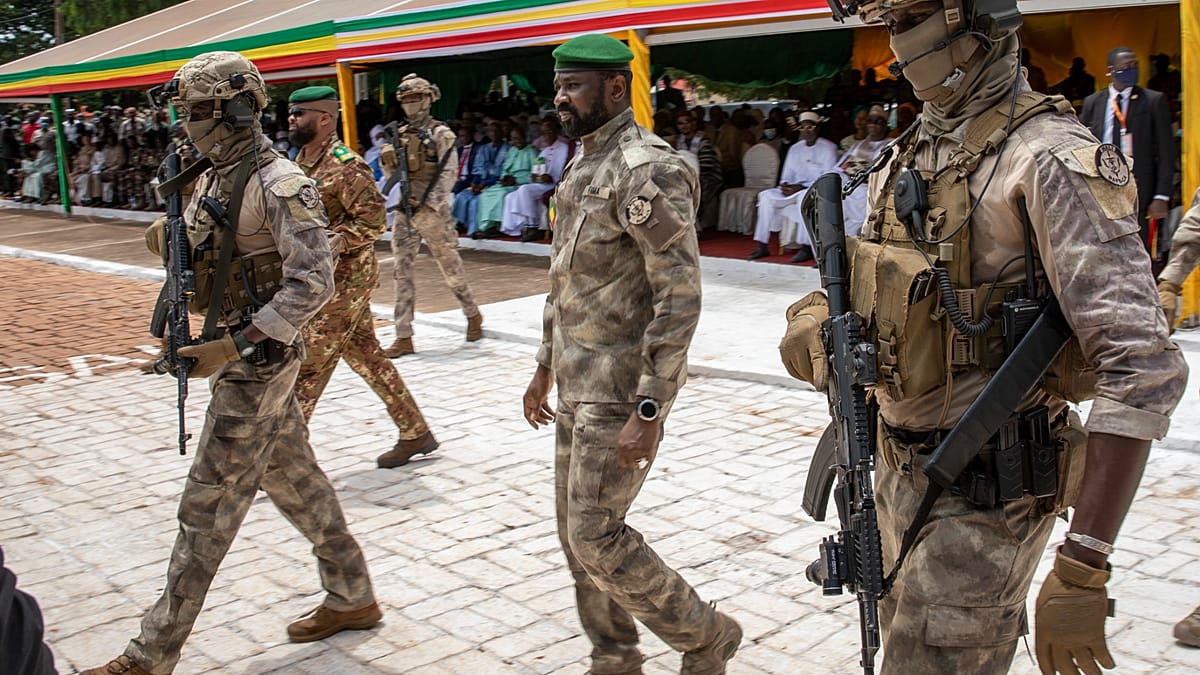
Mali's military junta is facing its most severe challenge since taking power, after a wave of coordinated attacks on Saturday killed the defence minister and saw rebels seize the strategic northern town of Kidal. The assault, which combined jihadist groups and Tuareg separatists, underscores the deepening instability in the Sahel and raises questions about the effectiveness of the junta's reliance on Russian military support.
General Sadio Camara, Mali's defence minister, was killed when a suicide car bomber and other assailants targeted his residence in the capital, Bamako, according to a government statement read on state television by spokesman General Issa Ousmane Coulibaly. “He engaged in an exchange of fire with the assailants, some of whom he managed to neutralize,” the statement said. “During intense clashes, he was wounded and then transported to the hospital, where he unfortunately succumbed to his injuries.”
The attacks on Saturday were among the largest ever mounted against the Malian army in Bamako and several other cities and towns. Sixteen people, including both civilians and military personnel, were wounded, and several militants were killed, Coulibaly added. The government declared the attacks over by Sunday, but the fallout is far from contained.
Separatists Declare Kidal 'Free'
The most dramatic development came in the north, where the Tuareg-led Azawad Liberation Front (FLA) announced that it had taken control of Kidal, a town that had long been a rebel stronghold before being captured by Malian forces and Russian mercenaries in 2023. FLA spokesperson Mohamed El Maouloud Ramadan said Russian Africa Corps troops and Malian soldiers withdrew from the city after an agreement for a peaceful exit. “Kidal is declared free,” Ramadan declared.
General Oumar Diarra, head of the Malian armed forces, confirmed the withdrawal in a televised statement late Sunday, saying forces were repositioning in Anefis, about 100 kilometres south of Kidal. The loss of Kidal is a symbolic and strategic blow to the junta, which had touted its recapture as a major victory against the rebellion.
For the first time, the separatists coordinated their operations with the al-Qaida-linked group JNIM, which claimed responsibility for attacks on a town outside Bamako and three other cities. Ramadan confirmed the partnership, stating, “This operation is being carried out in partnership with the JNIM, which is also committed to defending the people against the military regime in Bamako.” The FLA also called on Russia to “reconsider its support for the military junta,” accusing Moscow of contributing to civilian suffering.
The junta responded by imposing a three-day overnight curfew from 9 p.m. to 6 a.m. in the Bamako district, a measure that reflects the heightened state of alert.
Wider Regional Implications
The crisis in Mali is part of a broader deterioration in the Sahel, where military juntas in Mali, Niger, and Burkina Faso have turned away from Western allies and towards Russia for security assistance. Despite this shift, militant attacks have reached record levels, and government forces have been accused of killing civilians suspected of collaborating with insurgents.
The Economic Community of West African States (ECOWAS) condemned Saturday's attacks and called for a unified regional response. For European observers, the situation is particularly concerning. The Sahel has become a staging ground for jihadist groups that pose a direct threat to European security, as seen in past attacks on European soil and the ongoing instability that fuels migration flows towards Europe.
The coordinated nature of the assault—bringing together separatists and jihadists who have often been at odds—suggests a new level of tactical sophistication. It also highlights the limitations of the junta's strategy, which has prioritised military force over political dialogue. As the junta struggles to maintain control, the risk of further fragmentation and violence grows, with potential spillover effects for neighbouring countries and for European interests in the region.
European Pulse will continue to monitor the situation as it develops, particularly in light of ongoing discussions among EU leaders on security and defence cooperation, including recent crisis talks in Cyprus on energy and defence matters.