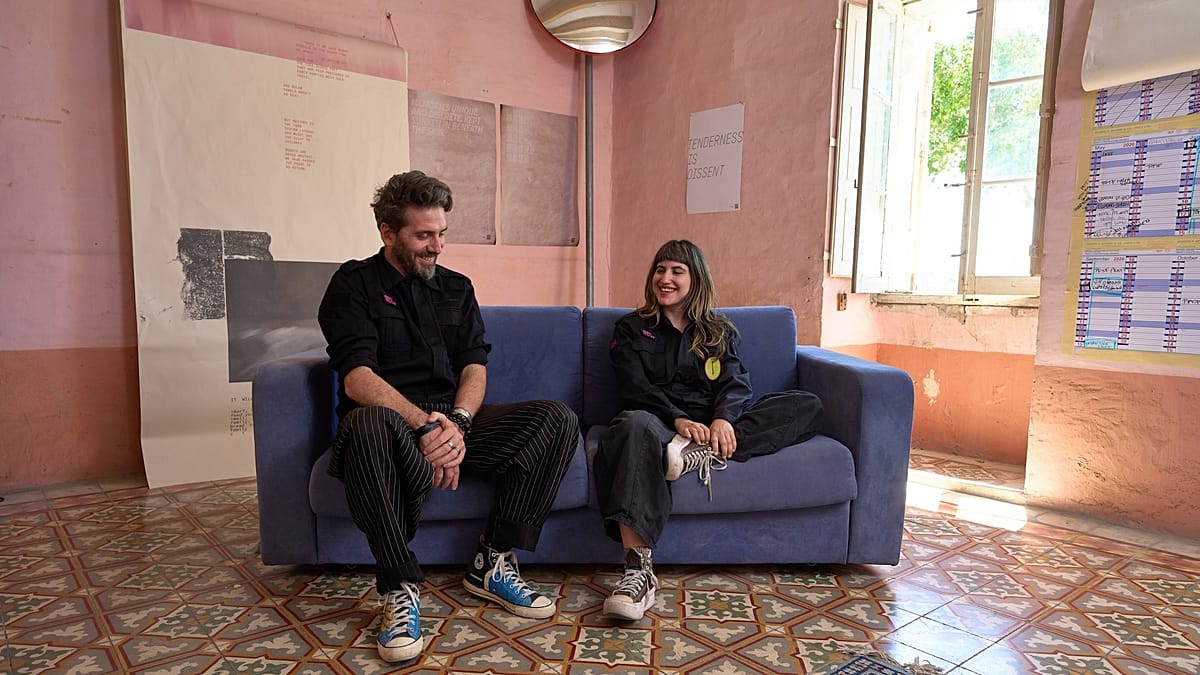
Julien Vinet wants you to picture twilight with him. The sun will rest like a crown on the limestone rooftops, and rivers of red and orange will flood into the shabby studio he shares with his creative partner, Sam Alekksandra. As another day slips into night over Malta's Three Cities, the warm light will wash over faded pink walls plastered with posters for their pop-up poetry events.
“Sunset is special here,” Vinet says with conviction. The French artist, who moved to Malta about a decade ago after eight years in Japan, has a talent for finding unexpected meaning in familiar moments. He likes to dig until he uncovers a truth worth exposing – or what he calls “obsolete beauty”. It is why he and Alekksandra, the duo behind the collective Ponks, are drawn to liminal things caught in the in-between, like their sunset ritual. And perhaps it is no coincidence that both have found creative freedom in a country defined by its own in-betweenness.
For Vinet, Malta has given him the time and space to pursue both sides of himself: the punk and the perfectionist. For Alekksandra, a Maltese journalist turned poet, it has provided a reference point to develop her own artistic language. That kind of creative latitude is relatively new to the country. For years, artists in Malta had few galleries and even fewer pathways to show their work. Now, with new institutions like the Malta Biennale and a growing international profile, the arts scene here is beginning to look very different.
The space between
Malta is an oddity, a small group of islands in the Mediterranean that has spent millennia absorbing one culture after another. Its cuisine spans African, Mediterranean and British influences. It has the only Semitic language written in the Latin alphabet. It has Phoenician boats, Catholic churches and UK crests. Despite this plurality of influences, Maltese art for many years was stuck in one episode of the past. As a guide would later tell me in Valletta's Muza Gallery: “Baroque this, baroque that – for many people in Malta, real art is only baroque.”
Now, cracks in the baroque façade are starting to show. Before meeting Vinet and Alekksandra, I go on a short tour of Valletta's art scene, starting – as most do – with Caravaggio's masterpiece, The Beheading of Saint John the Baptist at St John's Cathedral. But there is more to Malta's art scene than saints and martyrs. Apart from Muza and the new MICAS, Malta's first national museum dedicated to contemporary art, galleries like Valletta Contemporary have provided a space for more daring work – something many artists told me Malta had lacked for years.
Founded by architect and artist Norbert Francis Attard, the gallery has transformed a 400-year-old warehouse in the city's lower east end into a two-floor showcase for Maltese and international artists. When I visit, it is showing Still Time, a 50-year retrospective of photographer Joseph P. Smith curated by Lisa Gwen Chetcuti. “In Malta, there are very few private galleries, and they operate differently than they do in London or New York,” Chetcuti tells me. The galleries often don't own the work, meaning they aren't taking on inventory they need to sell – and artists don't necessarily want them to either. “In a small country, they don't want to put all their eggs in one basket,” she explains. “This exhibition was all done through public funding.”
Valletta Contemporary is an answer to the lack of galleries, but Attard's ambitions extend beyond exhibitions in the Maltese capital. He runs a residency at his home and studio in Gozo that brings artists from abroad and supports collaborative projects and exhibitions. He is now converting his Gozo home into a public archive, with a café and garden. “I'm the kind of person who can stop being an artist during my lifetime as a conscious decision,” he says. “That doesn't mean I stop being creative. There are a lot of ways one can create.”
Breaking with tradition
Back at their studio, Vinet and Alekksandra are thinking about what comes next, too. They have met up with their friend and collaborator, the sound artist Michael Quinton, to discuss their contribution to Malta's pavilion at the Gwangju Biennale in South Korea, which runs from 5 September to 15 November. Called BEJN / In-Between and led by Vinet as artistic director, the pavilion brings together Attard, Ponks and Quinton in a project that connects Malta and Korea through three linked installations.
Attard is creating a spatial installation that draws on Malta's festa traditions and Korea's Obangsaek system, using colours, tension and balance to draw attention to conflict and collective memory. Ponks is building the Rope Temple, a five-kilometre web of rope featuring poetry by more than 140 Maltese and Korean writers. The concept draws on Malta's maritime traditions and geumjul, sacred Korean ropes used to ward off evil spirits. Beneath the temple, the Base Polygon will divide the experience into three rooms exploring different aspects of poetry. In the first, Quinton combines recordings from Malta and Korea to make a soundscape that changes as visitors move through the space.
The pavilion is a bold statement of Malta's artistic ambitions, and it comes at a time when the island is increasingly looking outward. The Gwangju Biennale's Taiwan pavilion naming dispute has already sparked censorship accusations, highlighting the political sensitivities of international exhibitions. For Malta, the pavilion is an opportunity to showcase its cultural depth beyond the baroque, and to forge new connections with Asia.
As Vinet and Alekksandra prepare for the Biennale, they are also thinking about the future of Malta's art scene. “We want to show that Malta is not just a museum,” Vinet says. “It's a living, breathing place where artists can experiment and take risks.” With the Malta Biennale, MICAS, and now the Gwangju pavilion, that vision is becoming a reality. The cracks in the baroque façade are widening, and through them, a new generation of Maltese artists is stepping into the light.